Well, this old dog lernt somethin. White Mountains drain to the Colorado River. Who da thunk it.
The headwaters of the Little Colorado is in the White Mountains, you cross over on the way to Show Low out of Winslow. The Whites also drain into the Salt River drainage.
Course
The river rises as two forks in the
White Mountains of mid-eastern Arizona, in
Apache County. The
West Fork starts in a valley on the north flank of
Mount Baldy at an elevation of nearly 10,000 feet (3,000 m), while the
East Fork starts nearby. The forks meet in a canyon near the town of
Greer, forming the main Little Colorado River. It flows into River Reservoir, then leaves the canyon near
Eagar. The river then turns north, meandering through
Richville Valley, before emptying into
Lyman Lake, impounded by an irrigation dam built in 1912.
[4] From there the river continues north, past the town of
St. Johns. Shortly afterwards, the river transforms from a
perennial stream to an
ephemeral wash as it travels northwestwards through
Hunt Valley, where it receives the
Zuni River, then receiving Silver Creek and the
Puerco River—its main tributaries—near the town of
Holbrook as it flows into the Painted Desert.
[5]
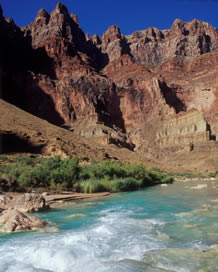
The Little Colorado River in its canyon

The Grand Falls of the Little Colorado River, seen at peak flow in April

Navajo Indians crossing the Little Colorado River, ca.1900
The Little Colorado passes
Joseph City and crosses the
Southern Transcon route of the
BNSF Railway (originally the
Atchison, Topeka and Santa Fe Railroad), now winding north into
Coconino County. The river enters the
Navajo Nation, and drops over the 185-foot (56 m)
Grand Falls of the Little Colorado shortly after. Below Grand Falls, the river flows through a short but rugged canyon for about 15 miles (24 km). Emerging into the desert again, the Little Colorado skirts the eastern edge of
Wupatki National Monument and passes the town of
Cameron, where it is bridged by
U.S. Highway 89.
From Cameron, the Little Colorado River carves an extremely steep and narrow gorge into the
Colorado Plateau, eventually achieving a maximum depth of about 3,200 feet (980 m). The depth of the canyon is such that groundwater is forced to the surface, forming numerous springs that restore a perennial river flow. It joins the Colorado deep inside the Grand Canyon, miles from any major settlement.
[5] The confluence marks the end of the
Marble Canyon segment of the Grand Canyon and the beginning of Upper Granite Gorge.
[6]
Discharge
The Little Colorado River is one of the two major tributaries of the
Colorado River in Arizona, the other being the
Gila River.
[7] Runoff typically peaks twice a year, first in the early spring (February–April) from snow melt and highland rain; and in the summer (July–September) from
monsoon storms. The annual runoff is extremely variable with the possibility of no flow occurring due to a weak snow pack or lack of summer rain. Conversely, years such as 1949, 1973, 1979, 1983 and 1993 have seen massive volumes of spring snowmelt while large monsoon runoff has occurred in 1955, 1964, 1984 and 2006. Monthly average flows in the springtime average several hundred cfs and can reach 2,000 to 3,000 cubic feet per second (57 to 85 m3/s). Only the upper reaches of the river above St. Johns, and the lowermost stretch below Cameron, flow year round; the middle section is basically a huge arroyo that carries water only during the wet seasons.
According to a streamflow gauge near
Cameron, before the river enters the Grand Canyon, the river's average annual flow was 367.2 cubic feet per second (10.40 m3/s) from 1948 to present. The highest annual average was 1,127 cubic feet per second (31.9 m3/s) in 1973, and the lowest was 14.1 cubic feet per second (0.40 m3/s) in 2000.
[8] The river's peak flows can be far higher than its average flow, because of quick desert runoff from
cloudbursts. At the same gauge, peak flows were recorded from 1923 to 2008, with spotty data from 1924 to 1947. The highest recorded peak was 120,000 cubic feet per second (3,400 m3/s) on September 20, 1923, while the lowest was 1,590 cubic feet per second (45 m3/s) in 1974.
[9]
History


.jpg)