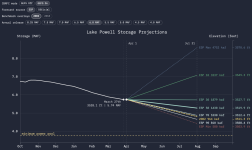
How much do we expect the lake to rise this spring/summer

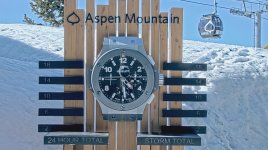
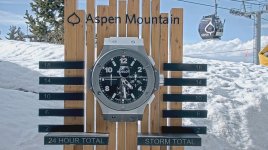
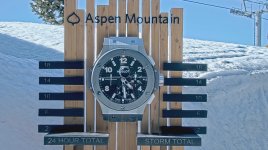
Here is an indicator of how rapidly this heatwave is stripping snow, even at high altitudes. These screenshots are exactly twenty four hours apart, yesterday and today. Very noticeable decrease in snow height, and this webcam is at over 11,000 feet.
I made a gif that cycled the images back and forth to make it easier to see, but it was too big to attach. But you can download the images and switch between them if you like.

IMG_6216.jpegIMG_6221.jpeg
 
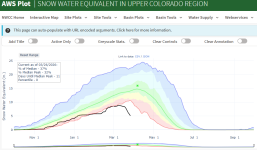
Well, the last week has put us firmly into record breaking territory of low snowpack.
1774536038744.png
It looks like snowpack peaked on March 9. Since then 40% of the snowpack has evaporated/melted. So far all this melt has generated no increase to reservoir inflow. Looking at the forecasted inflow it does appear this melt will generate some increase over the next two weeks. Inflows to Powell will jump from around 5,000 cfs to 7,000 cfs. Current releases are around 8,000 cfs. So the melting of half our snowpack won't even stop the decline of Powell, just slow it down a bit.

Current April to July inflow forecast is down to 1.6 maf. I don't see anyway we get to that number looking at this data.
 
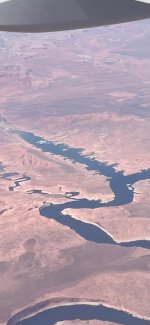
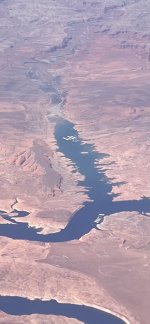
Not sure this is the best thread for these pics but with the activity at Bullfrog coming and some good images from above I thought the followers of this thread would appreciate it. These were taken on my way to Germany on Sunday 3/22.

Lone Rock, Escalante, BF/Halls, HiteView attachment 35299View attachment 35300View attachment 35301View attachment 35302View attachment 35303
Great shots!!! The one of the Escalante confirms you can’t reach Willow Gulch in a boat…
 
Current April to July inflow forecast is down to 1.6 maf. I don't see anyway we get to that number looking at this data.

This has been my thought as well. How does record low snowpack and record high temperatures get you nearly double the minimum historical runoff? Put another way, what made 2002 with more snow even worse? A really bad April I guess (maybe hot and windy)?

The only thing already in the bank that I could think of is that precipitation itself hasn’t been that low actually (it just hasn’t been frozen) and is that somehow offsetting soil and vegetation deficit meaning more of the puny runoff could make it to the river? In other words, the rain at least made the soil and vegetation moist even if it didn’t result in measurable snow pack. It just seems like the evaporative potential of the high temperatures would offset any such advantage to a large degree…

The 10% runoff track is historically the worst right now, so maybe this is all still “future weather is the biggest uncertainty”.

At this point though it isn’t like a few hundred kaf is making any big difference one way or another, the forecast is bad whether it sets a historical low or not. What happens to the lake level is mostly in BoR’s hands at this point as nature has made it clear it isn’t helping out this year.
 
Well, the last week has put us firmly into record breaking territory of low snowpack.
View attachment 35298
It looks like snowpack peaked on March 9. Since then 40% of the snowpack has evaporated/melted. So far all this melt has generated no increase to reservoir inflow. Looking at the forecasted inflow it does appear this melt will generate some increase over the next two weeks. Inflows to Powell will jump from around 5,000 cfs to 7,000 cfs. Current releases are around 8,000 cfs. So the melting of half our snowpack won't even stop the decline of Powell, just slow it down a bit.

Current April to July inflow forecast is down to 1.6 maf. I don't see anyway we get to that number looking at this data.
The little bit of runoff that we have had is going into the upstream reservoirs, most notably Navajo on the San Juan. Most of the reservoirs on the Green and Colorado rivers are also showing a slight uptick from about March 15 to 19. They will probably keep as much of the melt water as possible at the higher elevation reservoirs since they can feed the lower ones from there and the evaporation rate is much lower.
 
How does record low snowpack and record high temperatures get you nearly double the minimum historical runoff?
There is a white paper from Utah State critical of USBRs 24 month projections

In the paper, they publish the considerations that go into the forecast at various points along the water year.
USBR Forecast Considerations.png

March uses an ensemble streamflow forecast, that I'm convinced is currently running way high because what little snow is currently up there is being rapidly melted off by the recent heat wave.

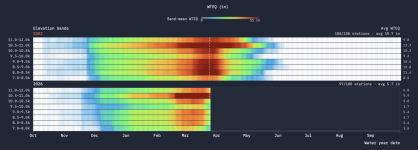
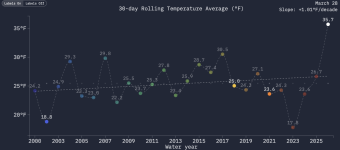
This is a heatmap of the SNOTEL data for the Upper Colorado River Basin for 2002 vs 2026. This year is 17! (not a typo) degrees warmer over the last 30 days than 2002 was, and the snowpack is melting nearly a month earlier than 2002.

Screenshot 2026-03-26 at 5.40.51 PM.png

I don't think we come anywhere near touching 2002 numbers - I think the forecast model is deeply flawed as outlined in that paper linked above.

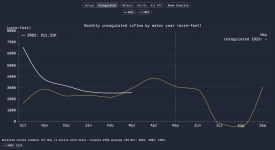
Here is the monthly unregulated inflow for 2002 against 2026. 2002 had a negative! monthly unregulated inflow for July and August. 2026 is melting a month earlier, and melting much less overall snowpack.

Screenshot 2026-03-26 at 6.26.47 PM.png

I don't really have words here. I'm currently working to try to put this all into a coherent story because we're currently staring down *at least* 12-14 months of precipitous drop in Lake Powell storage from a current position already approaching all time low storage.
 
There is a white paper from Utah State critical of USBRs 24 month projections

In the paper, they publish the considerations that go into the forecast at various points along the water year.
View attachment 35311

March uses an ensemble streamflow forecast, that I'm convinced is currently running way high because what little snow is currently up there is being rapidly melted off by the recent heat wave.

This is a heatmap of the SNOTEL data for the Upper Colorado River Basin for 2002 vs 2026. This year is 17! (not a typo) degrees warmer over the last 30 days than 2002 was, and the snowpack is melting nearly a month earlier than 2002.

View attachment 35312

I don't think we come anywhere near touching 2002 numbers - I think the forecast model is deeply flawed as outlined in that paper linked above.

Here is the monthly unregulated inflow for 2002 against 2026. 2002 had a negative! monthly unregulated inflow for July and August. 2026 is melting a month earlier, and melting much less overall snowpack.

View attachment 35313

I don't really have words here. I'm currently working to try to put this all into a coherent story because we're currently staring down *at least* 12-14 months of precipitous drop in Lake Powell storage from a current position already approaching all time low storage.
There's a good thread on this topic from last year...

 
The only thing already in the bank that I could think of is that precipitation itself hasn’t been that low actually (it just hasn’t been frozen) and is that somehow offsetting soil and vegetation deficit meaning more of the puny runoff could make it to the river? In other words, the rain at least made the soil and vegetation moist even if it didn’t result in measurable snow pack. It just seems like the evaporative potential of the high temperatures would offset any such advantage to a large degree…
The rain that has fallen so far this winter in place of snow has been completely inadequate to offset the record high temperatures that accompanied it.

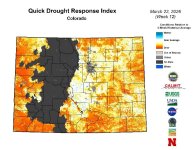
This can be seen by looking at the most recent Quick Drought Response Index plot for Colorado, where the majority of the runoff going to Lake Powell originates.

QDRI - CO - 26 March 2026.jpg

The QuickDRI is a recently developed composite index combining data on precipitation, soil moisture, evapotranspiration, vegetation health, and certain landscape characteristics such as soil type, land use, land cover, and elevation. It is designed to provide a snapshot of anomalously dry or wet conditions over the previous 4 week period and can serve as an indicator of emerging drought conditions at a 1-kilometer spatial resolution.

Based on the most recent plot shown here (the black areas are higher elevations where vegetation is still mostly dormant), it does not appear that the vegetation is very moist. In fact, quite the opposite - it would seem that a fair portion of what is currently melting off is likely to be taken up by thirsty plants.
 
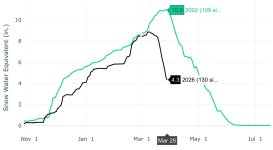
Just to echo/repeat my amateurish incredulity with the CBRFC forecast, here is today’s snowpack compared with the snowpack for the record low Apr-Jul runoff year of 2002:

IMG_0204.jpeg

So a bit before April and the snowpack is only 40% of 2002, but we are going to get 50% more April-July runoff than 2002?

Yes, some of the major melt in the past few days won’t actually hit Powell until April - so that apparent loss in the above plot would potentially be part of the April-July runoff for this year. And yes, the forecast depends on ensemble climatology for April and May which adds a lot of variation. Still, feels like one of those cases where the fancy computer driven weather forecast is saying one thing while just looking out the window is saying something very different.
 
Still, feels like one of those cases where the fancy computer driven weather forecast is saying one thing while just looking out the window is saying something very different.
Here is the document that outlines how they come up with the ensemble streamflow prediction https://www.cbrfc.noaa.gov/wsup/doc/Water_Supply_ESP.pdf

It is important to note that snow and snow water equivalent (SWE) are not direct inputs to the model. The snow model within each segment (or basin) builds and melts its own snowpack based on precipitation, freezing level, and temperature inputs.
Wow. Did not expect to read that.

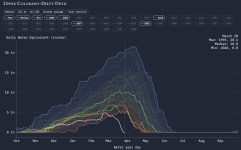
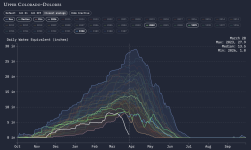
I mapped the SWE chart data for the various upper Colorado River sub-basins. Some of them are already effectively entirely melted.

For example:

Screenshot 2026-03-28 at 7.24.37 PM.png

Screenshot 2026-03-28 at 7.26.48 PM.png

Here is a link if you're interested in checking them out. Upper Colorado River Basin Snowpack

I emailed the NWCC a couple weeks ago asking about how the overall basin SWE values are determined, and apparently they're an average of all of the SNOTEL sites in a given basin / sub-basin. Some sub-basins have more SNOTEL sites than others, and I don't think the distribution necessarily corresponds to the amount of snowpack in a given sub-basin.
 
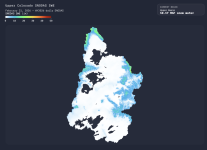
Another tool for snow water equivalents is SNODAS, and although on their FAQ they explicitly caution against using SNODAS for quantitative water budget analysis, like the SNOTEL data from NWCC, it gives a pretty good qualitative picture of the current snowpack conditions.

Screenshot 2026-03-28 at 8.13.48 PM.png
I snagged all the historical SNODAS data and clipped it to the boundary of the upper Colorado River Basin so you can compare snowpacks and water equivalent summations for each year at different dates.

SNODAS didn't exist in 2002, but 2021 had an April 1 - July 31 unregulated inflow of 1.83 MAF which is in the general ballpark of the 1.484 MAF the CRBFC is projecting for the current 50% forecast.

Screenshot 2026-03-28 at 8.28.49 PM.png

On March 27 the upper Colorado River Basin SNODAS total in 2021 was 15.69 MAF, which was actually the peak snowpack day for 2021.

Screenshot 2026-03-28 at 8.35.40 PM.png

Here's the SNODAS image and total for 2026 on March 28: 4.27 MAF.

Screenshot 2026-03-28 at 8.18.21 PM.png

Peak SNODAS for this year was 10.17 MAF on February 21. There's a pretty stark lack of snowpack depth in the higher elevations even at peak.

Screenshot 2026-03-28 at 8.39.56 PM.png

Here is the SNODAS SWE progression for some of the lowest recent years of inflow compared to this year in the same fashion as the SNOTEL plots from NWCC

Screenshot 2026-03-28 at 8.43.22 PM.png

Over the last 30 days, this year is 12! degrees F warmer than 2021 and a pretty unbelievable 16.9! degrees F warmer than 2002 in the upper Colorado River Basin according to the SNOTEL data. I've seen papers describe each degree C as contributing to ~6-7% runoff efficiency loss. This year has quite a bit less snow than 2002, and is nearly 17 degrees warmer during spring than 2002. Just absolutely off the charts numbers.

Screenshot 2026-03-28 at 8.45.31 PM.png

I am convinced that the middle of the road CBRFC forecast is wildly optimistic, and that we're looking at the very low end of their projections.

As of yesterday's forecast, with a current projected (and lowest ever) annual release of 6.0 MAF, an April 1 - July 31 inflow below that of 2002 would optimistically put Lake Powell at ~3510 ft at the end of August. Are there functional boat launches at those elevations?


Screenshot 2026-03-28 at 8.55.28 PM.png
 

Attachments

  • Screenshot 2026-03-28 at 8.52.52 PM.png
    Screenshot 2026-03-28 at 8.52.52 PM.png
    241.5 KB · Views: 2
  • Screenshot 2026-03-28 at 8.51.00 PM.png
    Screenshot 2026-03-28 at 8.51.00 PM.png
    288.5 KB · Views: 3
Wow. Did not expect to read that.

Seriously. Well, that explains why the forecast seems so disconnected from the SNOTEL estimated SWE.

They do have some ambiguity in there about forecasters being able to directly alter state in the model, but who knows if that happens or what exactly they would be comfortable tweaking. In theory that’d be a way to put direct SWE measurements in. No doubt there will be a post mortem when the dust settles end of WY.

I agree, at this point there seems to be decent evidence that the way the model is built that it could be way off on a record breaking year. Sort of like the piece of foam that certainly couldn’t have hurt the Space Shuttle. We’re NASA and we ran our model, stop your worrying!

(To be fair to CBRFC, they are very up front about the large uncertainties in the forecasts)


Some sub-basins have more SNOTEL sites than others, and I don't think the distribution necessarily corresponds to the amount of snowpack in a given sub-basin.

I see a lot of SWE models use weighted averages within or between basins. Is it possible they left out the “weighted” part in their response to you?

And thanks for all the digging and the excellent data presentations on your site!
 
Back
Top