
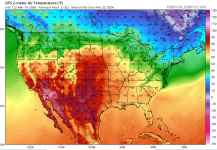
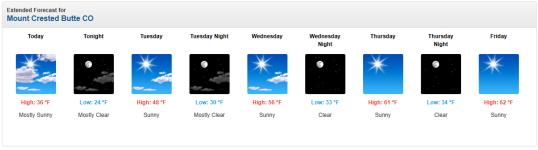
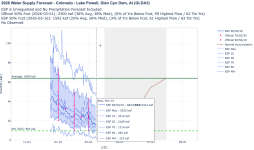
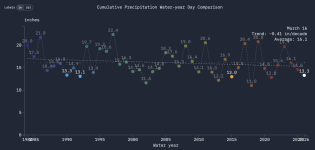
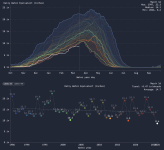
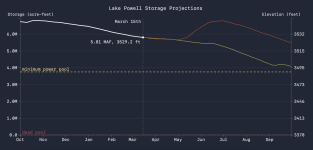
To add some additional doom, in addition to the current dry forecast, at least the next week calls for warm and wind, perfect conditions to evaporate our existing snowpack. This is scarily similar to what happened in 2002, which turned out to be the worst runoff year on record. In that year a poor but not terrible snowpack was hit by a very dry and windy March and April that led to large scale evaporation of the snowpack before it could melt and run off. On March 15 of that year the forecasted runoff was 4 million acre feet. After the dry and windy spring did its thing runoff ended up being just 1.2 million acre feet. It feels like the worst case scenario for this year keeps getting worse.
Great point on the wind, that can really accelerate evaporation. In my experience, more in the NV/CA deserts than the Rockies, the surface wind forecasts are the least reliable parts of the models which makes for a potential big wild card in how much water could disappear.
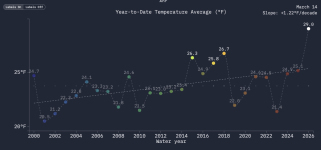
As far as temperatures go, the models, including the generally more reliable EPS ensemble, are really ugly the next two weeks with essentially no precipitation of any kind combined with substantially elevated temperatures for the entire forecast period. And yeah, with for now some windy periods. If that comes to pass it's not going to be good.
So USBR still has a few arrows in left the quiver if they choose to use them...
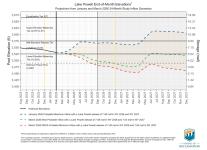
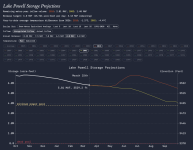
What the USBR does is the most opaque to me right now. From reading all the various documents it seems that they could make a call this month (perhaps after the March 24-Month Study is released) to alter their release plan for the rest of the year. As your excellent analysis shows they've got the potential to protect the lake level at 3525 as they've said is their goal. So if they decide to do that, do we hear about it soon?
As far as I understand they've already met the requirement to release as little as 6 Maf for the year as recent Minimum Probable forecasts show a level below power pool. That wasn't true at the start of the water year, so at that time they set the operating plan for the year at 7.48 Maf. But if I'm reading things right, they can change that plan if predictions show below power pool levels. What I don't understand clearly is exactly how quickly they can start doing that, but I sort of drew the conclusion that middle of the water year was when they could (i.e. about now). But no one is saying anything at all about this, which seems strange and makes me wonder if I've misinterpreted things.
Also, they never released a January 5 Year Probabilistic Projection which they say they typically do in low water years. Perhaps the 24 Month Study was already dire enough they didn't think they needed the 5 year...


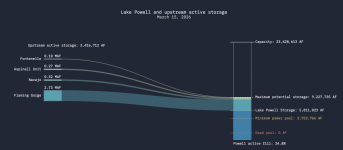

 Puts the whole basin into perspective. It's amazing to think that arguably one of the largest infrastructure projects in recent history--- controlling every drop of water on the NA continent, occurred from the mid 30s to the mid 70s. TVA, BoR, USACE et al.... 4 decades changed the entire show, 1/2 a lifetime. Don't know why I felt the need to say that haha, but the more I think about the scope of and impact of that -- many impacts and many scopes -- the more staggering it becomes.