
You are using an out of date browser. It may not display this or other websites correctly.
You should upgrade or use an alternative browser.
You should upgrade or use an alternative browser.
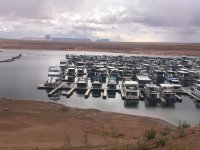
Whaweep Houseboats are locked in at the dock
- Thread starter Jackalope
- Start date
- Status
- Not open for further replies.

Jackalope
Well-Known Member
So, move the gas dock ... HA!Also you boaters with depth finders probably can confirm that an East to west cross section of Wahweap Bay will show a very steep drop off within feet of where the docks are anchored. Wahweap Creek was a narrow almost slot canyon before the lake filled, and I believe the marina sits just on the west edge of the underwater cliffs. If this is true, then perhaps it’s easier said than done to move the docks a few feet to the East right into the depths of the canyon. I’d be interested to hear what people on this site have seen with their depth finders if this is not the case.

Betting on the runoff and they made a bad bet

Ryan
Keeper of San Juan Secrets
That sounds like great advice for someone to lose their slip, and not be able to get another one....I would not pay the slip fee for every month I could not use my boat. They should have moved you to a different slip a month ago.


thebigcanoe
Well-Known Member
Lack of accountability.Yes removal of finger slips! Why not? Is that so far fetched an idea? Why is it that we can “solve” this problem right here and the people on the ground can’t make it happen? What are we missing?
The challenge is the structure (dock) has grown over time since original build and is probably now too big (shore to lake axis) for current limitations (shore to lake axis).
The wild card is the river course, the navigational channel out by M dock. The original natural river course is considered “navigational” and cannot be at will obstructed by things like docks. The dock cannot move into that path... and this is the problem.
The dock structure itself probably does have the physical ability (cable on drums) to shift toward the lake more to allow B dock to have plenty of egress but the outer boats and structure on the channel side (On the Rocks & Making Memories) and the boats between them will be in the river channel and this is a NO NO.
The best way for concessionaire to solve the problem long term is to remove a few sections of the main walk dock between store and the end of M dock. This will squeeze the distance behind slips on side docks for sure - to provide enough room it may even be required to remove an entire side dock, like they did with the Private Pier Dock (LOL - how did they miss that “private” on public lands thing - OMG, that is hilarious!).
Retire the side dock that is most outdated with a lowest revenue lease and usage. It is much easier to reposition smaller boats into other smaller slips than the big boats on B dock into scarce larger slips.
The last dock wiggle did get the tip end of B dock over much deeper water but the span from the B dock tip (closest to fuel pumps) to shallow water by shoreline is NOT very wide and this will be a big concern for shoreline side props and hull. Threading the needle is more more like threading 5 needles. It is WAY tighter than a single needle at this point.
At B dock, you cannot simply steer to lake once stern clears dock as the stern will hit ground during the turn to lake, and to complicate things, the shoreline at egress tip of B dock bends toward lake so bow will hit ground too without 90 degree starboard exit.
The only option when water depth permits is to exit B dock keeping starboard rail VERY close to dockside until stern clears dock and then turn (opposing thrust) to port toward the approaching land and pin bow to shoreline and then throttle pivot stern toward fuel dock and then back away from beach, once clear of all the obstacles perform a center pivot rotational 180 spin. This procedure is precise and probably well outside the ability of most recreational drivers, especially in wind. Once in open water it would be best to not return to the dungeons of B dock.
A lot of the boats on B dock are bigger expensive boats - this group is not looking for a credit, they are looking to pay their slip fees in full and on time every month and to enjoy their boat when they want to, and if they are restricted from this it will take more than just that single month credit to resolve - those boats pay slip fees all year long to be enjoyed just a few times a year. If a single trip is forced to be canceled that may represent 50% of the planned use of that asset for the year and that translates into viewing 50% annual lease discount as minimum consideration, plus inconvenience fees. I do not know the language of the Wahweap slip agreements but SAL could twist it up or down or left or right. Even if agreement claims no fault, there is still a cost to defend, big money of it converts to class action, it is much better to proactively drive solution from concessionaire level (regardless of fault) instead of fight it. It does appear concessionaire has been proactive but the fact remains, B dock is in a tough spot, and B dock makes the marina a boatload of money. Everyone wants B dock to work.
At the end of the day solving the problem at management level is key, allowing the problem too become the problem of individual slip lease holders is not the solution - this is not a marine law of average condition - management needs to resolve this issue so all parties are happy and that means fixing the problem to have zero restriction moving forward in low water years... it needs a long term solution as low water is probably here for awhile.
With the limiting reagent and constant value being distance from shoreline to navigational river, the flex variable becomes width. Growing in a width axis instead of a length axis has less restrictions. Longer side docks will require additional anchor lines between pivot point at main dock and tip, but this is easy especially with the buffet of attachment points available both on floating structure as well as on seabed. Energy increases as moment distance increases so legitimate cable bracing is key on the longer additions.
The “shock” is the busy season is now upon us and management has not planned for this event very well - it should have been anticipated and resolved before the curtain went up.
Another option is convert all the ski boat docks on Pier 49 to be B dock temp parking... at B dock rates of course.
Good luck - Be safe.
The wild card is the river course, the navigational channel out by M dock. The original natural river course is considered “navigational” and cannot be at will obstructed by things like docks. The dock cannot move into that path... and this is the problem.
The dock structure itself probably does have the physical ability (cable on drums) to shift toward the lake more to allow B dock to have plenty of egress but the outer boats and structure on the channel side (On the Rocks & Making Memories) and the boats between them will be in the river channel and this is a NO NO.
The best way for concessionaire to solve the problem long term is to remove a few sections of the main walk dock between store and the end of M dock. This will squeeze the distance behind slips on side docks for sure - to provide enough room it may even be required to remove an entire side dock, like they did with the Private Pier Dock (LOL - how did they miss that “private” on public lands thing - OMG, that is hilarious!).
Retire the side dock that is most outdated with a lowest revenue lease and usage. It is much easier to reposition smaller boats into other smaller slips than the big boats on B dock into scarce larger slips.
The last dock wiggle did get the tip end of B dock over much deeper water but the span from the B dock tip (closest to fuel pumps) to shallow water by shoreline is NOT very wide and this will be a big concern for shoreline side props and hull. Threading the needle is more more like threading 5 needles. It is WAY tighter than a single needle at this point.
At B dock, you cannot simply steer to lake once stern clears dock as the stern will hit ground during the turn to lake, and to complicate things, the shoreline at egress tip of B dock bends toward lake so bow will hit ground too without 90 degree starboard exit.
The only option when water depth permits is to exit B dock keeping starboard rail VERY close to dockside until stern clears dock and then turn (opposing thrust) to port toward the approaching land and pin bow to shoreline and then throttle pivot stern toward fuel dock and then back away from beach, once clear of all the obstacles perform a center pivot rotational 180 spin. This procedure is precise and probably well outside the ability of most recreational drivers, especially in wind. Once in open water it would be best to not return to the dungeons of B dock.
A lot of the boats on B dock are bigger expensive boats - this group is not looking for a credit, they are looking to pay their slip fees in full and on time every month and to enjoy their boat when they want to, and if they are restricted from this it will take more than just that single month credit to resolve - those boats pay slip fees all year long to be enjoyed just a few times a year. If a single trip is forced to be canceled that may represent 50% of the planned use of that asset for the year and that translates into viewing 50% annual lease discount as minimum consideration, plus inconvenience fees. I do not know the language of the Wahweap slip agreements but SAL could twist it up or down or left or right. Even if agreement claims no fault, there is still a cost to defend, big money of it converts to class action, it is much better to proactively drive solution from concessionaire level (regardless of fault) instead of fight it. It does appear concessionaire has been proactive but the fact remains, B dock is in a tough spot, and B dock makes the marina a boatload of money. Everyone wants B dock to work.
At the end of the day solving the problem at management level is key, allowing the problem too become the problem of individual slip lease holders is not the solution - this is not a marine law of average condition - management needs to resolve this issue so all parties are happy and that means fixing the problem to have zero restriction moving forward in low water years... it needs a long term solution as low water is probably here for awhile.
With the limiting reagent and constant value being distance from shoreline to navigational river, the flex variable becomes width. Growing in a width axis instead of a length axis has less restrictions. Longer side docks will require additional anchor lines between pivot point at main dock and tip, but this is easy especially with the buffet of attachment points available both on floating structure as well as on seabed. Energy increases as moment distance increases so legitimate cable bracing is key on the longer additions.
The “shock” is the busy season is now upon us and management has not planned for this event very well - it should have been anticipated and resolved before the curtain went up.
Another option is convert all the ski boat docks on Pier 49 to be B dock temp parking... at B dock rates of course.
Good luck - Be safe.

Gem Morris
Keeper of San Juan Secrets
Something Bubba said made me think of a change in the docks that have already happened over the winter with no explanation. Last fall when you left the Wahweap ramp in your runabout and boated towards the House Boat field there was an opening in the tire barrier near the fuel docks. That opening is now gone and it also appears to me that the Ranger and law-enforcement docks that were on the dam side have now been moved over to the fuel dock side. Did that happen or was it just my imagination? What happened to the opening in the tires? What change did they make already?
Last edited:
Jackalope
Well-Known Member
Bubba, I like the way you put it.
Is it my fault that we are now locked in? Who is legally responsible, because I am hearing that it's my fault (more of a feeling, not a direct quote)?
If you take a look, there are a couple boats that could not even back out without hitting the shore. At this point , if there were an issue with any of the boats on B-Dock, where you need to remove the boat from the lake, you would be stuck.
Someone screwed the pooch and I am feeling like the pooch. However, there are several owners that start the season in 3 weeks that will be siting on the dock, if they even want to use the boat. Campers = not happy.
Is it my fault that we are now locked in? Who is legally responsible, because I am hearing that it's my fault (more of a feeling, not a direct quote)?
If you take a look, there are a couple boats that could not even back out without hitting the shore. At this point , if there were an issue with any of the boats on B-Dock, where you need to remove the boat from the lake, you would be stuck.
Someone screwed the pooch and I am feeling like the pooch. However, there are several owners that start the season in 3 weeks that will be siting on the dock, if they even want to use the boat. Campers = not happy.

JFRCalifornia
Keeper of San Juan Secrets
I do not believe the water will rise 6 feet next month. More likely there will be no rise at all, just a flattening out at about 3560 near the end of May, stabilizing there for much of June, then a slow drop from there...if the water came up 6 feet in the next month would the boats that look like they couldn't even back up right now get out?
Thinking about bubba's excellent description, and seeing the pictures, it seems like it should be possible to get the boats out by hand-lining them through the gap, pulling out finger docks, or towing them with smaller boats. But there might not be any other place to put them, other than pulling them out of the water. Maybe the marina owner is trying to avoid the responsibility of finding a new place for the boats. It seems like Antelope Point is right in the middle of the navigation channel, so I don't see why the Wahweap navigation channel would be that much of a problem if they moved the docks out 100 feet or so. Still it's poor planning getting to this point. (They probably have a "force majure" clause in the rental contract to cover problems caused by changes in lake level.)
Last edited:
Probably yes but that is a big IF. Unless there is a whopper of a monsoon season I don't see much hope.if the water came up 6 feet in the next month would the boats that look like they couldn't even back up right now get out?
Jackalope
Well-Known Member
About 10 hours out ..I would have had my boat out of there months ago....Make friends with the T dock peeps and side tie... Sucks that they did not offer open slips. How close are you to the boat?
 but we have a few owners that are closer.
- Status
- Not open for further replies.