How much do we expect the lake to rise this spring/summer

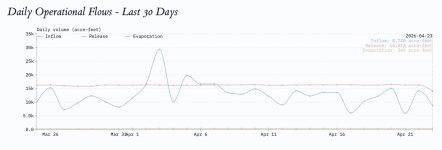
Based on all the info we have today (April 23) from BOR about their planned release concept, here's what my crystal ball comes up with for projected lake levels for the rest of this year and early next year. This accounts for projected inflow (from the April 24-month study), releases that feed Powell (with modified FG numbers through next April), evaporation, and reduced releases from Glen Canyon Dam. All these assumptions could change as we get into summer (runoff inflow might be less?), and then into early next spring (who knows what winter will bring?). It also assumes that BOR will evenly spread the reduced releases from GCD between now and the end of September, and then revert to what they have already planned in their latest 24-month study. I presume all actual modifications will be reflected in the May 24-month study, and I can update this chart then.

But here's what it says on the back of my napkin right now, keeping in mind these are guesstimates at best, but probably close:

All Elevations are for end of Month:

April 2026-April 2027


Apr - 3527
May - 3527
Jun - 3526
Jul - 3523
Aug - 3521
Sep - 3518
Oct - 3517
Nov - 3515
Dec - 3511
Jan - 3510
Feb - 3505
Mar - 3505
Apr - 3510


The big takeaway here is that the lake is likely to stay at or above 3520 through August, and possibly into mid-September. That obviously has access implications for those planning summer trips. Once we get to October, the lake starts dropping, but it looks like it will remain over 3505 in the dead of winter and early spring. From there, it all depends on what winter 2026-27 brings...
 
I put together a ledger and chart projecting Lake Powell forward through the end of April 2027 using the expected constraints published in the Bureau of Reclamation's news release. With expected inflows from Flaming Gorge and other CRSP reservoirs determined and releases from Glen Canyon locked in, that leaves only inflow projections to figure out. The values used for inflow here are smoothed out unregulated inflow values from 2002 into 2003, which, as far as I can tell, represent a ceiling for unregulated inflows for 2026. All numbers are for the end of month.


View attachment 35583


I put this on a page with sliders for reasonably realistic scenarios here: Lake Powell Projection Ledger | Will Turman

I'm not sure why my numbers differ so much from JFRCalifornia's above - I think it's probably a result of using USBR's forecast vs. using actual numbers from 2002 as a benchmark. Looking at the latest CRBFC projections, those seem to be converging rapidly. I'd welcome any critique or be happy to clarify anything that's unclear.

One lever/constraint that wasn't entirely nailed down in the USBR news release was outflows from the Glen Canyon Dam. They used language that specifies the releases through the end of September 2026, but beyond that is TBD. I used 500,000 acre-feet (6.0 MAF / year) for all months, which is an aspect of this that could change, I suppose.


I don't really know what to say beyond that. I know this has implications well beyond this forum.
I appreciate your detailed take on all this. And I looked at my work, and for the most part it pretty much agrees with most of your assumptions… except for the inflow estimate. Yours is based on a projection of about 2.85 maf from May 2026 to April 2027. Mine is based on the regulated inflow (which accounts for already-planned upstream releases) reported in USBR’s April 24-month study, which shows 4.15 maf over the same period. A big difference from your numbers. And that 1.3 maf delta accounts for your lake level differences almost exactly.

I realize those USBR numbers could (probably will) go down when they issue their May 24-month report, more in line with CRBFC projections. Your assumptions might be right. Or the real inflow could be somewhere in between yours and mine. We’ll know more in mid-May.

This all goes to show that when the lake is this low, even a small change in volume can make a huge difference in lake elevation…
 
As of yesterday it looks like the USBR changed operations from a 500,000 acre-feet / month release to a 420,000 acre-feet / month release.

Screenshot 2026-04-24 at 5.49.27 PM.png

I put together a ledger and chart for Lake Powell through the end of April 2027 with sliders for various scenarios.

Here is what it looks like using actual historical unregulated inflow numbers from 2002, a 425,000 acre-feet / month release rate, and a 1,000,000 acre-feet DROA release from Flaming Gorge:

Screenshot 2026-04-24 at 5.49.03 PM.png
Just enough to get us to next water year with on a prayer.

The ledger + chart is here if you'd like to try out scenarios

Lake Powell Projection Ledger | Will Turman
 
Last edited:
USBR’s April 24-month study, which shows 4.15 maf over the same period.

I'm scratching my head at this a bit, as I've found I do often with numbers from the USBR 24 month study.

4.15 maf represents the entirety of upstream active storage for the CRSP plus 700,000 acre-feet.

Screenshot 2026-04-24 at 5.59.06 PM.png

I think we've found ourselves in an unprecedented place where models haven't quite caught up.
 
I'm scratching my head at this a bit, as I've found I do often with numbers from the USBR 24 month study.

4.15 maf represents the entirety of upstream active storage for the CRSP plus 700,000 acre-feet.

View attachment 35586

I think we've found ourselves in an unprecedented place where models haven't quite caught up.

The delta between regulated and unregulated is 1.3 Maf, not 4.15.
 
As of yesterday it looks like the USBR changed operations from a 500,000 acre-feet / month release to a 420,000 acre-feet / month release.

View attachment 35584

I put together a ledger and chart for Lake Powell through the end of April 2027 with sliders for various scenarios.

Here is what it looks like using actual historical unregulated inflow numbers from 2002, a 425,000 acre-feet / month release rate, and a 1,000,000 acre-feet DROA release from Flaming Gorge:

View attachment 35585
Just enough to get us to next water year with on a prayer.

The ledger + chart is here if you'd like to try out scenarios

Lake Powell Projection Ledger | Will Turman
This is impressive how you put this together. The Ledger plus chart link is really cool, in a sobering sort of way. Thanks for sharing that.
 
... I'd also ask....is there much appreciable loss during the journey?.....:unsure:

evaporation, seepage and some straws along the way as i'm sure there are some places where people have wells, etc. however, this should all be fairly regular by now as to how much and where.

with how warm it has already been the evaporation rate is going to be higher.

what will really help is some good rains - hope the monsoons happen and a few big storms would be sweet. the Aspen CO weather for the next week is looking good for some more moisture.
 
All the talk of inflows & outflows makes me wonder what releases from Glen Canyon Dam are included in the figures posted on the Lake Powell Water Database. Is all the water that is used for power generation included in the outflow number? What rough percentage of the outflow is from power generation? Is there a way for the dam to use as much water as possible for power generation to limit the amount of releases that are required to meet a mandated annual release amount? When water is released for power generation it does not bother me like when water just flows through the dam and you have not used its potential energy.
 
All the talk of inflows & outflows makes me wonder what releases from Glen Canyon Dam are included in the figures posted on the Lake Powell Water Database. Is all the water that is used for power generation included in the outflow number? What rough percentage of the outflow is from power generation? Is there a way for the dam to use as much water as possible for power generation to limit the amount of releases that are required to meet a mandated annual release amount? When water is released for power generation it does not bother me like when water just flows through the dam and you have not used its potential energy.
The maximum release through the power turbines is 31,500 cfs, outlet works are 15,000 cfs, and the spillways are (theoretical maximum) 276,000 cfs. Note that the spillway tunnels were damaged in 1983 with flow levels around 20,000 cfs (each side).

It's unlikely that the outlet works would be used if the outflow level is less than 31,500 cfs. Current outflow (7,067 cfs) is less than a quarter of that.

They (most likely) prefer to release water through the power turbines to collect and redistribute that potential energy (as electrical power) rather than dissipating it eroding the outlet works and spillways tunnels.

The entrance to the spillways is well above the current water level, so there is no way that they can use those.

The usual high flow levels that they allow from Flaming Gorge Dam are around 2,800 cfs. (4/30/2026 edit: Power plant capacity is 4,600 cfs, outlet works 4,000 cfs (maximum), spillway capacity 28,800 cfs. They have run high flows for fisheries reasons well over 4,600 cfs, but the usual summer high flows are 2,800 cfs.) It sounds like they will need to exceed that by a wide margin to dump 1 million acre-feet over the next year. That should make for some exciting rafting, but people I know who did the Dutch John to Little Hole run during the massive releases in 1983 (power plant, outlet works, and spillway) said that there were no rapids, but the 7 - 8 mile run took about 45 minutes.
 
Last edited:
All the talk of inflows & outflows makes me wonder what releases from Glen Canyon Dam are included in the figures posted on the Lake Powell Water Database. Is all the water that is used for power generation included in the outflow number? What rough percentage of the outflow is from power generation? Is there a way for the dam to use as much water as possible for power generation to limit the amount of releases that are required to meet a mandated annual release amount? When water is released for power generation it does not bother me like when water just flows through the dam and you have not used its potential energy.
Except for the simulated floods to build beaches in the Grand Canyon, all releases are through the generation turbines. I don’t think we will hear anyone clamoring for simulated floods using the outlet works for several years.
 
Last edited:
In 2024/2025, the BoR began doing "cool mix flows" to help control the Smallmouth Bass population in the Grand Canyon. Smallmouth Bass are currently the biggest threat to the native fish population in the Canyon. Cool mix flows did NOT increase total release volumes through the dam. Coolmix flows utilized water from the River Outlet works in combination with releases through the penstocks to decrease the downstream water temperatures in hopes of controlling the population of Smallmouth Bass. The flows were successful in keeping the established Smallmouth Bass population from reproducing. WAPA spent approximately $6,500,000 in 2025 to replace power generation lost. Difficult to find 2024 numbers, but I see $16,000,000 on the WAPA site with reference to the fact that those estimates have been decreased. No explanation of the difference, on the WAPA site of the discrepancy in the costs. Multi-agency cooperation has spent many, many multiples of that protecting native fish in the canyon (successfully down listing the Humpback Chub in 2021 to threatened). The BoR operates Glen Canyon Dam under the Long Term Experimental and Management Plan (LTEMP), and is informed by the Grand Canyon Protection Act (GCPA).
 
Cool mix flows did NOT increase total release volumes through the dam.

Here is the volume of recent releases through the outlet works plotted alongside releases through the power generation channels.

IMG_8592.jpeg

Here is the entirety of the series of releases through the river outlet works from the data published by the USBR

IMG_8594.jpeg

Adding up all of the releases through the outlet works from 2004 adds up to 1,064,026 acre-feet.
 
Whoa Buddy!

Interestingly, and ominous, to my knowledge there has been one day, only, where the inflow to Lake Powell exceeded outflow (April 25, 2026). This is unprecedented in recorded history I do believe (???). Clearly, time for a drink!

Adjustments to inflow are made after reading the elevation but also adjusted once in a while for sedimentation. That the elevation can change due to weather (wind direction and air pressure) seems to me something also possible but I am not experienced in Lake Powell to know this as a fact. :)
 
Flaming Gorge is going to dial it up to 8600 cfs on May 4th sending an impressive surge down the Green. Powell inflow will probably get above 10,000 cfs around the 11th then which would finally result in a brief and tiny rise in lake level at Powell. Yeah, it’s essentially man made, but all we are likely to get this season.

For all intents and purposes the natural runoff this year can’t raise the lake on its own. The CBRFC forecast is irrelevant at this point. It’s written in stone the runoff is record low or very close to it. That is such a low runoff it almost doesn’t matter if it ends up being even lower than the current abysmal forecast (900 kaf). Everything is down to BoR operations plans now.
 
Back
Top