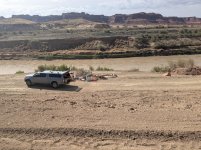
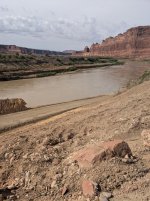
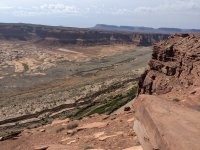
They are using the bypass to intentionally create a high flow for a "larval trigger study".
Here's some info about when they did a similar thing back in 2022:

That's awesome!
 For some reason I'd not seen that article before.
They are using the bypass to intentionally create a high flow for a "larval trigger study".
Here's some info about when they did a similar thing back in 2022:
For some reason I'd not seen that article before.
I am going to go with 3540.17 for the 2026 high water mark.....So I guess you are saying it’s not a good year to have a high water contest. Darn.
Going out on a limb there. What if an upstream dam bursts? Also, is the New Year's Day reading taken at 1 sec after midnight? Could be closer to 3540.40.I am going to go with 3540.17 for the 2026 high water mark.....


All of us locals are aware…This will be really dramatic for Flaming Gorge. I imagine it will be dropping a half a foot a day. I wonder how many of the locals know this is coming?
Pray for the hugest, most beautiful snowpack next year. Otherwise the Colorado River basin is going to be in the most rudest trouble. Been watching the Flaming Gorge graph and it's started to drop pretty quickly as the power plant has reach max capacity.

River looks like if has some good flow to it.For those of you that are interested in the work being done at Hite, I have some pictures of the new raft pullout.
It's on the Northwest side of the lake. One pic is overlooking what once was Hite boat ramp and the others are of the ramp.
Well the outflow at Flaming Gorge on May 6 was 8,471 CFS and Inflow was 2 CFS So on May 5th Flaming Gorge Reservoir was at 2,939,854 afAll of us locals are aware…

Nothing but sympathy from me. That said, I suspect it won't be too far in the future when we're going to be rethinking "water" altogether differently than we do now. Regardless the origin stories of the water reservoirs upstream from Powell and Mead and/or their original/intended purpose, the world they were built for doesn't exist any more.I hope not a single drop from the FG makes it to Powell, until the states can figure out how to play nice with each other. It has been mentioned again from the third Sh!ter from the left, that Blue Mesa and the FG will have no recoupe plan until the states have a new compact. If I am losing my lake to pacify California, then I hope that everyone else loses theirs too. It is only fair.
The BOR talks about boosting Lake Powell by 54 feet. This surge from Flaming Gorge will add maybe a foot. Where does the rest come from?Looks like FG is going to ramp the release down over a couple of days starting on May 12th. They ran at a few different outflows during this event, but roughly it is all equivalent to about 8 days at around 9000 cfs. This will get Lake Powell inflow to 12,000 to 14,000 for a similar period to give a rather small boost in elevation. At least the numbers should be slightly green for a number of days!
This also means FG will likely drop another 2.5 to 3 feet from today before the high flow event ends.
It appears the weather is going to get warm again and so the remainder of the snow pack will probably melt out soon creating a natural increased flow perhaps around the time the FG release is wrapping up. So that could keep Lake Powell inflows close to balanced to slightly positive for a bit longer.

This has been discussed ad nauseam on a few different of the water threads by the best water analysts we have. I'd suggest reading all of those start to finish and your answers are in there.The BOR talks about boosting Lake Powell by 54 feet. This surge from Flaming Gorge will add maybe a foot. Where does the rest come from?
California users have already conserved over 1,2 million acre-feet of water helping boost Lake Mead by 16 feet as of late 2024. New 2026 proposal California , Arizona and Nevada proposed a plan in May 2026 to cut back further on water consumption to prevent reservoirs from reaching critical low levels. Under these plans California has agreed to cut it's consumption by about 13%.. California has been quite vocal about climate change and the consequences.I hope not a single drop from the FG makes it to Powell, until the states can figure out how to play nice with each other. It has been mentioned again from the third Sh!ter from the left, that Blue Mesa and the FG will have no recoupe plan until the states have a new compact. If I am losing my lake to pacify California, then I hope that everyone else loses theirs too. It is only fair.
I’m not sure where to find these other threads, but going back and reading this one more carefully I think what I’m getting is that this current FG release is more about simulating a flood to trigger fish growth, hence the short duration. So presumably the releases intended to shore up Lake Powell levels will come at a later time and be of a greater scope.This has been discussed ad nauseam on a few different of the water threads by the best water analysts we have. I'd suggest reading all of those start to finish and your answers are in there.
I am not attacking you personally, but your reply is part of the problem. This is not about water conservation at this point, it is about accepting reality. If you look at the historical record water conservation by the lower states is pointless.. The upper basin states have several well documented collapses of civilizations over the past several thousand years due to long-term drought such as the Fremont and the Anastasi. The 1922 compact they took a three year average of some of the wettest years the region has ever seen, leading to a 15 to 25% over estimation of what the river actually provided at that time.California users have already conserved over 1,2 million acre-feet of water helping boost Lake Mead by 16 feet as of late 2024. New 2026 proposal California , Arizona and Nevada proposed a plan in May 2026 to cut back further on water consumption to prevent reservoirs from reaching critical low levels. Under these plans California has agreed to cut it's consumption by about 13%.. California has been quite vocal about climate change and the consequences.
California users have already conserved over 1,2 million acre-feet of water helping boost Lake Mead by 16 feet as of late 2024. New 2026 proposal California , Arizona and Nevada proposed a plan in May 2026 to cut back further on water consumption to prevent reservoirs from reaching critical low levels. Under these plans California has agreed to cut it's consumption by about 13%.. California has been quite vocal about climate change and the consequences.