What is BOR thinking?

Status
Not open for further replies.
That 2.5 feet could sure help some houseboats get launched. It is a shame the houseboats dry docked can't get back in the water. Halls is even worse than BF. The heck of it is there is no place to put them if they are launched unless they had a slip before dry docking.
Thanks John
 
That 2.5 feet could sure help some houseboats get launched. It is a shame the houseboats dry docked can't get back in the water. Halls is even worse than BF. The heck of it is there is no place to put them if they are launched unless they had a slip before dry docking.
Thanks John
Yep gonna get really crowded when the BF slips choke the main channel upstream of HC!! In our case - with our hb on our own trailer - we launch, play a week, then pull out to dry dock. Costs a little but not as much as a slip or bouy!! all contingent on having a tractor rig on that side - they have had to drive or ferry (work boat) one over from BF for us - takes some advance planning!! Probably to few in dry storage now - to justify a truck there all the time??
 
I think it important to recognize projections imply Mead will reach the Level 3 Shortage Condition (i.e., <1,025') Spring, 2024. To avoid reaching the Upper Elevation Balancing Tier (i.e., >3,575'), combined with "best-guess"/by-the-hour-Spring-2023-runoff rate-unpredictability; it appears BOR is doing a spectacular job of managing the Mead/Powell dynamic. It looks like those are the two primary thresholds by which major/anticipatory releases are being determined. It's really bad day if Powell were to reach 3,575' or Mead >1,050' from a Compact standpoint this year. Why? Because of the probability of regressing back below those respective thresholds in future year(s). I'll call it "pinballing" (for those of us old enough to remember when the pinball gets stuck between a cushion and a bumper reverberating wildly and unpredictably). Until there is a high likelihood of maintaining both lake levels at the next higher thresholds for several years in a row, it would be penny wise and pound foolish to bounce back and forth year-to-year. Before doing that, it looks to me like they will lean toward getting upstream reservoirs within the drainage back up to snuff. Hopefully climatic conditions allow that within the next few years and beyond. BOR is apparently further protecting power-generation head by treating WY2022 0.48maf from Flaming Gorge "as if" it has already been released WY2023 (sort of a hedge/cushion against greater impacts of unknowns than anticipated). As JFR stated (as well as myself numerous times) recreation is, perhaps at best, a quaternary concern of BOR (and should be). Flood control, water storage, power generation, recreation...in that order. Clearly, wildlife is also in the mix...probably putting recreation at a quinary (?) level.

Recall, in my limited understanding of the way the power grid works relies greatly on hydro-power because of it's ability to respond quickly, nearly instantaneously, to demand. Coal-fired (nuclear and natural gas-fired to a lesser degree) do not respond well to hourly demand changes which is why they are utilized as Base-level supplies. So, unless you like Texas-grade blackouts, it's darn good idea to be able to generate the juice with short notice. That requires head. In anticipation of some (always) unknown runoff rates, BOR is probably being judicious and planning for upcoming power demand in the Lower Basin (via Hoover). I have never had less than accolades toward BOR with regard to water management. They have access to a lot more data, experience, and intelligence than a bloke like me. Selfishly, I don't always like the result of their actions with regard to lake levels, in particular, but when I step back and swallow the proverbial pill with regard to the fact they have to look at things constantly from both macroscopic and microscopic views, I am grateful for (almost) all they do (smiling). Well done BOR! But, that's just me.
 
Last edited:
My thought is Why isn’t ARAMARK bitching at the BOR about the water conditions. Sq
I would be generally surprised if Aramark were to complain. I imagine they understand their place in the quagmire and no amount of complaining will influence reality. It's probably why I couldn't work for BOR, because if I did and were to answer the phone on such a complaint my response would be a lot less tactful than; "Dear (fill in the blank), BOR more than welcomes you to 'invent' or 'create' more water. When you do we will be more than happy to manage it for you. In the meantime, we suggest you stick to what you know and we'll call you if we need any further juvenile advice on water management. To be fair, we'll call you if we desire to offer any juvenile advice to you on how to empty holding tanks or fill the ice cream machines. Thank you and good day."
 
Last edited:
I think it important to recognize projections imply Mead will reach the Level 3 Shortage Condition (i.e., <1,025') Spring, 2024. To avoid reaching the Upper Elevation Balancing Tier (i.e., >3,575'), combined with "best-guess"/by-the-hour-Spring-2023-runoff rate-unpredictability; it appears BOR is doing a spectacular job of managing the Mead/Powell dynamic. It looks like those are the two primary thresholds by which major/anticipatory releases are being determined. It's really bad day if Powell were to reach 3,575' or Mead >1,050' from a Compact standpoint this year. Why? Because of the probability of regressing back below those respective thresholds in future year(s). I'll call it "pinballing" (for those of us old enough to remember when the pinball gets stuck between a cushion and a bumper reverberating wildly and unpredictably). Until there is a high likelihood of maintaining both lake levels at the next higher thresholds for several years in a row, it would be penny wise and pound foolish to bounce back and forth year-to-year. Before doing that, it looks to me like they will lean toward getting upstream reservoirs within the drainage back up to snuff. Hopefully climatic conditions allow that within the next few years and beyond. BOR is apparently further protecting power-generation head by treating WY2022 0.48maf from Flaming Gorge "as if" it has already been released WY2023 (sort of a hedge/cushion against greater impacts of unknowns than anticipated). As JFR stated (as well as myself numerous times) recreation is, perhaps at best, a quaternary concern of BOR (and should be). Flood control, water storage, power generation, recreation...in that order. Clearly, wildlife is also in the mix...probably putting recreation at a quinary (?) level.

Recall, in my limited understanding of the way the power grid works relies greatly on hydro-power because of its ability to respond quickly, nearly instantaneously, to demand. Coal-fired (nuclear and natural gas-fired to a lesser degree) do not respond well to hourly demand changes which is why they are utilized as Base-level supplies. So, unless you like Texas-grade blackouts, it's darn good idea to be able to generate the juice with short notice. That requires head. In anticipation of some (always) unknown runoff rates, BOR is probably being judicious and planning for upcoming power demand in the Lower Basin (via Hoover). I have never had less than accolades toward BOR with regard to water management. They have access to a lot more data, experience, and intelligence than a bloke like me. Selfishly, I don't always like the result of their actions with regard to lake levels, in particular, but when I step back and swallow the proverbial pill with regard to the fact they have to look at things constantly from both macroscopic and microscopic views, I am grateful for (almost) all they do (smiling). Well done BOR! But, that's just me.
Very well stated… I think this is right on the mark. It’s worth remembering that BOR is staffed with a lot of smart engineering geeks who eat this stuff for breakfast and get paid to do it. Most have no personal stake in the outcome one way or another, except to the extent they are trying a manage a complex resource by the guidelines set forth as a result of that agency’s mission.

Speaking for myself, I’m no engineer, don’t work for the BOR, and am instantly suspect in the eyes of many because I have gladly lived in California for nearly 50 years.

Objectively speaking, who’s the more credible source of information?

It’s The Oracle, that’s who.
 
For me it is the lack of coordinated effort between power and water providers, if a HFE is good for the rivers ecologically and great minds agree then OK lets do it. However how about the power grid providers ramp down their coal/gas fired plants for those three days and run all the water through the GC Dam turbines for the three days and generate a bunch of electricity as a byproduct of the "High Flow EXPERIMENT" instead of just releasing it.
 
I'm pretty certain that all 8 turbines will be running during the HFE. As I recall, the max flow through the turbines is 31,500 cfs. HFE scheduled for 39,500 cfs for 72 hours, so majority of flow generates power. Too bad all releases don't generate power, but gotta rearrange that sand so say the bueauracrats.

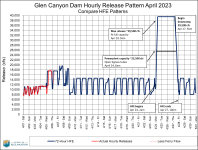
On edit -- I found the max flow through the turbines of 31,500 in Wikipedia, which had a footnote to BOR document that is no longer available. The Oracle posted the graph below showing turbine flow at approximately 25,500 during the HFE. One would presume the 25,500 is max possible flow, but a turbine could be down. Dunno.
 
Last edited:
I thought the press release where they talked about letting out more water the last two weeks just said they have several turbines down, and that’s why they had to start now?

It’s not the way they’re managing the water that’s frustrating, it’s the complete lack of any coherent information on the how and when.
 
Very well stated… I think this is right on the mark. It’s worth remembering that BOR is staffed with a lot of smart engineering geeks who eat this stuff for breakfast and get paid to do it. Most have no personal stake in the outcome one way or another, except to the extent they are trying a manage a complex resource by the guidelines set forth as a result of that agency’s mission.

Speaking for myself, I’m no engineer, don’t work for the BOR, and am instantly suspect in the eyes of many because I have gladly lived in California for nearly 50 years.

Objectively speaking, who’s the more credible source of information?

It’s The Oracle, that’s who.
I wholeheartedly agree. In all fairness to non-experts, good analysis and problem solving involves an outside perspective. I have worked for over 25 years with Subject Matter Experts (SMEs) regularly and it occurs too often that SMEs become too myopic that creative problem solving is ignored. Good problem solving involves perspectives that otherwise wouldn't be allowed. In the end, effective results include collaboration from SMEs and stakeholders.
 
April 24 - 27, 2023: Hopefully it does not negatively impact anyone's planned activities next week, but it is estimated next week's High-Flow Experiment (2023 HFE) will reduce the lake level by about 4-1/2'. Good timing (duh) considering projected inflows (JFR has posted some of these elsewhere). I reckon the lake level will rebound fairly quickly, but I wouldn't want my boat beached somewhere unattended for any length of time next week unless you desire easier below-the-waterline access for cleaning, etc....lol.

It is fun to look at the "HFE Routing through Grand Canyon" chart, via the below link, because it gives a sense of the time it takes for the flow to make its way down the river and return to normal (e.g., various "Peak Begin" & "HFE End" time/date stamps within that chart).

If you wish to see what almost 40,000 cfs looks like, head to Marble Canyon (Navajo Bridge), Lee's Ferry, Glen Canyon Dam, and/or any where else between river mile (RM) minus-16 (Glen Canyon Dam) and RM279 (Pearce Ferry).

(April 2023 High-Flow Experiment)

[As an aside, several years ago (when I was in good enough shape to do Rim-to-Rim's) was fortunate enough to be at the river near Phantom Ranch the week before an HFE and went back DURING the HFE. The USGS guys & gals were at the gage....river was 11 feet deeper across the channel there (about 150 yards wide???). IMPRESSIVE!]
 
Last edited:
April 24 - 27, 2023: Hopefully it does not negatively impact anyone's planned activities next week, but it is estimated next week's High-Flow Experiment (2023 HFE) will reduce the lake level by about 4-1/2'. Good timing (duh) considering projected inflows (JFR has posted some of these elsewhere). I reckon the lake level will rebound fairly quickly, but I wouldn't want my boat beached somewhere unattended for any length of time next week unless you desire easier below-the-waterline access for cleaning, etc....lol.

It is fun to look at the "HFE Routing through Grand Canyon" chart, via the below link, because it gives a sense of the time it takes for the flow to make its way down the river and return to normal (e.g., various "Peak Begin" & "HFE End" time/date stamps within that chart).

If you wish to see what almost 40,000 cfs looks like, head to Marble Canyon (Navajo Bridge), Lee's Ferry, Glen Canyon Dam, and/or any where else between river mile (RM) minus-16 (Glen Canyon Dam) and RM279 (Pearce Ferry).

(April 2023 High-Flow Experiment)

[As an aside, several years ago (when I was in good enough shape to do Rim-to-Rim's) was fortunate enough to be at the river near Phantom Ranch the week before an HFE and went back DURING the HFE. The USGS guys & gals were at the gage....river was 11 feet deeper across the channel there (about 150 yards wide???). IMPRESSIVE!]
Yeah, we were going down on Sunday to camp Monday-Thursday. I would guess the ramps will still be usable, but boat camping would be worrisome. Plus that is going to suck all the muddy water quickly down the lake...need to reconsider...
 
April 24 - 27, 2023: Hopefully it does not negatively impact anyone's planned activities next week, but it is estimated next week's High-Flow Experiment (2023 HFE) will reduce the lake level by about 4-1/2'.
I ran the numbers. It's not going to be a 4.5-foot drop, closer to 2 feet at this point, an maybe not even that much.

During those days, the outflow is going to be roughly 39,500 cfs each day against an average inflow probably about 24,000 cfs. That is to say, a net loss of about 15,500 cfs/day for 3 days, which translates to a little over 90,000 af lost in those 3 days. At this lake level, that means the lake will drop a hair under two feet...
 
Do they usually stick to the exact schedule? I will be up the Escalante during this period😳
TWO FEET, NOT 4-1/2???: JFR ran some numbers..."During those days, the outflow is going to be roughly 39,500 cfs each day against an average inflow probably about 24,000 cfs. That is to say, a net loss of about 15,500 cfs/day for 3 days, which translates to a little over 90,000 af lost in those 3 days. At this lake level, that means the lake will drop a hair under two feet..."

So, plan on a significant drop...leave it at that.;)

Hope that helps your plan :)
 
Last edited:
TWO FEET, NOT 4-1/2???: JFR ran some numbers..."During those days, the outflow is going to be roughly 39,500 cfs each day against an average inflow probably about 24,000 cfs. That is to say, a net loss of about 15,500 cfs/day for 3 days, which translates to a little over 90,000 af lost in those 3 days. At this lake level, that means the lake will drop a hair under two feet..."

So, plan on a significant drop...leave it at that.;)

Hope that helps your plan :)
The BOR posted the April 2023 24-month water projections. The attached *pdf is Lake Powell only. The link has the data for the Colorado River system.

Luke
https://www.usbr.gov/uc/water/crsp/studies/24Month_04.pdf
 

Attachments

The BOR posted the April 2023 24-month water projections. The attached *pdf is Lake Powell only. The link has the data for the Colorado River system.

Luke
https://www.usbr.gov/uc/water/crsp/studies/24Month_04.pdf
Nice! There you have it. USBR projects 3557 for end of May, 3590 for end of June, and 3590 for end of July. What the peak will be is somewhere in early July is not projected. That will get you the cut sometime in June and Halls launch ramp near the end of May. More importantly, they don't project dropping below 3560 anytime in the future. If you want to see beneath Gregory Natural Bridge, you have about a month to do so.
 
Status
Not open for further replies.
Back
Top