The wife and I catch our share. Mostly trolling crankbaits. Most of them being Flicker shads. The key for us is to keep the baits as close to the bottom as possible, trolling in 8 to 15 feet of water. If you're not snagging up once in a while, you're not going to catch as many fish. Having a good lure hound to retrieve snagged lures is a must. We usually troll with the kicker motor at 2.4 MPH, with water temps is between 60 and 70 which is the best time to catch them for us. Slower if cooler, quicker if warmer. I have caught them trolling 3.5 for strippers and I have had them hit suspended baits when we were stopped dealing with a fish on another pole. When trolling the banks, we troll 3 rods, one with a bait that runs 6 to 8 feet on the bank side, one that dives deep quickly at the end of the propwash (about 30 feet back) right behind the boat, and one that runs 12' or so on the outside. I set the steering wheel straight on the boat and steer with the trolling motor constantly watching the depth finder to avoid shallow spots and maintaining the boat in 10' of water. Most of the time the bait against the bank will catch the most walleye. Some days it will be the one in the middle. The bait in the deepest water will always catch the biggest walleye and also the most stripper. I have found that after the sun goes down for the last half hour of the day that the fish seem to come up shallower so we will shorten the length of line we have out and bring the lures up off the bottom. This also helps prevent hang ups which are not any fun once it's getting dark.
Since the mussels have shown up, getting cut off is a bigger issue trolling close to the bottom. I use a good leader behind 15/4 or 20/6 power pro braided line. I prefer using the yellow power pro because you can see it better especially when it starts to get dark. I like to use a 10-pound piece of leader 8 to 10 feet long. I only use two types of leader material - P line and Seaguar. When we are getting cut off often, I will go up to a 15- or 17-pound leader.
We fish mostly flicker shads and minnows because we have found them to be most effective. 7's and 9's usually, sometimes 11's if we need to go deeper to find the bottom. I prefer the ones that look like something that actually swimming in the lake, the wife likes the pinks and orange and purple ones. We have caught them on Rapalas and other crankbaits as well.
I have had good days using bottom bouncers. That being said that's me fishing by myself in the mornings, because my wife most of the time refuses to fish this way, and she does not fish before noon usually. I often tell people if the first time someone took me fishing and taught me to bottom bounce and that this was what fishing is all about, I would have been a golfer. Under the right conditions it is a very efficient way to put them in the boat.
I will rarely tip a single tail grub with a piece of nightcrawler, it just does not allow the bait to swim properly. I much prefer to use a tube jig and stuff the piece of worm on the hook and up inside the tube jig. I will find a likely looking bank and just drift or troll around 1 MPH down the bank keeping the bait in 8 to 12 feet of water simply picking it up a foot or so and setting it back on the bottom. If you feel anything thing that resembles a bite, or lack of weight or simply see line moving off, lift the rod a little and if you feel any weight, set the hook.
Biggest problem a person will have is finding good areas to fish. 1% of the water will hold 99% of the walleyes. It sometimes takes 3 or 4 days to find them and what they want. Most people don't have that long or the patience to find them. Then when you do find them and come back a month later, the water has dropped 4 feet they have moved, and you start looking again.
As far as where to look for them, long flat points that go way out into the middle of the lake or bay, and flats in 8 to 15 feet of water, are the best. Any rocky shoreline, especially with a lot of points on it are good as well. There are a lot of these in GHB, before you get to good hope bay and till you run out of lake going further north. My favorite spot was further north. In the fall of 2017, we caught over 270 in 3 trips (about 15 days of fishing) in an area about 10 to 12 acres. I shot an elk that year in September, and it took up less room than the walleye, crappie and smallmouth did in the freezer. Just two short years later in 2019 we took pictures of cattle grazing right where we were catching all those fish.
As far as size, we have probably caught 50 or so in the last 10 years that were 3.5 to 5 pounds, at least 40 of these were caught in late November to mid-December. The large majority of the walleye we catch are 17 to 18 inches. The further north you go usually the bigger the fish are. If you are catching a lot of 20-to-21-inch fish, you know something I don't know, or your tape reads different than mine.




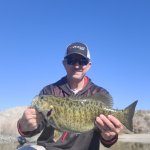
 . Pic of 5.25 smallie last weekend at Lake Mohave. Still swimmin. And limits of eater smallies and walleyes won't.