
You are using an out of date browser. It may not display this or other websites correctly.
You should upgrade or use an alternative browser.
You should upgrade or use an alternative browser.
Walleyes at Lake Powell
- Thread starter becattron
- Start date
- Status
- Not open for further replies.


Dungee
Keeper of San Juan Secrets
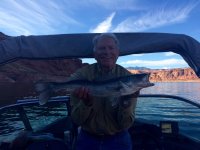
Our biggest was this one Andrew caught. Between the bathroom and ticaboo. Caught it on a single tail shad grub. We just cast shore for smallies, if we run into some walleye we will try and stay in that area if it’s April or May. If someone in our packed boat wants to target some walleye they just fish slower off the back as we are pounding bank.
Can’t remember the measurements but it was either just under 7 or 8lbs, want to say like 6.14 or something like that. Fat, mid April.
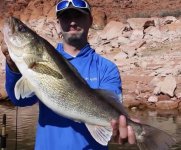
The other biggest walleyes we got into was in February one year when we hiked out to the fork of White and Farley and casted rattle traps. Caught about a dozen big females on a wind swept bank. All those ones were above average and in that four pound range. Haven’t seen anything like that size wise bunched together before. Seems like they can bunch off islands or points that have that old river cobble on them.
Preston
Can’t remember the measurements but it was either just under 7 or 8lbs, want to say like 6.14 or something like that. Fat, mid April.
The other biggest walleyes we got into was in February one year when we hiked out to the fork of White and Farley and casted rattle traps. Caught about a dozen big females on a wind swept bank. All those ones were above average and in that four pound range. Haven’t seen anything like that size wise bunched together before. Seems like they can bunch off islands or points that have that old river cobble on them.
Preston

fishfry
Well-Known Member
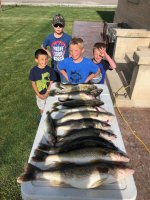
I’m not really a good fisherman rather a strategic planner of logistics. The fish I caught in these pics were all from shore and most of them on a small crappie jig with a 3 inch single/curly tail. It was also during the spawn and they were hungry. I don’t really know how to fish for walleye exclusively and don’t like to slow troll or bottom bounce( I’m not patient enough). It was more timing than anything.Fishfry
Since this is an information post, I thought I would ask what you caught all those walleye on? I know there are a lot of secrets out there, but thought you might be willing to share your secret.
Back in the 80s and 90s we caught walleye by accident here and there, but I did't know much about walleye fishing then. There was a point up by Hite where the fry were literally jumping out of the water when being chased. Back then we thought it was Bass chasing them, but now I think it was probably walleye. We caught a couple of walleye trolling plugs, but we were bass fishing. Didn't know how to walleye fish. I think we could have really loaded up if we would have known how to fish them.
I later learned a little about walleye fishing with a bottom bouncer, and I got a fair amount of bites, but caught very few fish. I was a trout fisherman, and when you get a bit you set the hook. I assumed that their bony mouth would not let the hooks penetrate, and that is why I missed so many. Then I finally learned that you have to do the opposite, give them line and let them eat it when you feel a bite. I still have a hard time not reflex jerking when I feel a bite, and I just pull it away from them.
Another fishing buddy liked to fish walleye with a three way swivel, weight on one connection kind of like a drop shot rig and a short leader on the other swivel connection with a red and white F7 flatfish. He would drape a whole nightcrawler over the two hooks on the hook spreader and fish it like a bottom bouncer. He caught a lot of walleye that way.
Then there is another buddy that is a catch and release guy. He doesn't like to eat fish, and he knows how to catch walleye. But his idea is why waist time catching dishrags, when you can fish for something that really gives you a fight. Every body to his own.
I am a catch and fry guy myself.

Wet1
Well-Known Member
I thought about that quite a bit but you have many lakes in Arizona that get as hot or hotter and aren't nearly as deep. Roosevelt, Apache, Canyon and Saguaro grow big walleye. I would think the bigger walleye are about as temp tolerant as the larger stripers may employ the same strategy. The temps may keep the numbers of larger ones down but man, as a percentage with the way the walleye numbers have exploded over the last 10 years you would think we'd see a few 6 to 10 pounders every spring.I suspect there are not that many big fish or they would be caught more frequently (I am sure Wayne has a lot of gill net data over the years too). I always figured it was due to the warm temperatures of LP compared to most waters that hold walleye. They can tolerate warm water but prefer it to be colder than the bath water LP is for many months of the year. They can go deep to escape the hot temperatures, but there is not much forage down deep. That my 2 cents.
Most the time will cast towards shore and then bounce back. I think you need to be contacting the bottom as much as possible so pick your jig weight accordingly. Although I tend to cast towards the bank, my wife tends to try all directions from the boat. Some days she does better, some days I do. There is the occasion when you seem to be sitting right on top of them and then yes simply dropping down works too. By staying on the bottom you will be tying on lots of jig heads but that is just the way it goes. Good luck.Hey Chris
Do you jig straight up and down or do you cast and bounce along the bottom as you reel back?

PBH
Well-Known Member
The question I have had for many years about Lake Powell walleye is where are all the big fish? The lake produces phenomenal numbers of what I call cookie cutter 17 - 21 inch fat fish just like in your pictures but bigger fish in the 4 - 10 lb range are very rare and I know they must be in there in good numbers. The best theory I have come up with is that the bigger fish become somewhat pelagic in Powell and stop orienting to structure but rather follow the shad around in open water and therefor are rarely caught.
It's the same answer as the stripers.
Lake Powell is a predator heavy lake with few systems in place to limit natural reproduction. One limiting factor is prey. We talk all the time about shad numbers -- harvesting as many stripers as possible to "protect the shad". But it isn't only about the amount of prey, or, in other words, you can't add more prey and fix the equation. You have to reduce the population overall.
Look at the harvest regulations for Lake Powell:
20 smallmouth bass
25 catfish
no limit on striped bass
no limit on walleye
The reason you don't see those larger walleye is just a basic population equation. High population numbers = lower average size. How do you get higher average sizes? You lower the population. How do you lower the population? You harvest more fish -- thus a regulation with no limit on walleye.
of course, there will be a few exceptions, as there always are. But on average, you are catching exactly what is in Lake Powell: 17-20" walleye.
Think about it like filling a jar with jelly beans. The jar can only fit so many jelly beans. You can fill the jar with a few BIG jelly beans, or you can fill the jar with a lot of small jelly beans, or a mixture of both. But once the jar is full, you cannot add more jelly beans.
fisheries management is the same concept. Lake Powell is no different. The difficulty with Lake Powell is that the system is a HUGE system, and certain aspects, like suitable spawning habitat and natural recruitment, are extremely difficult to control. How could you ever control smallmouth bass reproduction? Striper reproduction? Walleye reproduction? You can't. So, instead, you focus on education -- you educate your anglers to the importance of harvesting fish, like stripers! Walleye are in that same bucket. The more walleye anglers will harvest, the better chances we have to increase their average size.
Wet1
Well-Known Member
WRONG! Over population is NOT the reason we aren't seeing bigger walleye in Powell. They do not run the same cycle as stripers. They are way more adaptable when it comes to forage than stripers are. When the stripers are skin and bones the walleye are still fat. I have fished walleye in many boom and bust lakes all over the west and experienced the over population and prey crashes that result in "hammer handles". That is not the case at north Powell. You are correct in that man will not impact the walleye population in Powell but wrong about the reason we aren't seeing larger ones. Temperature intolerance is a much more believable theory.

Coho975
Well-Known Member
No doubt they can and do thrive in warmer waters. I agree with you though, I think the bigger fish become mostly pelagic, as they often do in the Great Lakes during the summers.I thought about that quite a bit but you have many lakes in Arizona that get as hot or hotter and aren't nearly as deep. Roosevelt, Apache, Canyon and Saguaro grow big walleye. I would think the bigger walleye are about as temp tolerant as the larger stripers may employ the same strategy. The temps may keep the numbers of larger ones down but man, as a percentage with the way the walleye numbers have exploded over the last 10 years you would think we'd see a few 6 to 10 pounders every spring.
"Missouri, Arkansas, Kentucky and Tennessee have produced the four largest walleye on record, all over 21 pounds. Tennessee holds the big fish title with a whopping 25 pounder caught from Old Hickory Lake in 1960."
Last edited:
Coho975
Well-Known Member
Again, I agree with you on this. Growing up in MI, we had tons of inland lakes with a good walleye population where there were no shad, shiners, smelt or any other baitfish. They thrived on perch, BG, crappie, crawdads, etc. I think they're much more efficient predators than stripers. With the BG in LP learning to efficiently feed on the smaller mussels, which I have witnessed spearfishing, and is evident by the size they are attaining, I think the walleye are feeding heavily on them. they have been in great shape for the last several years.They are way more adaptable when it comes to forage than stripers are. When the stripers are skin and bones the walleye are still fat.

RandyAustinFishing
Well-Known Member
Yep. We do need to harvest Walleye and Smallmouth too many jellybeans. But as I have argued this point before, too many of the larger fish are harvested. Same with smallmouth. It takes many years for walleye and smallmouth to reach trophy size. Few at Lake Powell survive to trophy size. Besides the smaller fish are better to eat than the big fish.WRONG! Over population is NOT the reason we aren't seeing bigger walleye in Powell. They do not run the same cycle as stripers. They are way more adaptable when it comes to forage than stripers are. When the stripers are skin and bones the walleye are still fat. I have fished walleye in many boom and bust lakes all over the west and experienced the over population and prey crashes that result in "hammer handles". That is not the case at north Powell. You are correct in that man will not impact the walleye population in Powell but wrong about the reason we aren't seeing larger ones. Temperature intolerance is a much more believable theory.
Dungee
Keeper of San Juan Secrets
Yep. We do need to harvest Walleye and Smallmouth too many jellybeans. But as I have argued this point before, too many of the larger fish are harvested. Same with smallmouth. It takes many years for walleye and smallmouth to reach trophy size. Few at Lake Powell survive to trophy size. Besides the smaller fish are better to eat than the big fish.
This! I’ve seen a lot of really nice smallies on the fillet table at bullfrog. Keep the 9-11”. Put those bigger ones back!

Mildog
Well-Known Member
As far as “thinness”in walleye it seems very much to me to cycle with the shad population. Low shad skinny walleyes ( and stripers etc.)I’ve always been surprised about how thin the walleye are. This was the biggest dad has View attachment 21390caught, a few years back. If memory serves it was around 25”. Would have weighed significantly more in a more northern lake.
Also a hungry walleye is much easier to catch in IMHO when prey is limited, walleye are easier to catch and therefore might also catch more skinny ones. I’ve noticed in several
“Walleye” lakes we fish it’s much easier to get them when they have less prey to eat. A hungry walleye is a good thing

Wet1
Well-Known Member
I am a walleye fanatic, could be called a walleye snob I guess as I consider stripers to be a carp in a tuxedo and do my best not to catch them, lol. I have fished the amateur walleye tournament trail all over the west qualifying for the Cabela's National Walleye Championship 3 times. When I go to Powell they are my focus although I do love big crappies as well but unfortunately the crappies have been collapsing the last few years with the low water and are another story all together. I have many friends that are very, very good walleye fisherman and know how to find them in any body of water that also fish Powell. I'm not trying to be a braggart here but just trying to humbly establish that I have some knowledge of how to find and catch walleye.
For many years my friends that are fellow walleye fanatics at Powell and I have had an ongoing discussion trying to figure out why we don't see hardly any fish over 4 pounds. I think the most plausible is that the bigger fish stop orienting to structure and become more pelagic like they do in the great lakes. This would also fit with temperature intolerance like the bigger stripers have and keep them below the thermocline. The bigger walleyes in most bodies of water are not school fish anyhow like they are in the great lakes like Erie. My theory is that temperature intolerance keeps the numbers of bigger ones down as they suffer much more stress from the higher temps like bigger stripers. With that said there should still be some larger fish especially in the 4-6 pound range. Perhaps if they are pelagic and staying in deep open water the stripers out compete them for the lures and keep the catch rate suppressed beyond what it should be?
We have often discussed the hope there would someday be a professional walleye trail tournament at Powell that might show us if there are in fact any significant numbers of larger walleye in there.
For many years my friends that are fellow walleye fanatics at Powell and I have had an ongoing discussion trying to figure out why we don't see hardly any fish over 4 pounds. I think the most plausible is that the bigger fish stop orienting to structure and become more pelagic like they do in the great lakes. This would also fit with temperature intolerance like the bigger stripers have and keep them below the thermocline. The bigger walleyes in most bodies of water are not school fish anyhow like they are in the great lakes like Erie. My theory is that temperature intolerance keeps the numbers of bigger ones down as they suffer much more stress from the higher temps like bigger stripers. With that said there should still be some larger fish especially in the 4-6 pound range. Perhaps if they are pelagic and staying in deep open water the stripers out compete them for the lures and keep the catch rate suppressed beyond what it should be?
We have often discussed the hope there would someday be a professional walleye trail tournament at Powell that might show us if there are in fact any significant numbers of larger walleye in there.
Mildog
Well-Known Member
I’m not sure either theory is exactly on but good points, a lake in Utah that has produced big 12 lb plus walleyes for over 3 decades, it is very similar to Lake Powell in structure and temperature. It gets very warm In theYep. We do need to harvest Walleye and Smallmouth too many jellybeans. But as I have argued this point before, too many of the larger fish are harvested. Same with smallmouth. It takes many years for walleye and smallmouth to reach trophy size. Few at Lake Powell survive to trophy size. Besides the smaller fish are better to eat than the big fish.
Summer months. I Don’t think temperature is affecting them that much as they can move down into
The water column like Powell.
It’s loaded with hammer handles now but still produces a few very big ones (double digits every year) The average size has dropped dramatically the last few years and it seems to be limited prey as the biggest issue. You can catch lots of them . Too many mouths too few things to eat. There are efforts underway to increase prey options.
I have seen some healthy walleye when stripers are snaky at Powell and it varies by the conditions where they are caught, Lake Powell in many ways is like many separate lakes, we have caught fat walleyes in one canyon and a few canyons away they are snaky on the very same same trip. Also we
See lots of crayfish and other than shad fish in stomachs of walleye when things are lean at lake Powell. I’m sure there are a variety of reasons as to the size situation at Lake Powell. I remember when walleye were fewer at Lake Powell it seemed to be that the average size was larger.
Way back in mid 80’s we didn’t catch that many but the always seemed fat and happy 5 lb not uncommon when we got them. On one trip in 80’s my bothers in laws came to fish Powell they were from Minnesota (walleye country) we caught a handful that trip of nice sized walleye. His Father in law got a 7.5 lb walleye the largest walleye he had ever caught!! I believe he had it mounted. He told us where he fished at home in Minnesota he caught lots of them but usually about 2 lbs was the average and not much bigger ever.
Well that’s some food for thought!
Pun intended!
Good luck on lots of water and Walleyes at Powell this year!
Maybe Wayne or fishery biologist can add some thoughts?
Mildog out!

svivian
Escalante-Class Member
If im thinking of the same lake that the Utah DOW has encouraged the take of 15" walleye with a limit of 10, then I agree that lake has suffered a dramatic decrease in large walleye populations. I am not sure why either other than the older ones are being harvested at a higher rate.I’m not sure either theory is exactly on but good points, a lake in Utah that has produced big 12 lb plus walleyes for over 3 decades, it is very similar to Lake Powell in structure and temperature. It gets very warm In the
Summer months. I Don’t think temperature is affecting them that much as they can move down into
The water column like Powell.
It’s loaded with hammer handles now but still produces a few very big ones (double digits every year) The average size has dropped dramatically the last few years and it seems to be limited prey as the biggest issue. You can catch lots of them . Too many mouths too few things to eat. There are efforts underway to increase prey options.
I have seen some healthy walleye when stripers are snaky at Powell and it varies by the conditions where they are caught, Lake Powell in many ways is like many separate lakes, we have caught fat walleyes in one canyon and a few canyons away they are snaky on the very same same trip. Also we
See lots of crayfish and other than shad fish in stomachs of walleye when things are lean at lake Powell. I’m sure there are a variety of reasons as to the size situation at Lake Powell. I remember when walleye were fewer at Lake Powell it seemed to be that the average size was larger.
Way back in mid 80’s we didn’t catch that many but the always seemed fat and happy 5 lb not uncommon when we got them. On one trip in 80’s my bothers in laws came to fish Powell they were from Minnesota (walleye country) we caught a handful that trip of nice sized walleye. His Father in law got a 7.5 lb walleye the largest walleye he had ever caught!! I believe he had it mounted. He told us where he fished at home in Minnesota he caught lots of them but usually about 2 lbs was the average and not much bigger ever.
Well that’s some food for thought!
Pun intended!
Good luck on lots of water and Walleyes at Powell this year!
Maybe Wayne or fishery biologist can add some thoughts?
Mildog out!
I am going to follow you around and catch 10+ pound walleye.I'm not sure on the water temperature theory though either... I can go to Lake Mac in Nebraska in July on a hot day and find 10+ pound walleye regularly.

I follow the logic of all the arguments presented, I would side with the larger fish being more pelagic and suspending at the same elevation as the shad are using. If there is not enough oxygen present in the deeper water the walleye can't exist in the cooler water w/o oxygen. Then they are forced to go up higher in the water column and water is possibly too warm there and they are stress and die. Larger fish do get stressed easier than small fish and then the cycle repeats.
Earlier in the post someone mentioned a 31" fish, that could/should have been a lake record. Every 31" fish that I have seen, weighed well over 12 lbs and most were 13 lbs.
However without a doubt the walleye in Powell are thin for their size.



Dorado
Keeper of San Juan Secrets
Yes the are more adaptable in terms of forage than stripers, but shad are still their primary forage as adults. I have caught lots of 15-18" walleye out of LP that had nothing in their stomachs other than zooplankton. Smaller fish can grow and thrive on just zooplankton, but as they get larger they are less efficient, and require larger forage. The boom-and-bust cycles of shad may not have quite the same effect as it does on stripers, but they are still the main thing walleye are eating. I have observed quite a bit of variability in the numbers of walleye we catch from year to year, and in the size and condition of the ones we catch. This points towards high recruitment during the boom years and less during the "down cycles".WRONG! Over population is NOT the reason we aren't seeing bigger walleye in Powell. They do not run the same cycle as stripers. They are way more adaptable when it comes to forage than stripers are. When the stripers are skin and bones the walleye are still fat. I have fished walleye in many boom and bust lakes all over the west and experienced the over population and prey crashes that result in "hammer handles". That is not the case at north Powell. You are correct in that man will not impact the walleye population in Powell but wrong about the reason we aren't seeing larger ones. Temperature intolerance is a much more believable theory.
Seems like we need some graduate student to study the walleye in LP and get some scientific knowledge about their diet and life history and not just a bunch of internet speculators (I include myself a member of this group)!

Let's see if I can post this report on line?
https://wildlife.utah.gov/pdf/fish/technical-reports/2021_lake_powell_fisheries.pdf
Looks like it worked. Walleye are on page 100
https://wildlife.utah.gov/pdf/fish/technical-reports/2021_lake_powell_fisheries.pdf
Looks like it worked. Walleye are on page 100
- Status
- Not open for further replies.