Lake Level rapidly rising!

Status
Not open for further replies.
Lake Powell is still coming up over a foot per day. On June 21 the report was lake level at 3603. Hopefully on Monday the new lake level will be near 3606. Thanks to all of those that have actually studied the rising water and compared it to other years. They have provided great information that has been very informative.

Come on Lake Powell - Keep rising!
 
I am sitting in Manila Utah, and looking a lot of snow in the Ashley national forest. It looks there will be snow up there until mid July. All that water will be going to Powell. By the way for all of you sweltering down south. The high here was 56 today. I actually had my gortex on this morning, it was a balmy 39 at 7:00 am.
 
The lake has come up over a foot a day on the date base. Looking at the last 10 years, the highest per day rise on the chart is .78. Glorious to see.
 
Since June 9, the lake has risen at least a foot every day--that's 14 straight days. Now you might be scratching your head, wondering when was the last time the lake ever rose more than a foot a day for 2 weeks straight. It happened one time--in 1993, with 16 straight days... see below... Except for in 1964, when the lake was just starting to rise, we are now in uncharted territory. The lake has never had a 2-week sustained rise quite like this one. The closest rivals were:

1993 - 16 straight days of 1+ foot rise (May 19-June 3)... followed by one day of 0.92, then one day of 1.04
2005 - 11 straight days (May 23-June 2)
1968 - 10 straight days (June 2 to June 11)

In 1973, there 12 days that exceeded a 1-foot rise, but they were spread over a 16-day span.

How much has the lake risen in 2 weeks? From June 9-22, the lake has gone up 16.17 feet. That total has only been exceeded once--in 2005, when the lake came up 17.41 feet from May 22-June 4. But this year is more impressive, because we are at a higher lake level than in 2005, and it takes more volume to produce that kind of rise. In 2005, the 2-week gain went from roughly 3574 to 3591. This year, the 2-week gain has gone from 3589 to 3605. (But maybe 1993 was even more impressive in that span--rising 15.41 feet in 14 days, from about 3635 to nearly 3650--a lot of volume!)

2019 is already unique (or close to it) in other respects too. The lake has sustained an inflow of 65-75K cfs since June 9, and such a late season high flow volume has only been exceeded a few times. The only years that were more impressive were 1995, which saw 65K+ cfs from June 1 to July 18, and those two giant years of 1983-84. In 1984, the lake sustained at least 65K cfs from May 16-July 6! In 1983, it was May 30-July 16. Both years saw peak inflows of 120K+ cfs...

But it's not over yet... remaining snowpack is still well above average for this date, so it's reasonable to expect sustained (although somewhat diminished) flows for some time....
 
Last edited:
JFR- do snowpack and recent storms make you change your guess on lake level for this season?
Not really... Of course, I'm working with the same data as everyone else, so my wild guess is the same as yours. I mostly just look at past trends for years with similar characteristics to base my predictions on. This year so far the lake has added a net volume of about 3.3 MAF since the lake started rising in early April, but about 40% of that has come in the last 2 weeks. So it's a question of how long the lake can sustain this kind of rise. The late snow obviously helps some, but the volume of new snow is nothing like what fell earlier in the spring, so hard to predict what this means...

My rule of thumb is that if the lake has an inflow of 60K cfs per day (assuming normal outflows), that translates to about 0.1 MAF increase per day. It's about 0.05 MAF at 40K cfs inflow. I think it's reasonable to expect to split the difference for at least the next 2 weeks, possibly longer. If the lake averages 50K cfs inflow for 3 weeks, that's about 1.5 MAF added in that time--about the same as in the past 2 weeks. That's consistent with past trends in similar years. We might add another 0.5 MAF after that until the lake peaks...

...And if we do that, we end up somewhere around a total of 5.3 MAF in net volume from the time the lake started rising, or a total peak lake volume of about 14.3 MAF... which translates to a lake level of around 3625-3628... that's pretty close to the BOR's latest estimate (which they tend to be conservative about)... obviously a lot of variables I'm ignoring, and the data is incomplete... much will depend on what happens in the next week to 10 days...

But what do I know? I'm just looking at numbers, not measuring snowpack...
 
That,s all Folks.
All major western slope lakes in Colorado are cutting discharge.
Fill er up and check the oil.
Strange storm system. Hung out in Montana a while, and trained the cold and moisture and cold on down.
 

Attachments

  • image2(1).jpeg
    image2(1).jpeg
    93.1 KB · Views: 47
About another fit to 18 inches and it should be wet total widtg
 

Attachments

  • 7A7464A7-21DB-4FED-AE7E-2E28F8B5A247.jpeg
    7A7464A7-21DB-4FED-AE7E-2E28F8B5A247.jpeg
    333.3 KB · Views: 101
5401

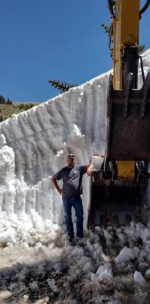
This picture is a buddy of mine that works on the Henry Mountains and this picture was taken just this week. Judging from the green in the background and the angles of the shadows, he's on the North facing side of the hill but that is still a lot of snow for the end of June.

It is this kind of information that makes me question the 20' left of water rise that is being predicted.
 
If all that water went to Powell alone, I think you’re right: we could fill Lake Powell.

But I’m certain Lake Mead will take a lot of it, hence the lower predictions.

But who knows, they may retain the water in Powell for summer, then let it all out later in Fall.

(Powell stores the water more efficiently with much less surface area than Mead, therefore much lower evaporation losses).
 
If all that water went to Powell alone, I think you’re right: we could fill Lake Powell.

But I’m certain Lake Mead will take a lot of it, hence the lower predictions.

But who knows, they may retain the water in Powell for summer, then let it all out later in Fall.

(Powell stores the water more efficiently with much less surface area than Mead, therefore much lower evaporation losses).
This water year ending Oct 1, Lake Powell releases to Mead will be 9.0 maf. No more, no less under USBR's operating guidelines. I agree that anecdotal evidence on snowpack makes one think we'll exceed USBR forecasted peak of about 3622 ("only"15 feet more), but a rise of 54 feet from the low of 3568 is tremendous.
 
Status
Not open for further replies.
Back
Top