Eric_Cheney
Member
Very clever use of a variety of knots!


Great post, thanks!.....have always loved Stan....Eric,
If your group is still confident about the Escalante arm NOW IS THE TIME TO DO IT!
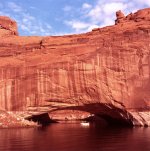
Gregory Arch went underwater circa 1969 and has been underwater until just recently. I was fortunate enough to go there September 5th, 2021 and it is exposed about 3 feet only...a virtual rebirth, if you will. Check out this Stan Jones link. I think it is about 45 miles from Bullfrog, give or take (we came from the downstream end of the lake, so not sure). A houseboat is a tight fit to see the arch... a runabout would be better, but you can get a houseboat in there if it is your only option. As you go upstream in the Escalante arm, Fifty Mile Canyon branches off on the left (west) side of the Escalante. Gregory arch is in Fifty Mile Canyon. good luck and have a great time! Check out this link....
(Gregory Arch)

 ( I just can't remember that far back......)

Yes, Gregory Natural Bridge is made of Navajo Sandstone (same formation that the dam resides in, by the way). Just to provide some visual context for what to expect as the bridge re-emerges, here's a couple of historic shots:It was inundated circa 1969 and has never been seen since, I believe. You have a greater chance of winning the lottery 3 weeks in a row than being under it when it actually spalls. Gregory Arch appears to be made of Navajo Sandstone (not sure)...if so, that sandstone is cemented with silica (not water soluble) and is porous (saturated). Your concern is valid in that the daily/seasonal thermal fluctuations WILL cause spalling to some degree. However, there is no chance whatsoever the entire span will collapse all at once in our granchildren's, grandchildren's, grandchildren's lifetimes, let alone in the next 100 years. Obviously, a spall weighing more than an ounce can cause serious injury. Personally, I wouldn't give it a care in the world...but that's just me.

So you're saying that the water does not penetrate deeply into the sandstone because of the silica, and I assume JFR's comment about the dam backs that up. Thanks for that explanation..It was inundated circa 1969 and has never been seen since, I believe. You have a greater chance of winning the lottery 3 weeks in a row than being under it when it actually spalls. Gregory Arch appears to be made of Navajo Sandstone (not sure)...if so, that sandstone is cemented with silica (not water soluble) and is porous (saturated). Your concern is valid in that the daily/seasonal thermal fluctuations WILL cause spalling to some degree. However, there is no chance whatsoever the entire span will collapse all at once in our granchildren's, grandchildren's, grandchildren's lifetimes, let alone in the next 100 years. Obviously, a spall weighing more than an ounce can cause serious injury. Personally, I wouldn't give it a care in the world...but that's just me.
We leave for Bullfrog Thursday. This looks like a neat excursion for the PB! Thanks for the heads-up!Eric,
If your group is still confident about the Escalante arm NOW IS THE TIME TO DO IT!
Gregory Arch went underwater circa 1969 and has been underwater until just recently. I was fortunate enough to go there September 5th, 2021 and it is exposed about 3 feet only...a virtual rebirth, if you will. Check out this Stan Jones link. I think it is about 45 miles from Bullfrog, give or take (we came from the downstream end of the lake, so not sure). A houseboat is a tight fit to see the arch... a runabout would be better, but you can get a houseboat in there if it is your only option. As you go upstream in the Escalante arm, Fifty Mile Canyon branches off on the left (west) side of the Escalante. Gregory arch is in Fifty Mile Canyon. good luck and have a great time! Check out this link....
(Gregory Arch)
The dam abutments are notched into the sandstone much deeper than Hoover Dam, since the Navajo sandstone is not as strong as the granite where Hoover Dam is built. There is a lot of serious civil engineering well outside of my field for calculating how large the abutments needed to be, sheer strength of sandstone, and all kinds of considerations. If they get it wrong there are major consequences, look up dam failures on Google for several in the US. You can also have problems because of the location of the dam, see the Vajont Dam disaster as an example. (Nothing went wrong with the dam, just the mountain above the reservoir.)So you're saying that the water does not penetrate deeply into the sandstone because of the silica, and I assume JFR's comment about the dam backs that up. Thanks for that explanation..
Which of course leads to another question....when the dam was built, were the canyon walls 'notched' and concrete poured into the notches, with rebar coming out?
Pardon my naiveté....I don't know a dam thing about this...but it's fascinating...
Thanks again for the education...
10 years of house boating on Powell and this site and the members keep dropping brilliant ideas. I have never thought to bring moving blankets or any blankets to soak and then put over coolers. We always use car sun shades.. there will be no more of that. Love the idea of dropping drinks in a net and letting them sink. We were just there in late July and the water had to be 85 in halls bay but 3 feet down the water felt considerably coolers, Really smart, Thank you for sharing.Things that have worked well for me. Dry ice on made beforehand frozen meals for later in the week. Mark them for each days use for food. Tape those coolers up (duct tape) at the lid to seal them and do not open them until you intend to eat them. Lasagna, casserole type dishes feed a big bunch and freeze nicely. Keep coolers in the shade as much as possible. Bring old heavy blankets or comforters you can soak in lake water and put them on top of the coolers after you soak them. The evaporation will help keep them cool and keep the sun off of them. If you are cooling beverages and putting new ice on cans pre-cool your cans with old cooler water. If you dump new ice on hot cans you can watch your ice disappear. I have even used a heavy net bag and placed cans off the back of the boat with a rope in deeper water to pre-cool them. My first trip in the late 80's we used so much ice. Luckily we had boats to go back to BF. The next trip we used only a 1/4 of the ice we did the first time. Mid Sept. was one of my favortie trips to Powell. Nights were cooler but we had some days that were fairly warm.
I cannot answer to the fuel questions but no need to run the boat at full throttle unless your trying to get somewhere in a hurry. Back it off and fuel usage goes down significantly.
For $15 purchase Navonics for your cell phone. Download the maps for Powell so they are on your memory, put in the correct offset for lake level and you will know exactly where you are. It we be the best money you will have spent on anything your getting for this trip to have peace of mind knowing a few things like depth and location. Download some good maps if you can showing canyon names etc. There's a lot of free stuff online you just need to be PC savvy. Don't plan on seeing buoys or where they should be. Park service doesn't maintain these with any precision. (My experience) The people you are renting your boat form will not be of much help so prepare yourself with as much knowledge as you can before hand. This site has so much info its really unbelievable.
Like Raven said: Plan on more ice than you think. Anchor that boat well. Winds come up out of no where and can be brutal. If you are not ready the wind will win. I never been to Powell all these years and not expreinced a blow of some kind. And yes wear life jackets. The second best thing about a Powell trip is being able to tell everyone you know about it in person

I think you need to invite someone with experience
i agree, trial and error works best and you will figure it out, we all had a "day one" in a houseboat.Not necessarily. Millions of people that have never operated a houseboat rent them each year. Just plan ahead, don't get in a hurry and be aware of your surroundings.
best piece of advice ever, follow it and your trip will be amazing, "Anchor early and securely".Precooked and frozen meals make life a lot easier on the lake. We freeze our chicken and our pork but not our steaks. We eat those early in the trip. We pack our food cooler based on the day we plan to eat everything. First day on top and last day on the bottom. That way we only have to open it once a day and do so quickly. Food cooler stays in the Galley so sun is not an issue. Drink/ Ice storage cooler is in a designated well under the bench seat in the cockpit so it does not get sun either. We don't drink canned drinks so we freeze small water bottles and use them to keep food cool and in the drink/ice cooler.
Anchor early and securely. We have a cruiser so it's an easier task but in a houseboat try to find a beach with some large rocks to wrap your anchors around. Otherwise dig them in at the water line.
The lake is dropping so you'll need to be aware and move the boat off the beach daily.
I always rent a satellite phone for the trip. Plan on having no cell reception 20 minutes after leaving the bullfrog dock. You will probably never need it but if for some reason you do the $200 spent will pay for itself quickly. You have some older people on your boat and if there is a health issue or accident the cell phones will not work and sometimes the marine radios on the houseboats are not reliable depending where you are on the lake.Hello Everyone;
My group of six is renting a 46' Voyager HB from Bullfrog for a week (six nights) in mid September. None of us have ever done a HB trip. I have a number of questions regarding trip planning. I have lots of experience hiking and kayaking the canyons of the Colorado Plateau but this is a totally new experience. (None of us fish.)
None of us have ever operated a HB. We are all rookies and half are elderly.
We would like to go up the Escalante arm for sight seeing and do some easy to moderate level hiking as three of six are 80+. The youngsters are in their 50's and 60's. I don't know where to find resources which will tell me what is or is not accessible at current water levels. We have the Kelsey book on LP. I assume there is so much to see/do that we would cherry pick the easy and accessible options if we knew what they were.
The closure of the DR marina clearly may have a major impact on our planning.
Aramak has not been very helpful in terms of any kind of planning. They say the boat uses about 10 gallons per hour while underway and the generator uses 1-2 gallons per hour. They could not tell me if we could charge everything that needed to be charged by the generator while underway to save fuel. Their info says their refrigerator/freezer will not keep perishables from going bad in temperatures of 90F or above. They say to use the 150 liter cooler on the deck.
I would be OK not using the AC to conserve fuel. I had planned to buy ice in SLC the day before we leave unless there is a better option. How long will our ice last if we only use the cooler for our perishables (not drinks) and access it just a few times per days.
How far can we expect to go up the Escalante and still get back to Bullfrog w/o running out of fuel or get stuck in some way?
If fuel constraints force us back to BF before our time is up I'm OK with heading North of BF for the remainder of the trip.
How does one even know where they are on LP other than references to mileage bouyes in the main channel?
If anyone can point me to specific resources for planning this trip or is willing to offer specific advice that would be greatly appreciated. We are looking for an enjoyable experience of sight seeing and ideally some easy to moderate hiking.
I have seen some multi-day trip itineraries on line but I am sure they were written assuming a relatively full lake and assuming fuel was available at DR.
Thank You in advance for your insights. I'd be happy to share my phone/email if that would be easier.
Eric
6 on a HB is a skeleton crew. 6 rookies with 3 80+, wow, just wow.
I've HB'ed 8 times at Powell over the last 40 years. 1st time with ten rookie 20 somethings 8 male 2 fems. I sure hope someone on the crew has significant boating experience. It's not a house, it's a big underpowered floating box.
So here are just some of the mistakes you will likely make and some of the outcomes. We did them at one point or another.
You won't start looking for an anchorage untill late afternoon. You should have started AT noon (or earlier).
You will choose a marginal spot to anchor since you lack a scout boat, experience, and time (late start).
Your anchors will not be well set due to your marginal spot and your relative lack of manpower. Properly anchoring a HB is hard work and can take the better part of an hour. Note, a 46' boat in a 20mph breeze can exert ~1000lbs on an anchor line. They better be set well.
If the wind blows (it will sooner or later) your anchor/s will pull out. Had it happen AT NIGHT 3 times over the years. It's pretty frightening. Twice we got re-anchored after using the engines to keep from getting blown sideways on the beach. Once we didn't. Barely got the engines shutdown and tilted up in time. Yes, you will think they are set "good enough" and sooner or later you will be wrong.
Nothing like an emergency drill at 2am to get the adrenaline flowing. Amazing nobody even ended up getting hurt. Some sore backs though.
Ok, enough of the scary stuff. Other inconvenient things are.
You won't have enough gas. Ok scratch that. the HB has enough. But, If you do take a runabout you will end up wanting to take it out but won't have enough gas to do so after 2 or 3 days. Oh and you can't get to the back of the canyon where the best hikes are without a runabout or better yet jetskis. It still often requires a swim (often through debris).
You will run out of ice and be drinking warm drinks the last few days and plan on at least one or two meals that don't require refrigeration. Fill the big cooler that come with the boat FULL of blocks of ice and nothing else. Everything that needs to be cold should be cold before it gets loaded onto the HB. More sore backs from hauling coolers. I always take and use a weightlifting belt.
Don't make a detailed itinerary, have a goal or two but be flexible. Monitor/track your fuel use daily. Adjust plans accordingly.
Using a houseboat like a touring bus and moving it every day is a lot of work. Did that on the 1st trip (we were in our 20's then) and never again. Anchoring 3 times in one week is my absolute limit.
Resupply runs in a runabout take 2 to 4 hours depending on how far your are from marina. I hate 'em. The chop is usually bad and you will get tired of being bounced around. Nothing but tiring. Oh and hauling more ice not fun. Fuel cans, not fun either.
Things to take.
Binoculars for reading mileage makings on channel bouys.
First aid kit. We always buy a brand new one for every trip.
Emergency meds. Medical care hours away.
There's lots more.... but it is way late a night now.