
You are using an out of date browser. It may not display this or other websites correctly.
You should upgrade or use an alternative browser.
You should upgrade or use an alternative browser.
Bullfrog six night trip planning help for HB rookies.
- Thread starter Eric_Cheney
- Start date
- Status
- Not open for further replies.

SkibumUT
Well-Known Member
Ask @Havalina for details. They were posting about it earlier this year: Garmin Inreach suggestionsI'm sure someone will chime in with the complete answer, but there is an air ambulance service that offers a subscription package for discounted helicopter flights off the lake directly to a properly equipped hospital, should the need arise.
With a crew of advanced age, it may be worth the money to pay the fee. The peace of mind would be priceless in a real emergency.
I have a 42' and always want and use four anchors -- I would insist on them (nicely) as KBJ just statedWhen renting house boats in the past, I have had success insisting nicely for extra anchors

Eric_Cheney
Member
OK, my take-away on the SB is we should be cruising in vicinity of 1500 rpm to conserve our fuel as much as possible. 8 miles per hour seems painfully slow but getting ~ 4 miles/gallon vs. only ~ 2 is enormous leverage. Plus the time consumed by going back to BF for gas isn't trivial. Aramark says the 150hp 19' SB consumes 14 gallons/hr! but that is got to be for starting, stopping and dragging water toys. We are just touring. Based on these numbers the 45 gallon tank could provide us a range of up to 180 miles at 1500 RPM since we would only be consuming about 2 gallons/hr. That would be fantastic and with some extra five gallon containers perhaps we can do a lot of touring and not have to return to BF for fuel! I guess the only downside is that it could easily take a couple of hours each direction in the main channel to get to the Escalante. But it will be a spectacular ride and still multiples faster than my usual mode of Colorado river transportation which is paddling!ANCHORING: Use EVERY anchor that comes with the boat. Usually two off the stern on each side (more to come on that). If you don't push the bow onto a sandy beach well with the engines, the bow can "blow out" from under you (i.e., yeah, the stern is anchored, but the bow can be pushed off the bank by a strong crosswind.) So, just nudge up to a SANDY beach at about 2 knots (just above idle as you approach...make sure everyone aboard is prepared for the sudden HALT) , then 'push' it on using about a 5-second burst of full-throttle (before you use that much throttle, ensure the stern is in enough water (4+ feet should do it). With water levels dropping the 'bite' of your bow will only get better the longer you are in one spot. Don't worry about not being able to get the boat off of the beach...you just see-saw the stern back-and-forth in low throttle reverse and off she'll come. No problem.
Important: Anchors DO NOT hold vertically, they hold HORIZONTALLY. You'll most likely have what are called Danforth-type anchors... get them as high up the beach as you can... the higher in relation to the boat, the better. Seriously, if I have enough rode, I walk mine up to a level above the top of the boat. Use as much of your rode as you can... the catenary also serves as a shock absorber. ABSOLUTLEY above the water line, not in the water, and out at about a MINIMUM 30-degree angle from the boat (the 'wider' they are positioned the better, within reason.) 45-degrees is PERFECT, not more than 60-degrees, because any wind from the side actually helps force the bow harder onto shore, thus preventing bow blowout. In tight anchorages (i.e., neighbors nearby), some folks (myself included) like to use two stern anchors, one on each side, to be at relatively shallow angle (i.e., more parallel to the boat's centerline) COMBINED with a midships anchor at a relatively wide angle to handle side-loading (especially if you think there's any chance the bow could blowout). In that situation, the anchors on a given side end up being at about the same position on the beach, give-or-take.
BIG PICTURE?: USE EVERY ANCHOR THAT COMES WITH THE BOAT (4 MINIMUM) NO MATTER HOW GOOD THE WEATHER FORECAST LOOKS! USE THOSE LINES (you don't want 30 feet of useless rode sitting on the deck or on a cleat. 10 feet okay, 5 better, 30 no.). You do that, decent angle away from boat, place them high on the shore... it's really tough to go wrong.
Carry 4 or 5 5-gallon extra cans for insurance, don't go above 5/8 throttle or so. Fuel consumption exponentially increases with throttle position, just like you car, only MUCH worse. Wind and waves also effect fuel consumption, but to a lesser degree than speed. Besides, you only gain a couple of knots by using high throttle. If your cell phone has a GPS app you can see for yourself.
Since Dangling Rope (DR) is closed your generator will use more fuel keeping the ice cream, that you otherwise could have gotten at DR, frozen. But, take the ice cream no matter what!
SAMPLE Speed/Fuel Burn Performance
Engine Speed (RPM) Boat Speed (NMPH) Fuel Burn (GPH)
600 3.1 0.3
1,000 5.3 0.7
1,500 7.9 1.9
2,000 9.8 4.9
2,500 16 8.4
3,000 19 14
3,500 WOT 23 22
Interestingly the efficiency doesn't decline much between 2000 and 2500 rpm though that range of RPMs is twice as thirsty per mile as 1500 rpm.
I will ask assertively for two extra anchors. Four sounds much better than two in case one blows out. Hopefully the three others hold giving me time to reset the one that came loose if necessary.
Thanks for the very useful info!
Eric_Cheney
Member
We will have the SB for touring. I personally want to experience CitD. Do you have a good sense of how many miles up the Escalante a SB can/should go at these water levels? Presumably it gets shallow and choked off with debris as some point.Okay, I've rented the 46-footer many times, and most of the other cheaper rental boats too. The good news on that boat is that it has plenty of gas to get to the Escalante and back to Bullfrog. Done that one a lot. WIth side diversions, it might be an 80-mile round trip, and that boat has twin 88-gallon tanks, which is plenty to get you there and back. But there is no toy tank, so any fuel you use on the runabout (if you have one) is going to have to be self-contained--no refuel options short of the long haul back to Bullfrog. The 19-footer rental has a 45-gallon tank, which is plenty if all you use it for is some minor exploration and scouting. You've got about 100-mile range on that boat, probably better than that in reality, but to be conservative, it'll make 100 miles. Keep track of that and don't trust the gauge.
As for whether you should do that trip to the Escalante at all, why not? Once you figure out how to operate the boat, and with a good map (and/or app), you can do this. Just watch the fuel. You might consider stopping for a night along the way (maybe Rincon?) and check your fuel use with the yardstick provided, just to confirm your gas mileage if you're nervous about that. The 46-footer is easy to drive.
Anchoring is way easier in a 46-footer than larger boats. It's only got two anchors, and the small profile makes it more stable on a windy night. Tie the lines to the rear cleat, and spread them at 45 degrees of slightly more. As others have said, a good anchorage is critical. And it is hard sweaty work on a hot day in the sun. But you youngsters in your 50s and 60s are up to the task if you're used to a little physical labor followed by a beer. The 80-year olds can heckle you.
As for good easy hikes in the Escalante at low water, the best bet is Davis Gulch, but you'll need a runabout to get there. You'll be able to ditch that thing at the end as the lake shallows out, and it should be obstacle-free at the end. Tie up either far right or left, and helpful to bring your own spike to tie the boat down--no trees or good boulders there. And do the hike in the morning, because the sun can be brutal later in the day. A good goal is LaGorce Arch (about 3/4 mile each way at current levels), or if you're ambitious, to a small pool and waterfall, which is about 2 miles in. You can go farther, but it becomes a slog. In any case, your feet will be constantly wet on this hike.
C

JFRCalifornia
Keeper of San Juan Secrets
I was just there. You can get about a half mile past the entrance to Willow Gulch, or about 8 miles from the entrance to the Escalante. Past Willow you'll start encountering light green (i.e., shallow) water, but there's no real obstacles other than small pieces of random floating wood debris until you hit the mudflats where the lake becomes a river. I took a speedboat to the very end.We will have the SB for touring. I personally want to experience CitD. Do you have a good sense of how many miles up the Escalante a SB can/should go at these water levels? Presumably it gets shallow and choked off with debris as some point.
You can't reach Three Roof Ruin in a boat. You can't get far up Willow either; the lake ends about 1/4 mile before Willow's confluence with Bishop Canyon. You could park a boat at the end and walk from there (I did), but you'd be traversing mudflats and quicksand at first.
You'll have no trouble getting to CITD. Easy landing, and I'd do it on the right site before entering the final turn into the Cathedral proper, then walk in. Less chance of getting stranded in mudflats if you park on the right while it's still a little deep, then walk in around the corner. Hopefully through someone's campsite that shouldn't be there.
Powder Hound
Active Member
Typically that boat /engine combo will get 3 to 4 MPG at about 3500 to 4000 RPM. Forget that 1500 rpm because you will be all day trying to get from point A to point B. Almost every side canyon you will be going into you will probably be coming off plane and down to a wakeless speed which is usually below 6mph. Those side canyon trips will take a lot of time but it is worth it so while in the main channel of Escalante or the main channel of Powell get up on plane quickly and then run about 3500 to 4000 rpm on that outboard. PeterOK, my take-away on the SB is we should be cruising in vicinity of 1500 rpm to conserve our fuel as much as possible. 8 miles per hour seems painfully slow but getting ~ 4 miles/gallon vs. only ~ 2 is enormous leverage. Plus the time consumed by going back to BF for gas isn't trivial. Aramark says the 150hp 19' SB consumes 14 gallons/hr! but that is got to be for starting, stopping and dragging water toys. We are just touring. Based on these numbers the 45 gallon tank could provide us a range of up to 180 miles at 1500 RPM since we would only be consuming about 2 gallons/hr. That would be fantastic and with some extra five gallon containers perhaps we can do a lot of touring and not have to return to BF for fuel! I guess the only downside is that it could easily take a couple of hours each direction in the main channel to get to the Escalante. But it will be a spectacular ride and still multiples faster than my usual mode of Colorado river transportation which is paddling!
Interestingly the efficiency doesn't decline much between 2000 and 2500 rpm though that range of RPMs is twice as thirsty per mile as 1500 rpm.
I will ask assertively for two extra anchors. Four sounds much better than two in case one blows out. Hopefully the three others hold giving me time to reset the one that came loose if necessary.
Thanks for the very useful info!

Meatwagon
Keeper of San Juan Secrets
I agree, if the boat is burning 14gph. And running 45 mph at 5000rpms that would be a 3mph average. I have always gotten the best fuel economy by running between 3000rpm and 4000rpm. So given a 20 mile run for fuel to bullfrog would be about 6gal of fuel. If you have extra fuel cans you can dedicate 10gal (2 cans) for a fuel run if needed and use the remaining cans for exploring. That is if you're camped 20 miles from Bullfrog, which cruising at 30mph would be a 40min run to get there.Typically that boat /engine combo will get 3 to 4 MPG at about 3500 to 4000 RPM. Forget that 1500 rpm because you will be all day trying to get from point A to point B. Almost every side canyon you will be going into you will probably be coming off plane and down to a wakeless speed which is usually below 6mph. Those side canyon trips will take a lot of time but it is worth it so while in the main channel of Escalante or the main channel of Powell get up on plane quickly and then run about 3500 to 4000 rpm on that outboard. Peter
Powder Hound
Active Member
Make sure before you leave the marina to go fill the house boat and runabout so they are full. sometimes they are not filled properly before getting returned. Any and all cost for filling before leaving should not be on you. Do not totally trust the fuel gauge on the runabout. Peter

The Oracle
Well-Known Member
Clark Wilhelm Griswold and I are great friends! I am positive he would apply some of that non-caloric silicone-based cooking oil his company has been working on (since it is 500 times slipperier than any other) to the anchor flutes as well as propeller blades. I mean; HECK!, he coated the entire hull with the stuff last time he had the boat hauled. Afterall, it worked on his disk in Christmas Vacation, right?Alot of good advice, But the rule is "What would Clark Griswold do"?

sparkin5280
Well-Known Member
I bought a set of 4 of these 10 years ago from Home Depot and they have been absolutely mission-critical equipment since. I will use one between the anchor line on the houseboat and whatever I'm trying to, usually a large boulder or possibly an anchor. 2 on each side. That way you can cinch up each anchor line tight enough to walk across and the boat won't sway to either side in a windstorm (the swaying and subsequent tugging on the anchor lines is what's going to cause the failure). And then as the water slowly goes down you don't have to be constantly tying and untying knots. My morning routine is usually a cup of coffee in one hand and go out and adjust the ratchet straps, no drama. If there's any mention of weather, which there usually is, I will then put out a third line on either side as a backup to the other two lines, this one would be looser with no ratchet strap but it's a Fail-Safe. Ours is a 55' pontoon.
Amazon.com: KEEPER 04622 Heavy Duty 27' x 2'' Ratcheting Tie Down, 10,000 lbs Rated Capacity with Double J-Hooks, Yellow, 1.5"" x 1.5"" x 0.75""" : Tools & Home Improvement
Buy KEEPER 04622 Heavy Duty 27' x 2'' Ratcheting Tie Down, 10,000 lbs Rated Capacity with Double J-Hooks, Yellow, 1.5"" x 1.5"" x 0.75""": Ratcheting - Amazon.com ✓ FREE DELIVERY possible on eligible purchases
www.amazon.com

Ed_on_WD
Well-Known Member
I've learned to tie a 1 inch anchor line at each cleat, and walk the line to shore, and tie a "bowline on a bight", providing 2 loops at the end of each rope. We find suitable HUGE rocks, loop around them with 1 inch ropes, tie a regular bowline at each boulder, and run the rope to the beach, with a bowline on a bight at the end of each line. Depending on the situation, we leave something like 6 to 20 feet between the sets of loops. These ratchet straps are 27 feet long.I will use one between the anchor line on the houseboat and whatever I'm trying to, usually a large boulder or possibly an anchor. 2 on each side. That way you can cinch up each anchor line tight enough to walk across and the boat won't sway to either side in a windstorm. And then as the water slowly goes down you don't have to be constantly tying and untying knots. My morning routine is usually a cup of coffee in one hand and go out and adjust the ratchet straps, no drama.
We then use 2 ratchet straps to connect each cleated line to each boulder line, utilizing the double loops on each pair of lines. This allows us to snug each ratchet as the water rises or as the nose of the boat wallows into the sand. These straps can only take up so much slack (maybe 2 feet) before they "coil bind" and then need to be loosened to pull the free end of the strap to reset it again for a new pull. By using 2 straps, we keep one ratchet under tension on each line while one ratchet is reset. In the worst windstorms, we remain rock steady while we take the slack out of the lines, without ever having any line completely loose. When we are happy with the tightness of the lines, we adjust the pairs of rachets so that they are equally stressed.
We normally run 3 lines per side, so we use a minimum of 12 ratchet straps. I do carry even more. Overkill, maybe, but we've been doing it for 15 years with a 65 foot monohull, and we have never had an incident that left us wishing for a more secure anchorage. My gear bag includes big stainless steel quick links, and 2x4 blocks to prevent ropes from being abraided by rock ledges. I've seen people use pieces of old fire hose to deal with abrasion.
I did read once about someone who had straps custom made from 3 inch wide webbing that were 150 feet long. That set up had to be bulky, heavy, and awkward to work with, but I belive my method to be even stronger.
SkibumUT
Well-Known Member
We started doing this last year on two of our lines and it’s worked great for both rising and dropping water levels.I bought a set of 4 of these 10 years ago from Home Depot and they have been absolutely mission-critical equipment since. I will use one between the anchor line on the houseboat and whatever I'm trying to, usually a large boulder or possibly an anchor. 2 on each side. That way you can cinch up each anchor line tight enough to walk across and the boat won't sway to either side in a windstorm (the swaying and subsequent tugging on the anchor lines is what's going to cause the failure). And then as the water slowly goes down you don't have to be constantly tying and untying knots. My morning routine is usually a cup of coffee in one hand and go out and adjust the ratchet straps, no drama. If there's any mention of weather, which there usually is, I will then put out a third line on either side as a backup to the other two lines, this one would be looser with no ratchet strap but it's a Fail-Safe. Ours is a 55' pontoon.
Amazon.com: KEEPER 04622 Heavy Duty 27' x 2'' Ratcheting Tie Down, 10,000 lbs Rated Capacity with Double J-Hooks, Yellow, 1.5"" x 1.5"" x 0.75""" : Tools & Home Improvement
Buy KEEPER 04622 Heavy Duty 27' x 2'' Ratcheting Tie Down, 10,000 lbs Rated Capacity with Double J-Hooks, Yellow, 1.5"" x 1.5"" x 0.75""": Ratcheting - Amazon.com ✓ FREE DELIVERY possible on eligible purchaseswww.amazon.com
sparkin5280
Well-Known Member
I've learned to tie a 1 inch anchor line at each cleat, and walk the line to shore, and tie a "bowline on a bight", providing 2 loops at the end of each rope. We find suitable HUGE rocks, loop around them with 1 inch ropes, tie a regular bowline at each boulder, and run the rope to the beach, with a bowline on a bight at the end of each line. Depending on the situation, we leave something like 6 to 20 feet between the sets of loops. These ratchet straps are 27 feet long.
We then use 2 ratchet straps to connect each cleated line to each boulder line, utilizing the double loops on each pair of lines. This allows us to snug each ratchet as the water rises or as the nose of the boat wallows into the sand. These straps can only take up so much slack (maybe 2 feet) before they "coil bind" and then need to be loosened to pull the free end of the strap to reset it again for a new pull. By using 2 straps, we keep one ratchet under tension on each line while one ratchet is reset. In the worst windstorms, we remain rock steady while we take the slack out of the lines, without ever having any line completely loose. When we are happy with the tightness of the lines, we adjust the pairs of rachets so that they are equally stressed.
We normally run 3 lines per side, so we use a minimum of 12 ratchet straps. I do carry even more. Overkill, maybe, but we've been doing it for 15 years with a 65 foot monohull, and we have never had an incident that left us wishing for a more secure anchorage. My gear bag includes big stainless steel quick links, and 2x4 blocks to prevent ropes from being abraided by rock ledges. I've seen people use pieces of old fire hose to deal with abrasion.
I did read once about someone who had straps custom made from 3 inch wide webbing that were 150 feet long. That set up had to be bulky, heavy, and awkward to work with, but I belive my method to be even stronger.
Holy cow you guys must sleep well at night then, you're not going ANYWHERE in a middle of the night gust!
Ed_on_WD
Well-Known Member
My first trip to Powell was aboard an old 46 foot Aramark rental. The first half of our trip was stormy. And by the end of the first night, our hands were torn up from trying to pull the ropes tight by hand while the winds were trying to send the boat across the cove. There had to be a better way.Holy cow you guys must sleep well at night then, you're not going ANYWHERE in a middle of the night gust!
I spent some time as a big rig tow truck driver, so I adapted my experience pulling wrecks back upright and applied that to the problems that winds cause to houseboats. Yes, I've had rangers boat up with a slack jawed expression on their faces, but I've never found myself with drive damage from being blown sideways onto the rocks.
And yes, it is possible to get the lines tight enough for a person to walk on them without getting their feet wet.

KBJ
Active Member
When the wind comes up you will have 2 anchors holding, remember to keep the lines on the Leeward side tight also.OK, my take-away on the SB is we should be cruising in vicinity of 1500 rpm to conserve our fuel as much as possible. 8 miles per hour seems painfully slow but getting ~ 4 miles/gallon vs. only ~ 2 is enormous leverage. Plus the time consumed by going back to BF for gas isn't trivial. Aramark says the 150hp 19' SB consumes 14 gallons/hr! but that is got to be for starting, stopping and dragging water toys. We are just touring. Based on these numbers the 45 gallon tank could provide us a range of up to 180 miles at 1500 RPM since we would only be consuming about 2 gallons/hr. That would be fantastic and with some extra five gallon containers perhaps we can do a lot of touring and not have to return to BF for fuel! I guess the only downside is that it could easily take a couple of hours each direction in the main channel to get to the Escalante. But it will be a spectacular ride and still multiples faster than my usual mode of Colorado river transportation which is paddling!
Interestingly the efficiency doesn't decline much between 2000 and 2500 rpm though that range of RPMs is twice as thirsty per mile as 1500 rpm.
I will ask assertively for two extra anchors. Four sounds much better than two in case one blows out. Hopefully the three others hold giving me time to reset the one that came loose if necessary.
Thanks for the very useful info!
The Oracle
Well-Known Member
Thanks "Ed_on_WD"...pieces of lumber at hard points to prevent chafing is a fantastic idea for someone renting! If they bring along scraps of dimension lumber for FIREWOOD, which stacks very compactly, they'll be dialed on two fronts. It's always satisfying to multi=purpose.I've learned to tie a 1 inch anchor line at each cleat, and walk the line to shore, and tie a "bowline on a bight", providing 2 loops at the end of each rope. We find suitable HUGE rocks, loop around them with 1 inch ropes, tie a regular bowline at each boulder, and run the rope to the beach, with a bowline on a bight at the end of each line. Depending on the situation, we leave something like 6 to 20 feet between the sets of loops. These ratchet straps are 27 feet long.
We then use 2 ratchet straps to connect each cleated line to each boulder line, utilizing the double loops on each pair of lines. This allows us to snug each ratchet as the water rises or as the nose of the boat wallows into the sand. These straps can only take up so much slack (maybe 2 feet) before they "coil bind" and then need to be loosened to pull the free end of the strap to reset it again for a new pull. By using 2 straps, we keep one ratchet under tension on each line while one ratchet is reset. In the worst windstorms, we remain rock steady while we take the slack out of the lines, without ever having any line completely loose. When we are happy with the tightness of the lines, we adjust the pairs of rachets so that they are equally stressed.
We normally run 3 lines per side, so we use a minimum of 12 ratchet straps. I do carry even more. Overkill, maybe, but we've been doing it for 15 years with a 65 foot monohull, and we have never had an incident that left us wishing for a more secure anchorage. My gear bag includes big stainless steel quick links, and 2x4 blocks to prevent ropes from being abraided by rock ledges. I've seen people use pieces of old fire hose to deal with abrasion.
I did read once about someone who had straps custom made from 3 inch wide webbing that were 150 feet long. That set up had to be bulky, heavy, and awkward to work with, but I belive my method to be even stronger.
Sometimes I will used pieces of used 2" double-jacket firehose myself. I had to purchase mine online (just search "used firehose"}, but if folks have buddies at their local fire station, they may be able to get it for free. I was shocked how tough that stuff is to cut with tin snips...lol. FINALLY gave up, ran out of beer, and found a friend with a bandsaw to cut me some 1-foot lengths...owed him a new blade afterwards. The whole thing was ridiculous and hilarious.
Changing Propellers, proverbially: I have found having stern and midships anchor lines fairly snug (i.e., myself and another person giving a good pull before rounding the cleat) to be more than adequate. Remember, most anchor rodes, 3-strand as well as double-braided, are made of nylon for a very intentional purpose...STRETCH! While, on the onset, it may seem like a good idea to pull those lines very tight, but doing so places unnecessary stress on everything and removes the safety factor of having that stretch/elongation available. If using the newer polypropylene stuff, or cable, the situation becomes even worse. No give, so something's gotta' give/break. You want the boat to be able to move some, typically at least 2 - 3 feet of swing at the stern with a light breeze. The reason cars, for example, have suspension is not just to improve passenger comfort and car handling, but to keep from breaking the car into pieces after a few good bumps. Maybe a poor analogy, but anchoring is the same way...you want some give. Proper anchoring angles eliminates the need to overtighten the rodes and reduces stress on virtually every part of the boat...especially when that gust hits. If anyone is interested I developed an Excel spreadsheet wherein you enter your boat's dimensions (freeboard/topsides, LOA, & beam) and it calculates the sideforce load (in pounds) on the vessel itself as well as the force on the stern cleat rode all at varying windspeeds. It is amazing how much force even a 5 knot breeze places on an anchor rode especially when the rode is situated at an acute angle to the longitudinal axis of the boat. So, all I am saying is, if you 'preload' that rode too much sooner-or-later you'll go for quite the ride and it's pretty impressive what a broken shackle, cleat, etc. can do when it goes through the side of the boat...lol. Remember folks, you want the line to break before any hardware it is attached to decides to let go. So, oversizing hardware is generally a good idea to a point, but don't prestress the whole show by going too tight on the rodes to begin with. Essentially, you might consider having about 12-inches of catenary (droop) in the lines for every 60' - 70' of rode secured from the stern cleat to the shore anchors. Treat her like a lady and you'll be rewarded, pull her hair too hard and wait for the eventual wrath...lol.
Last edited:

Eric (and fellow wordings)
We have an alternative to the ratchet straps, we use a butterfly or alpine butterfly knot that helps significantly in tightening the ropes. I made a couple of very amateur videos showing how to set it up, but can't figure out how to post. if you're interested PM me and I will email them to you
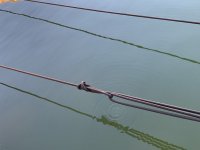
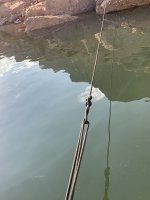
We have an alternative to the ratchet straps, we use a butterfly or alpine butterfly knot that helps significantly in tightening the ropes. I made a couple of very amateur videos showing how to set it up, but can't figure out how to post. if you're interested PM me and I will email them to you
Ok, created what I think will work as a shared photo album with the videos of the butterfly knot and how we use them - Remember AMATEUR photographers here


- Status
- Not open for further replies.