Paladin
Well-Known Member
Enough with the Launch Porn.
I have Ramp Envy.

Enough with the Launch Porn.
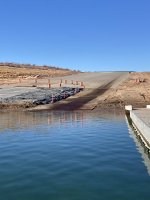
The LPWD shows about 3,490' from October, 1964 until May, 1965, when it started a rise to 3,545' by June, 1966, before dropping to 3,511' in Jun, 1967. The geometry of the whale to the right of the launch ramp matches a water level of about 3,490'. There is no bathtub ring visible, which rules out any time after May, 1965. The vegetation has a "fall" look to it, and there is no snow on Navajo Mountain, but still quite a few visitors on the lake, which leads me to guess October.LPWD says Oct 1964 was 3491....the entire month....not even moving by more than 1/2 foot. They must have done that for the generators??

Yup, a very reasonable synopsis.The LPWD shows about 3,490' from October, 1964 until May, 1965, when it started a rise to 3,545' by June, 1966, before dropping to 3,511' in Jun, 1967. The geometry of the whale to the right of the launch ramp matches a water level of about 3,490'. There is no bathtub ring visible, which rules out any time after May, 1965. The vegetation has a "fall" look to it, and there is no snow on Navajo Mountain, but still quite a few visitors on the lake, which leads me to guess October.
They filled the lake pretty quickly to 3,490' so they could run water through the generators instead of the outlet works, but Lake Mead had gone down to the 1,090' range by that time, and they were probably trying to balance filling Powell and maintaining Mead.


There is so much redundancy built into the grid that it is unlikely there will be any appreciable power availability impact from a loss of generation at Glen Canyon. The impact will be in the pocket book, however. Power from Powell is for all intents free or extremely low cost since the cost of the Dam is not part of the cost of generation. The power companies that have subscribed to the Glen Canyon power generation station will have to replace that power with more expensive alternatives.Intakes are at 3490 and they would suck in so much air (picture giant vortex) that turbines would burn out. That’s why we talk so much about 3520 to give a 30 foot buffer. Can you imagine the infrastructure cascade effect if LP electrical generation were to fail (or even go down by 50%)? Phoenix in summer becomes uninhabitable.

The best explanation that I have seen on 3,525' and 3,490' was in an article in the Salt Lake Tribune on July 19, 2021:Yup, a very reasonable synopsis.
So at 3490 they still run the generators, just not so fast as to create the dreaded 'vortex'? So they still produce power, just not as much?
Which leads us back to Phx and Vegas in the summer...which has a few more peeps than in 1964....
most of us, when we flip a light switch, have no idea of the complexities involved with AC current, which cannot be stored.
Hats off to the folks in the industry who for the most part keep our electricity flowing 24/7
More power to 'em....
 Hmmmmm.....
Got it. Thanks for taking the time to inform this old dummy.Basically, Stateline Auxiliary is easy to extend, none of the other ones are. The Stateline Auxiliary (Gustaveson) ramp was originally built in the sixties for lake access as it was filling, so the grade is already there, and permitting was simple because they were rehabilitating an existing ramp. The main and spur ramps at Bullfrog don't have enough gradient for launching, the north/exec ramp at Bullfrog is too steep beyond the end and requires a bit of earthmoving, and Halls ends in a steep cliff. Bullfrog Exec has been mentioned for extension to be done by late spring.

Time will tell, but I agree with you 100%. I was also surprised to see no mention of the North End issues. We need to get vocal with our concerns, for what ever good it will do. SqThey don’t give a crap about Bullfrog obviously
Just sayin'.......Time will tell, but I agree with you 100%. I was also surprised to see no mention of the North End issues. We need to get vocal with our concerns, for what ever good it will do. Sq