
You are using an out of date browser. It may not display this or other websites correctly.
You should upgrade or use an alternative browser.
You should upgrade or use an alternative browser.
Lake Powell - Photos from the Early Years
- Thread starter JFRCalifornia
- Start date

Rainbowbridge
Keeper of San Juan Secrets
You are correct.....but $3.55 isn't what Aramark is charging last I heard...$0.29 in 1958 is about the same as $3.25 today. Not that much less than the average Arizona gas price of $3.55.

Also, you bring up a juicy topic regarding 'inflation' and WHY & HOW does .29 turn into $3.25.....in only 65 years?

I'll get scolded for broaching that here.....but just ask yourself: Why was there hardly any inflation from 1776 to 1913...then the (not so) federal reserve took control of our sovereign country?

RichieW13
Well-Known Member
But $0.29 wasn't the price of fuel on the lake in 1958.You are correct.....but $3.55 isn't what Aramark is charging last I heard...

JFRCalifornia
Keeper of San Juan Secrets
A bit off-topic, but I’ll address the point. The 18th and 19th century weren’t inflation-free. Rather, prices experienced periods of both high inflation and significant deflation, which more or less averaged out over time. There were also significant price fluctuations due to things like war, changing technologies, and shifts in the supply and demand of gold and silver. It was a very volatile economic period.I'll get scolded for broaching that here.....but just ask yourself: Why was there hardly any inflation from 1776 to 1913...
During the 1849 Gold Rush, miners were charged $1 per egg in gold dust. That's about $40 in today's money.
Now back to our regularly scheduled programming.
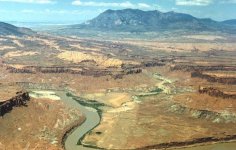
Here's a 1961 aerial over the mouth of Trachyte Canyon looking west, with the Henrys in the background. The flat area is the original location of Hite, and the ferry is at the bend in the river, right at the bottom of the photo.
Last edited:
JFRCalifornia
Keeper of San Juan Secrets
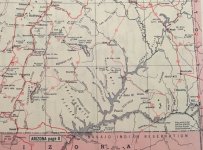
...and building on the previous 1961 image of the original location of Hite, here's an excerpt from an early 1960s road atlas showing Lake Powell as if it were full, but referred to as "John W. Powell Res." Pay careful attention to Highway 95, where it still shows its original alignment near Hite, which is to say it runs south along the west side of the river from North Wash to make a ferry crossing at Hite toward White Canyon, where the road continues up White/Farley to the east. The big bridges over the Dirty Devil and Colorado River are not there yet... By my reckoning, this puts the map in the pre-1965 range...
Last edited:

dallas massie
Escalante-Class Member
Fort Moki just around the corner in White?A bit off-topic, but I’ll address the point. The 18th and 19th century weren’t inflation-free. Rather, prices experienced periods of both high inflation and significant deflation, which more or less averaged out over time. There were also significant price fluctuations due to things like war, changing technologies, and shifts in the supply and demand of gold and silver. It was a very volatile economic period.
During the 1849 Gold Rush, miners were charged $1 per egg in gold dust. That's about $40 in today's money.
Now back to our regularly scheduled programming.
Here's a 1961 aerial over the mouth of Trachyte Canyon looking west, with the Henrys in the background. The flat area is the original location of Hite, and the ferry is at the bend in the river, right at the bottom of the photo.
View attachment 34006
JFRCalifornia
Keeper of San Juan Secrets
Yep… just off the edge of the photo…Fort Moki just around the corner in White?
JFRCalifornia
Keeper of San Juan Secrets
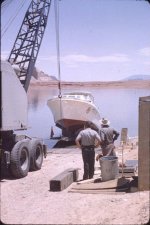
Art Greene supervises the launch of a new tour boat on Lake Powell in 1964...
JFRCalifornia
Keeper of San Juan Secrets
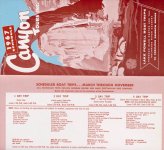
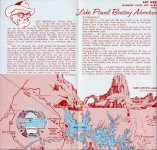
Here's a portion of a very interesting brochure of the boat tours offered in 1967 by Art Greene. A hundred bucks for a 3-day trip sounds pretty good, although its the equivalent of about $1000 today... Interesting that he says they'll visit Gregory Bridge "unless inundated"... as it turns out, they were in the clear for 1967. Gregory Bridge did not disappear completely until April 1969...
Rainbowbridge
Keeper of San Juan Secrets
That, as all the goodies you post...is SO KOOL! I assume they pitched tents? and there's no mention of food....any thoughts on that? Did Mrs. Greene do the cooking?Here's a portion of a very interesting brochure of the boat tours offered in 1967 by Art Greene. A hundred bucks for a 3-day trip sounds pretty good, although its the equivalent of about $1000 today... Interesting that he says they'll visit Gregory Bridge "unless inundated"... as it turns out, they were in the clear for 1967. Gregory Bridge did not disappear completely until April 1969...
View attachment 34023

JFRCalifornia
Keeper of San Juan Secrets
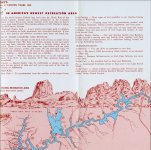
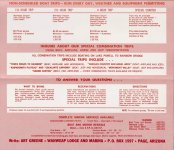
Well, that piece of the brochure raises a lot of good questions about camping, cooking, logistics, etc. All these questions are answered in the rest of the brochure, which I'm attaching.Sounds to me as if they're departing every morning and returning in the evenings.
Cool pics JFR!
1. Camping. They definitely camped on multi-day trips. See the section on "What to Bring." They don't say anything about tents, but they did furnish "bedrolls". It also says they furnish "food", but doesn't say what that means. Could be PB&J on Wonder bread for all I know. Sounds like you're mostly on your own.
2. Reservations. You get a full refund if you cancel more than 15 days in advance. Kids under 12 are a third off if accompanied by parents. Was it full price for a kid if they went on their own?
3. Trip frequency. Those trips were going all the time, all over the place! How many boats were in Greene's fleet?
4. Special Trips. The "Three Roads to Rainbow" trip is particularly intriguing. They'd been doing this one for a long time, because that trip was featured prominently in an April 1957 issue of National Geographic.
5. Fishing. He notes that at least in 1967, Kokanee salmon were apparently plentiful in Lake Powell. He also mentions trout fishing more than once.
6. Map features. His map shows a graded landing strip near the top of Hole in the Rock! Is it still there? Anasazi Canyon was still called Mystery Canyon on his map. And Iceberg Canyon is still shown as "Wilson Canyon."
7. Boat rentals. The biggest rental houseboat was 36 feet. The smallest was 28 feet (!). Definitely no modern behemoths or beach bags needed then...

Gem Morris
Keeper of San Juan Secrets
Kokanee huh? Never knew that. Where’s Wayne when you need him?

Rivergoer
Keeper of San Juan Secrets
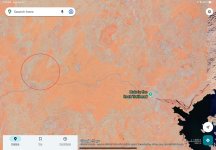
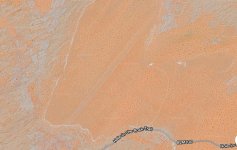
Could this be the remnants of the graded landing strip? Approx 1-2 miles from HITR, looks like an old access road from the strip to HITR road.Well, that piece of the brochure raises a lot of good questions about camping, cooking, logistics, etc. All these questions are answered in the rest of the brochure, which I'm attaching.
6. Map features. His map shows a graded landing strip near the top of Hole in the Rock! Is it still there?
Gem Morris
Keeper of San Juan Secrets
Good find! Likely possibility.Could this be the remnants of the graded landing strip? Approx 1-2 miles from HITR, looks like an old access road from the strip to HITR road.
View attachment 34027
View attachment 34029
On a related note, a recent court ruling in Utah turned over responsibility of maintaining the hole in the rock Road to the county as opposed to the federal government. The thinking is that it’ll be much more useable going forward. I’ve been down it three times in my life. One of the worst washboard roads I’ve ever been on for 50 miles?
And as a sidenote to my sidenote, along this road is where the second most deadly automobile accident in the history of Utah happened

nzaugg
Keeper of San Juan Secrets
The county really wants to pave it. We'll see if they get their way.Good find! Likely possibility.
On a related note, a recent court ruling in Utah turned over responsibility of maintaining the hole in the rock Road to the county as opposed to the federal government. The thinking is that it’ll be much more useable going forward. I’ve been down it three times in my life. One of the worst washboard roads I’ve ever been on for 50 miles?
And as a sidenote to my sidenote, along this road is where the second most deadly automobile accident in the history of Utah happened
JFRCalifornia
Keeper of San Juan Secrets
Here's Gregory Bridge in September 1966, when the lake was at about 3530. It's useful from today's perspective, because this is likely the same lake level we'll see in January 2026...
You'll notice there was a bathtub ring even then. That's because the lake topped out at 3545 in June 1966. Using that as a yardstick, you can see that the opening is just under 20 feet high in the center...
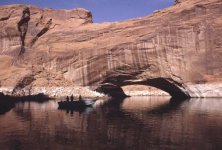
You'll notice there was a bathtub ring even then. That's because the lake topped out at 3545 in June 1966. Using that as a yardstick, you can see that the opening is just under 20 feet high in the center...
Last edited:
RichieW13
Well-Known Member
The second most deadly accident was on a dirt road? What happened? How many people died?And as a sidenote to my sidenote, along this road is where the second most deadly automobile accident in the history of Utah happened
Gem Morris
Keeper of San Juan Secrets
Years ago before the dam was built there used to be an organization that would haul people on that road so they could run the river. I think they would put in at hole in the rock and take out at Lee’s ferry, but I’m not 100% sure? They had an old truck or tractor that would haul an open trailer full of people. Going up a steep grade the driver felt he needed to downshift and put in the clutch and attempted to downshift and missed, and the tractor gained momentum going backwards. The trailer was so heavy compared to the tow rig that there is no way the brakes of the tow rig could hold it from going back. Eventually, the entire rig overturned killing something around 10?
There is a monument on the side of the road at the site of the accident.
There is a monument on the side of the road at the site of the accident.