Dock swimming - electrocution

Status
Not open for further replies.
What about running a Honda 1000 on shore to power on board battery charger would it be safer with generator onboard?
Yes it would. However, if you are running an extension cord to the the battery charger from the generator, just be sure that extension cord is not in the water and you will be fine.
 
Yes it would. However, if you are running an extension cord to the the battery charger from the generator, just be sure that extension cord is not in the water and you will be fine.
Is the only risk the extension cord being in the water with generator on shore? Or are there other factors involved thanks for the input just want to be as safe as possible 👍
 
Is the only risk the extension cord being in the water with generator on shore? Or are there other factors involved thanks for the input just want to be as safe as possible 👍
As long as you are not plugging it into the boat, and only the appliances, you will be fine. This will isolate the power between the generator and the device.
 
I spoke with the maintenance tech on the Bullfrog dock when he was troubleshooting the wiring to the panel supplying our HB.
He found the hot and neutral legs were tied together on the hot line underneath the dock. o_O
He said the wiring on the docks hasn’t been updated for at least 30 years. And they change head electrician every year and the latest one is not marine certified.
All that being said, keep yourselves out of the water around the docks to avoid the shocks.
If one looks at the official electrical inspection most is redacted
 
Just got back and the lake was HOT this last couple weeks!

While at the dock I relayed the issue to several house boaters that were swimming off the back. Some took the warning well and even asked what they could do and checked out the ELCI I had installed. However there were more that just did not care and said "if it was that big of a deal, they would enforce this rule"...
 
Many years ago I learned the following from an IAEI (International Association of Electrical Inspectors) publication. The effect of very small amount of electrical current on the body: from 9 to 25 milliamps (thousands of an amp) involuntary muscle control results meaning you could not move a muscle to get out of the trouble you are in. 20 or more milliamps produces direct paralysis of the respiratory system; you stop breathing. 75 milliamps produces ventricular fibrillation; the heart flutters but does not pump blood. Only 4 amps produces immediate cardiac arrest. So as little as 20/1,000 amp can produce near instantaneous fatality.

In my real world experience, it does not take much for electricity to leak; for instance, a damp extension cord connector leaking 1/2V to ground kept milk cows from moving past one point in a barn. A faulty water heater element leaked current to ground through the water pipe, not enough current to trip the breaker but enough to electrocute the owner when he opened a connection in the pipe, with one hand on each side of the connection, he became the conductor. (He could have quickly died had it not been for an electrician friend standing by who knew what to do without also becoming part of the circuit.
 
Tom,

You forgot to mention the voltage and if AC or DC. Note that at much higher frequency (AC) you could withstand much higher voltage :)
 
All numbers are based on 120V AC, the most lethal voltage based on number of deaths. I don't know how many times I've heard "It's only 120 volts!"
 
All numbers are based on 120V AC, the most lethal voltage based on number of deaths. I don't know how many times I've heard "It's only 120 volts!"
I was in the electrical business for 49 years and when my experienced electricians were shocked it was usually 120 volts. They always let their guard down.
 
We were at the Wahweap marina last weekend and there are still many people swimming behind their boats. It looks like there are some new signs warning of electrocution as you walk onto the docks.
One particular group of about 10 kids had one of those large floating mats out that literally blocks half of the fairway to get out of your slip. Besides the obvious electrocution danger, they present a navigation hazard when leaving or returning to the slip.
They were diving (jumping) from the top deck of their houseboat, most without life jackets, and just to top it off they were shooting off fireworks at the same time.
My question? Where is the enforcement of the rules? Are they really that short staffed that the marina can't be patrolled for violations?
It's too bad that things have gotten to the point that you can't jump off the back of your boat to cool off, but when a few ruin it for everyone and the marina turns a blind eye to electrical dangers, its going to take a tragedy for something to be done about it.
 
A couple of items. First the shock. Electric Shock Drowning (ESD) works by causing uncontrollable muscle contraction. You will lose control, can't swim and your diaphragm will cease to move. If in the water and you feel a tingling, you need to move back to where you came from. Make a very wide loop and exit the water well away from where you felt the sensation. If someone is in the water and exhibits an inability to speak or swim DO NOT JUMP IN or REACH in to assist. You will only become part of the problem. It is sad to say but the only chance you have to help is with a long insulated pole.

Second. The isolation transformer discussed above will not resolve the issue. Almost all transformers are "isolation transformers" but have one conductor grounded, usually the grounded conductor (normally referred to as a neutral depending on the system it is used on). Two exceptions, auto transformers and ungrounded transformers (ungrounded systems). Many of the new Tesla systems are using auto transformers and European equipment is often supplied with these units as they are far less expensive. I believe the posts above are referring to an ungrounded transformer or system such as is used in Europe. You see these here in the US in hospital operating rooms and in industrial process where assured power are critical and where the systems constantly monitored and maintained by personnel specially trained on the use of this equipment. These systems will not prevent shock. When one of these systems shorts out, it becomes a grounded system. If the ungrounded system is not maintained or does not have ground detection, it will be impossible to know if it has one of the system conductors that has grounded and will act, for all intents and purposes, like a grounded system. These systems can be safer if installed properly, maintained properly and are properly monitored. Unfortunately, this is far from the case as the vast amount of tradesmen and engineers are not familiar with these systems and far fewer understand how they function.

Anyway, a good article on ESD can be found here: StackPath. You will have to create an account and log in but it is an interesting read. Full disclosure, I have no affiliation with the EC&M magazine.
 
Last edited:

So why does every major safety article on this subject suggest the use of an isolation transformer? From my understanding if the IT is on your boat, then any stray current that may exist due to faulty wiring or device will not enter the water, but return to the IT.

Not looking to argue, we all just want to know more about this subject.
 
I did a brief read of the manufacturer's information. These are isolated systems, not ungrounded systems. They work just as any transformer does, through magnetizing an iron core. That core, when magnetized, then creates current flow on the secondary side of the transformer. There is no direct current carrying connection from the primary to the secondary side. Once the new separately derived system is created, it is again grounded (neutral to ground or earth) on the secondary side.

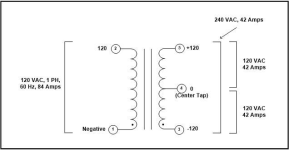
Below is a diagram of how this will look. The primary side (left side of the two vertical bars in the center) would be the shore power. The windings on the right, the secondary side, represent the new isolated system. These are isolated as there is no direct electrical (not grounding) connection between the primary or secondary side. Then, once the system is derived on the secondary side a new ground is established between the center tap and any non-current carrying part on the boat through what is called a system bonding jumper (formerly called a main bonding jumper). This jumper is one of the most critical elements of an electrical system. The removal of this device creates not only a significant shock and fire hazard, it allows the new derived system voltage to fluctuate which can burn out electronics.

In looking at the box around the diagram, envision this is the case of the transformer. The case is connected to the shore power grounding system. The center tap is also connected to the case through the system bonding jumper. The grounding system is connected together, along with equipment cases, conduits, and the grounding electrode system. The goal is to create a single plane of voltage or in other words, to eliminate the difference of potential between any two exposed metal parts. By eliminating potential, you cannot be shocked. Think of a bird on an electrical wire. The utility wires are not insulated and birds are always on these energized wires. They are fine as they are at the same electrical potential as the wire. The danger comes when the bird's wings touch two wires at the same time. This establishes a path between the conductors and the system attempts to equalize the voltage potential through the birds wings and electrocutes the bird. The same thing happens in the water. For more information on this, read the ESD article I referenced above.

1599228122115.png
 

So why does every major safety article on this subject suggest the use of an isolation transformer? From my understanding if the IT is on your boat, then any stray current that may exist due to faulty wiring or device will not enter the water, but return to the IT.

Not looking to argue, we all just want to know more about this subject.

And you are correct, the current will return to the isolation transformer to complete the circuit and allow the actuation of an overcurrent device. It does this through the grounding system and the system bonding jumper. As there is no direct electrical connection to the shore power, and current can not flow beyond the transformer as it cannot complete a circuit but it will continue to try as long as there is a path. This is why grounding is imperative.

Remember the old saying, electricity takes the least path of resistance to ground? That is WRONG! It takes ALL paths available to it to ground. The amount of current flowing on each path will vary depending on the resistance of each path. A great way to illustrate this is with your home. On a windy day you open a window on your home. If only one window in the home is open, only a little air movement will be felt through the window. This is because a home is not absolutely tight, some air movement will be through gaps around doors and bathroom exhaust vents. Now if you open a window on the other side of the house, you get a lot of air movement. Now, open a third smaller window somewhere else in the house. You will still see air movement through the original window and a smaller amount of air movement through the third because the smaller window has more resistance but, it still allows air movement. Electrical current flow acts exactly the same way. It will take all paths available to it back to the source.
 
Why wouldn't ground fault interrupters at each slip pedestal eliminate stray voltage? The isolation transformer would eliminate the effectiveness of the GFCI.
 
Status
Not open for further replies.
Back
Top