
You are using an out of date browser. It may not display this or other websites correctly.
You should upgrade or use an alternative browser.
You should upgrade or use an alternative browser.
Boat question
- Thread starter Crjmech
- Start date
- Status
- Not open for further replies.

Dungee
Keeper of San Juan Secrets
Not trying to nit-pick, but you are only down a little over 9% in HP at Powell - you lose 3% for every 1000’ in elevation.
coming from Colorado, I always have thought of Powellas a low elevation lake.....
Same, try going to Strawberry where its almost 8k... lol

Ryan
Keeper of San Juan Secrets
Sounds like you are way more educated on this than I am.Try again-
Its not physical altitude but DENSITY ALTITUDE that counts in that computation. Call up the airport weather service for Page airport and get the DENSITY ALTITUDE read out for the day and then figure your 3% per 1000' Most days in the summer are 7500 feet for density altitude.
We have to figure that in for every takeoff at high altitude airports. Temperature affects the density of the air making it "thinner" than what the physical altitude would lead one to believe.
7500 feet of density altitude equates to about 3/4 of your rated horsepower. A 200 HP airplane engine makes 150 HP at 7500 feet. Basic pilot stuff.
The 3% only works on physical altitude if it is a "Standard Day" and that means the temperature drops with altitude. Here in the summer the temp never gets down to Standard Day Temperature
This is what kills a lot of pilots from the low altitude airports going to a high and hot airport for the first time.
Everything I’ve ever read says 3% /1000’. So what you’re saying is that the temp is much more important than the altitude? Which would also be hard for me to believe as every boat I have ever taken to Powell runs the same in July as it does in April or October.
Understanding density altitude
With Embry-Riddle Aeronautical University, helicopter training provider Guidance Aviation, the North-Aire flight school, and other training providers, Ernest A. Love Field in Prescott, Arizona, is a hotbed of training activity. How do flight schools at the high-desert airport—elevation 5,044...
www.aopa.org
Эпикстар казино - вход и регистрация на официальном сайте EpicStar
EpicStar казино - Быстрая регистрация, эксклюзивные условия и щедрые бонусы! Регистрируйтесь в ЭпикСтар прямо сейчас!
here's 2 articles that explain the connection with loss of HP due to temp and elevation (density altitude)
In the second one draw a line between 4300 feet (lake elevation) and 100 degrees on the left and see how much takeoff distance and climb rate are affected by that, that means loss of HP due to density altitude.
While it is 3% per 1,000 feet it has to do with what the DENSITY altitude of the air is and not elevation above sea level (its also a SWAG and not perfectly accurate).
Same with your non-turbo'd car at any high altitude, It reacts to density altitude of the air and not the elevation sign you just passed. The elevation has nothing to do with what the engine is breathing, only density altitude does.
Last edited:

sherman mconell
Active Member
if you will max out the hp that the boat will take and run a two stroke e teck you will get the max from your boat being able to stay on plain and not doing it at full throtle will save u fuel every pound u add drops preformance and fuel mileage

Edward Gerdemann
Well-Known Member
This might not be right place for this but...I’m sure there’s a few guys in my my situation. I got a free boat from a buddy of mine last year. It’s a 16’ tracker pro guide with a 50hp Mercury 2stroke. I tried talking him into the 75 when he bought it new but he decided to save the money and go with the 50. Im not going to complain about a free boat but as you can imagine, it’s rather under powered. I really don’t mind the boat. It handles big water pretty well. I’ve got 2 props for it and neither make much difference. I’m considering repowering. 2options im looking at. Either a new 75hp 4 stroke or a used reman 75 2 stroke like an optimax. I’m wondering what to realistically expect on top end speed going from the 50 to a 75. I get 26mph on a good day now. Anyone in a similar situation with real input? I’m leaning towards an optimax due to weight and price.
Get the 4-stroke. You'll never regret it. The new ones are better than ever.

Ed Gerdemann

Crjmech
Member
Ed, I have no doubt the new 4s are really the way to go. The 4s are way quiet for sure. But they’re still quite heavy and quite expensive lol. I feel like I could never really get enough money back in resale with an $8000 motor on the back of a $3000 boat. After all the input, I’ll just Try to make sure this one is jetted right and see if I can’t just get a new rig in a year or so. If I took the 4K I think I can get for this boat with the 4-5k a good used optimax would cost me, I’d have a good chunk towards a gently used bigger more power boat.Get the 4-stroke. You'll never regret it. The new ones are better than ever.
Ed Gerdemann
My oldest son has the exact same boat - 16 foot tracker with a mercury 50 HP 2 stroke. The boat had come from Denver originally and was jetted for 6000 feet elevation. He too was looking at putting a bigger motor on it to get more speed. After looking at all the options, and cost, he re jetted it and got a 4 blade prop. Now the boat loaded my his family and camping gear will go 24 - 25 MPH. Just him at will go 28 - 29. He said that the 4 blade prop did not add put maybe 1 MPH difference, but added a lot more low end power to get on plane much quicker and that it pulls a big load like camping gear or someone on a tube much better. Best thing about that motor is the gas low rate of gas consumption, best we can tell it gets around 12 MPG.
Ryan
Keeper of San Juan Secrets
Since the OP seems to have come to a conclusion, I'd like to learn a little more about this. Because I still don't understand what you are saying or what the "interactive aviation koch chart" shows.Understanding density altitude
With Embry-Riddle Aeronautical University, helicopter training provider Guidance Aviation, the North-Aire flight school, and other training providers, Ernest A. Love Field in Prescott, Arizona, is a hotbed of training activity. How do flight schools at the high-desert airport—elevation 5,044...www.aopa.org

Эпикстар казино - вход и регистрация на официальном сайте EpicStar
EpicStar казино - Быстрая регистрация, эксклюзивные условия и щедрые бонусы! Регистрируйтесь в ЭпикСтар прямо сейчас!www.takeofflanding.com
here's 2 articles that explain the connection with loss of HP due to temp and elevation (density altitude)
In the second one draw a line between 4300 feet (lake elevation) and 100 degrees on the left and see how much takeoff distance and climb rate are affected by that, that means loss of HP due to density altitude.
While it is 3% per 1,000 feet it has to do with what the DENSITY altitude of the air is and not elevation above sea level (its also a SWAG and not perfectly accurate).
Same with your non-turbo'd car at any high altitude, It reacts to density altitude of the air and not the elevation sign you just passed. The elevation has nothing to do with what the engine is breathing, only density altitude does.
If I put in a elevation of 3500', and a temp of 100* (typical Powell), it shows you need a runway of 1470'.
If I put in an elevation of 8000', and a temp of 60* (mountain lake in Utah or Colorado), the runway would only need to be 950'.
So, is that saying that an engine would perform better at a mountain lake like Strawberry, Blue Mesa, or the like than it would at Lake Powell? Because that is not my experience.
This info is what I mentioned in my earlier post (although my quoted number was 3% per 1000'). This is from the article you linked.
Another rule of thumb: A normally aspirated aircraft engine will lose approximately 3.5 percent of its horsepower for every 1,000-foot increase in density altitude. So at a density altitude of 7,000 feet, 25 percent of engine power has vanished.
Enter KPGA in the "load conditions" box and it will draw the line for the current airport conditions (temp) in the chart on the right. You can then drag the left side "airport temperature" up to 100 degrees F (change C to F) and then see how much (as a percentage) you would need to add to your "normal take off distance" at sea level and standard day conditions (sea level, 59 degrees) in the middle of the chart.
The numbers on the left side denote what you would need at those conditions compared to your normal take off distance.
Page airport is 4206 feet above sea level and at 100 degrees F the chart says that at those conditions if your normal sea level take off distance is 970 feet then you would need 2201 feet for a runway at Page in the summer at 100 degrees. This is just to show you how much a difference temp makes.
One needs to use the percentages in the center of the chart on the right and compute for themselves just what runway is required for their own airplane. If the normal take off distance at sea level is 800 feet then one would add 800 and 1280 (126% of 800) together and get 2080 feet required for takeoff at Page at 100 degrees.
Your rate of climb would decrease by 63% If your normal R of C is 1,000 feet per minute then you would only see 37% of that on takeoff in Page (370 feet per minute)
It really shows you how much horsepower you lose at Page in the summer compared to a sea level lake and cooler conditions.
On an average 100 degree day in Page the density altitude is around 7600 feet. Therefore you are working on 75% of your rated motors horsepower. 200 HP rating is only producing 150 HP that day at Page. 50 HP equals 37.5 HP!
The numbers on the left side denote what you would need at those conditions compared to your normal take off distance.
Page airport is 4206 feet above sea level and at 100 degrees F the chart says that at those conditions if your normal sea level take off distance is 970 feet then you would need 2201 feet for a runway at Page in the summer at 100 degrees. This is just to show you how much a difference temp makes.
One needs to use the percentages in the center of the chart on the right and compute for themselves just what runway is required for their own airplane. If the normal take off distance at sea level is 800 feet then one would add 800 and 1280 (126% of 800) together and get 2080 feet required for takeoff at Page at 100 degrees.
Your rate of climb would decrease by 63% If your normal R of C is 1,000 feet per minute then you would only see 37% of that on takeoff in Page (370 feet per minute)
It really shows you how much horsepower you lose at Page in the summer compared to a sea level lake and cooler conditions.
On an average 100 degree day in Page the density altitude is around 7600 feet. Therefore you are working on 75% of your rated motors horsepower. 200 HP rating is only producing 150 HP that day at Page. 50 HP equals 37.5 HP!
Last edited:
Ryan
Keeper of San Juan Secrets
So why would a boat engine run better/have more power at 100* at Lake Powell than it would at 65* at a lake that is 8000'? Am I reading your linked chart wrong, because that is what it makes it look like?Enter KPGA in the "load conditions" box and it will draw the line for the current airport conditions (temp) in the chart on the right. You can then drag the left side "airport temperature" up to 100 degrees F (change C to F) and then see how much (as a percentage) you would need to add to your "normal take off distance" at sea level and standard day conditions (sea level, 59 degrees) in the middle of the chart.
The numbers on the left side denote what you would need at those conditions compared to your normal take off distance.
Page airport is 4206 feet above sea level and at 100 degrees F the chart says that at those conditions if your normal sea level take off distance is 970 feet then you would need 2201 feet for a runway at Page in the summer at 100 degrees. This is just to show you how much a difference temp makes.
One needs to use the percentages in the center of the chart on the right and compute for themselves just what runway is required for their own airplane. If the normal take off distance at sea level is 800 feet then one would add 800 and 1280 (126% of 800) together and get 2080 feet required for takeoff at Page at 100 degrees.
Your rate of climb would decrease by 63% If your normal R of C is 1,000 feet per minute then you would only see 37% of that on takeoff in Page (370 feet per minute)
It really shows you how much horsepower you lose at Page in the summer compared to a sea level lake and cooler conditions.
On an average 100 degree day in Page the density altitude is around 7600 feet. Therefore you are working on 75% of your rated motors horsepower. 200 HP rating is only producing 150 HP that day at Page. 50 HP equals 37.5 HP!
You are correct. It will have more power at Powell than 8000 feet up at a lower temp.
Density altitude at Page at 100 degrees is equivalent 7587 feet above sea level
At 8,000 feet and 65 degrees the density altitude is 10,110 feet above sea level.
You lose 85% of your climb at 8000' and "only" 63% at 4206 Lots less HP at 8000' and 65 degrees
The engine will "seem" more powerful at Page at 100 degrees than 8000' at 65 degrees because of the lower density altitude that the engine is sucking in (more oxygen).
That's also why it has to be rejetted (for less fuel) as you go to a way higher altitude so that there is the correct amount of fuel going into the cylinders to be used by the lower oxygen content air going in.
In the 'old days" of carburetors on cars they would always run bad at high altitudes because the fuel/air ratio was way too rich as you went higher, If you never drove a car with a carb you will have no idea of the effect of altitude as fuel injection "leans' out the fuel to the engine as it goes higher.
Density altitude at Page at 100 degrees is equivalent 7587 feet above sea level
At 8,000 feet and 65 degrees the density altitude is 10,110 feet above sea level.
You lose 85% of your climb at 8000' and "only" 63% at 4206 Lots less HP at 8000' and 65 degrees
The engine will "seem" more powerful at Page at 100 degrees than 8000' at 65 degrees because of the lower density altitude that the engine is sucking in (more oxygen).
That's also why it has to be rejetted (for less fuel) as you go to a way higher altitude so that there is the correct amount of fuel going into the cylinders to be used by the lower oxygen content air going in.
In the 'old days" of carburetors on cars they would always run bad at high altitudes because the fuel/air ratio was way too rich as you went higher, If you never drove a car with a carb you will have no idea of the effect of altitude as fuel injection "leans' out the fuel to the engine as it goes higher.
Last edited:

lakepowellnut
Well-Known Member
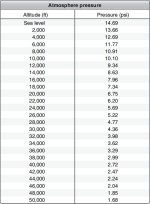
Density is directly related to air pressure. Less air pressure affects carburetor performance. The following chart shows how elevation affects pressure.

Bill Sampson
Keeper of San Juan Secrets
I am dealing with the above situation right now. My 1969 Camarpo (carbureted) was tuned for 30 feet elevation where I lived. I now have moved to 5,280 feet, and have re-jetted the carburetor, and am still dealing with some tuning issues. I will figure these out.You are correct. It will have more power at Powell than 8000 feet up at a lower temp.
Density altitude at Page at 100 degrees is equivalent 7587 feet above sea level
At 8,000 feet and 65 degrees the density altitude is 10,110 feet above sea level.
You lose 85% of your climb at 8000' and "only" 63% at 4206 Lots less HP at 8000' and 65 degrees
The engine will "seem" more powerful at Page at 100 degrees than 8000' at 65 degrees because of the lower density altitude that the engine is sucking in (more oxygen).
That's also why it has to be rejetted (for less fuel) as you go to a way higher altitude so that there is the correct amount of fuel going into the cylinders to be used by the lower oxygen content air going in.
In the 'old days" of carburetors on cars they would always run bad at high altitudes because the fuel/air ratio was way too rich as you went higher, If you never drove a car with a carb you will have no idea of the effect of altitude as fuel injection "leans' out the fuel to the engine as it goes higher.

Dorado
Keeper of San Juan Secrets
I have a 2 stroke, carbureted 90hp with oil injection and 17' Crestliner. I live at 7200' and most of the lakes I usually use my boat on are 7500-8000'. I do not rejet, but I have 3 seperate props--15"-17"-19". I can get almost 40 mph at Powell with the 19", but usually run the 17" because my boat is usually so loaded down with supplies and camping gear . Sounds to me like a used 75 would be the way to go....
. Sounds to me like a used 75 would be the way to go....
Crjmech
Member
The original jets should be good to about 2500’. You might try 2 sizes down for altitude. The one nice thing about a 2stroke is, no valves or anything to worry about but too lean will be bad for pistons. Each jet size should be in the ball park for every 2000’.I am dealing with the above situation right now. My 1969 Camarpo (carbureted) was tuned for 30 feet elevation where I lived. I now have moved to 5,280 feet, and have re-jetted the carburetor, and am still dealing with some tuning issues. I will figure these out.

linnell
Well-Known Member
Camaro?I am dealing with the above situation right now. My 1969 Camarpo (carbureted) was tuned for 30 feet elevation where I lived. I now have moved to 5,280 feet, and have re-jetted the carburetor, and am still dealing with some tuning issues. I will figure these out.
Crjmech
Member
I’m really leaning that way! The optimax is fuel injected so I’d never think about jetting again. I’d be ecstatic with 40mph out of this boat. I’m hoping for 35 realistically with the repower.I have a 2 stroke, carbureted 90hp with oil injection and 17' Crestliner. I live at 7200' and most of the lakes I usually use my boat on are 7500-8000'. I do not rejet, but I have 3 seperate props--15"-17"-19". I can get almost 40 mph at Powell with the 19", but usually run the 17" because my boat is usually so loaded down with supplies and camping gear
- Status
- Not open for further replies.