Uranium Mine East of Good Hope Bay

Status
Not open for further replies.
if there's any radiation danger present?
No radiation danger, even the highest grade of ore requires a lot of refining to get to something useful. Red Mesa Mill(outside Blanding) is one of the only uranium mills in operation in the US. The Navajo tribe has been accusing the dust from the mill for causing cancer in the area, but I haven't seen any studies that show an increased cancer risk locally. My dad worked the mines/mills from the late 50's to the late 70's(when they bought our dryland farm) with very little PPE. He will be 86 in March and is still very healthy/active for his age, though he did refuse to go ice fishing with us a couple weeks ago. That may have just been his wisdom, because we got skunked on Miramonte.
 
Last edited:
No radiation danger, even the highest grade of ore requires a lot of refining to get to something useful. Red Mesa Mill(outside Blanding) is one of the only uranium mills in operation in the US. The Navajo tribe has been accusing the dust from the mill for causing cancer in the area, but I haven't seen any studies that show an increased cancer risk locally. My dad worked the mines/mills from the late 50's to the late 70's(when they bought our dryland farm) with very little PPE. He will be 86 in March and is still very healthy/active for his age, though he did refuse to go ice fishing with us a couple weeks ago. That may have just been his wisdom, because we got skunked on Miramonte.
Miramonte!! Should raise a little this year. Oops just hijacked from GHB to Lonecone…
 
No radiation danger, even the highest grade of ore requires a lot of refining to get to something useful. Red Mesa Mill(outside Blanding) is one of the only uranium mills in operation in the US. The Navajo tribe has been accusing the dust from the mill for causing cancer in the area, but I haven't seen any studies that show an increased cancer risk locally. My dad worked the mines/mills from the late 50's to the late 70's(when they bought our dryland farm) with very little PPE. He will be 86 in March and is still very healthy/active for his age, though he did refuse to go ice fishing with us a couple weeks ago. That may have just been his wisdom, because we got skunked on Miramonte.
I would love to hear some old mining stories love to know who the guy was that cut the road to Hey Joe mine he had a set.
 
Didn't Madam Curie die from uranium exposure? And the cabin where she lived for awhile is on the San Rafael Swell near (north of) Goblin Valley?
 
Didn't Madam Curie die from uranium exposure? And the cabin where she lived for awhile is on the San Rafael Swell near (north of) Goblin Valley?
From nobelprize.org:
"Curie decided to do her thesis on radiation, recently discovered in uranium by Henri Becquerel. She found that an ore containing uranium was far more radioactive than could be explained by its uranium content. This led her and her husband, Pierre, to the discovery of a new element that was 400 times more radioactive than uranium. In 1898 it was added to the Periodic Table as polonium, named after Curie’s birth country."
 
A fair bit of the uranium that Madam Curie worked with came from early prospects in the Bull Canyon area of southwestern Colorado, in the vicinity of the appropriately named Radium Mountain. And yes, she did eventually die from long-term radiation exposure.
I believe it was determined that she most likely died as a result of radiography due to X-rays she help administer for solders during WWI with no shielding for protection. Her body was exhumed in 1995 and the French determined that she could not have perished from radium as she did not ingest it. The fact is she spent a large amount of time around radioactive materials during her life as a scientist so there was plenty of exposure with no monitoring available to measure amounts she was receiving. I work with all these materials as I develop electronic probes used to search and explore for uranium and other radioactive materials. I also utilize other strong radioactive sources in conjunction with various detectors to obtain readings from boreholes drilled at mines for mineral exploration. It is all treated with the utmost respect. I find this post most entertaining.
 
No radiation danger, even the highest grade of ore requires a lot of refining to get to something useful. Red Mesa Mill(outside Blanding) is one of the only uranium mills in operation in the US. The Navajo tribe has been accusing the dust from the mill for causing cancer in the area, but I haven't seen any studies that show an increased cancer risk locally. My dad worked the mines/mills from the late 50's to the late 70's(when they bought our dryland farm) with very little PPE. He will be 86 in March and is still very healthy/active for his age, though he did refuse to go ice fishing with us a couple weeks ago. That may have just been his wisdom, because we got skunked on Miramonte.
You are probably right in that a short exposure to any low-grade radioactive material is a pretty minimal risk for someone exploring an old mine. But lung cancer rates are pretty high for people with long term exposure, primarily through the Radon exposure. Even very low concentrations...
 
I believe it was determined that she most likely died as a result of radiography due to X-rays she help administer for solders during WWI with no shielding for protection. Her body was exhumed in 1995 and the French determined that she could not have perished from radium as she did not ingest it. The fact is she spent a large amount of time around radioactive materials during her life as a scientist so there was plenty of exposure with no monitoring available to measure amounts she was receiving. I work with all these materials as I develop electronic probes used to search and explore for uranium and other radioactive materials. I also utilize other strong radioactive sources in conjunction with various detectors to obtain readings from boreholes drilled at mines for mineral exploration. It is all treated with the utmost respect. I find this post most entertaining.

do you have much to do with mine-water reclaiming groundwater and things like that? i've seen some reports in the past about people who are doing that and it sounded like a great thing for a geologist in the west around a lot of mines to be involved with. :)
 
do you have much to do with mine-water reclaiming groundwater and things like that? i've seen some reports in the past about people who are doing that and it sounded like a great thing for a geologist in the west around a lot of mines to be involved with. :)
I have worked on several mine closure projects. They can be very interesting and introduce a lot of complex problems to solve. The only problem is there is virtually no money to complete that work unless the mine is owned by an entity that is currently in business or if the state or federal government prioritizes closure. When you do get funded by a government entity, they want to cheap out and propose solutions that are as low cost as possible, like constructed wetlands, that have long-term mitigation concerns, under the idea that they can go back for permanent closure later. The only mines that get funded for closure are those that significantly impact downstream water resources.

The State of Utah is in the process of sealing up many abandoned mines with concrete without other mitigation methods. It definitely reduces the fun of exploring, but it is quite a bit safer for those who would go in but don't know what they are doing.
 
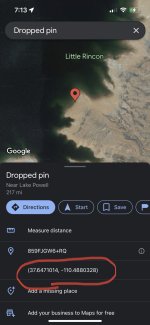
Gem, It’s just a generic lat/long for the East shore of GHB. That's about where I remember trail coming down. I was trying to use that as a starting point. 37°38'51,22N 110°28'50.36 This was about 36 years ago. Sq
 
Ok, try these (circled in red). Drop the parenthesis and the comma - just put a space between the 2 sets of numbers. This is for the SE shore of GHB (as shown in the picture)
 

Attachments

  • A65D185E-EE58-4D4A-BA0B-A39D89EFB1DD.jpeg
    A65D185E-EE58-4D4A-BA0B-A39D89EFB1DD.jpeg
    178 KB · Views: 52
Thanks, I’ll give that a try.
I tried it multiple ways without any positive results. I always end up in China. Thanks for you help, I'll keep slogging thru Google Earth.
Sq
 
Last edited:
Radiation is present in all old uranium mines. If you do not linger too long, the dose is about equivalent to a chest x-ray. Mostly alpha particles.

The biggest hazard is radon gas, which is a byproduct of radioactive decay, and builds up in poorly ventilated spaces underground. The radioactive particles get pulled into your lungs, and can stay there. Over time, that can give you lung cancer, although a single exposure is generally not that hazardous. But if you feel any shortness of breath, leave immediately.

Better yet, unless you really have a compelling reason to go into old uranium mines, it is best to stay out.
Expat is completely correct. Alpha particles won't penetrate your skin, so external exposure is not a risk. But radon inside your body will just sit there and irradiate your lungs, so it's quite dangerous. I wrote my Master's thesis on yellowcake (uranium ore) economics. While in grad school in the late '70s, I had occasion to be at Mineral Bottom on the Green, where a couple of guys were trying to restart a small uranium mine from the '50s. They offered me a tour, explaining that we wouldn't need to wear masks or filters inside the mine because their adit sloped gradually upward as it went into the cliff, so all the radon would flow out naturally! True, in principle, so I went ahead, but only spent about 10 minutes inside. No cancer yet! Of course those guys were inside all the time, and nonlaminar airflow means some of that radon was being circulated up to their head level and not flowing quietly along the bottom of the adit, so I can't vouch for their health.
 
Status
Not open for further replies.
Back
Top