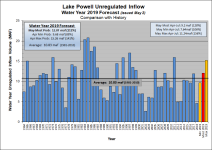
This year is shaping up, water wise, very similar to 2011

Status
Not open for further replies.
Well I'm not entirely sure I can interpret this data correctly either, but it's very cool stuff for sure! The way I read it, there's a 50% probability that total accumulated streamflow will end up exceeding 9.2 MAF, whereas normal by August is 7.2 MAF... and that total accumulated so far is at about 2.85 MAF, which is on track to be normal... however, jump back to the 2011 data and you'll see what happened that year--it went off the charts after being "normal until the end of May, and in mid-June and was at 11.5 MAF accumulation in mid-July, compared to expected normal of 6.8 MAF at that point... but it also shows we're not quite at the same volume potential this year as in 2011, but not bad...

Also look at 2018 if you want to see something awful...

Bottom line is the I'm not sure what I'm talking about, but I like to talk anyway...
Ok that makes more sense, looking at the bottom part of the graph, I was thinking it was going to be added water volume. I was thinking if 2011 added 5.9 MAF then we are on pace to do even better than that, but it doesn't factor in outflows. But hey, it will be a cool graph to keep in eye on to see just how much better than average we are doing throughout peak inflow season.
 
Ok that makes more sense, looking at the bottom part of the graph, I was thinking it was going to be added water volume. I was thinking if 2011 added 5.9 MAF then we are on pace to do even better than that, but it doesn't factor in outflows. But hey, it will be a cool graph to keep in eye on to see just how much better than average we are doing throughout peak inflow season.
And if I'm reading this right, and that we can expect a total of 9.2 MAF +/- inflow, here's what it means for lake level rise. Since we know the BOR plans to release 9.0 MAF for water year 2019, and they've already released 5.6 MAF, that means they still need to release another 3.4 MAF by Sept 30. We also have already accumulated 2.8 MAF out of the projected 9.2 MAF inflow, so there's still 6.4 MAF left to come into the lake this season. So if you subtract 3.4 (projected outflow) from 6.4 (projected inflow) you get a likely net inflow of 3.0 MAF from now till the end of Sept. That translates to a total lake volume of 13.0 MAF at the end of September, which is about elevation 3612.

But I'd guess that we'll see a lake level peak a bit higher than that, because most of the inflow will happen between now and the middle of July, whereas releases will happen more steadily through September. Let's make some assumptions. If we assume 50% of the 3.4 MAF release from now to Sept 30 will happen in Aug-Sept, that would mean net release through July would be 1.7 MAF... and assume 80% of the projected remaining 6.4 MAF inflow to the end up Sept happens through July--this would be 5.1 MAF. In this case, net inflow by the end of July would be about 5.1-1.7 = 3.4 MAF... And if that holds true, you've got a peak lake volume of 13.4 MAF at the end of July, which is about 3617.

All rough back of the napkin guesses, but probably in the ballpark.

Of course, if it keeps snowing...
 
Question - even though runoff has been delayed because of the cool wet weather, the SWE above LP has decreased from 21.5" to 12.5" - over a 40% decrease and has produced an 11' rise of the lake so far.

Yet we are still thinking an additional 30-40' rise will occur on only 12.5" SWE that is remaining?

(This is rough math, and I know there are variables such as filling upstream reservoirs, but I'm sure you get the point of my question)

I find these numbers to be confusing! What does that 12.5" refer to? Mean from the SNOTEL sites? Is that weighted by the relative contribution of each SNOTEL site, since some contribute a lot more water to the drainage than others???

I do know that as of today, 79% of average MAXIMUM (April 6) snowpack has yet to melt off. There is a lot of snow still to come! Many of the upstream impoundments are filling up now. When the high elevation snowmelt begins in earnest, LP will really start filling!!!
 
And if I'm reading this right, and that we can expect a total of 9.2 MAF +/- inflow, here's what it means for lake level rise. Since we know the BOR plans to release 9.0 MAF for water year 2019, and they've already released 5.6 MAF, that means they still need to release another 3.4 MAF by Sept 30. We also have already accumulated 2.8 MAF out of the projected 9.2 MAF inflow, so there's still 6.4 MAF left to come into the lake this season. So if you subtract 3.4 (projected outflow) from 6.4 (projected inflow) you get a likely net inflow of 3.0 MAF from now till the end of Sept. That translates to a total lake volume of 13.0 MAF at the end of September, which is about elevation 3612.

But I'd guess that we'll see a lake level peak a bit higher than that, because most of the inflow will happen between now and the middle of July, whereas releases will happen more steadily through September. Let's make some assumptions. If we assume 50% of the 3.4 MAF release from now to Sept 30 will happen in Aug-Sept, that would mean net release through July would be 1.7 MAF... and assume 80% of the projected remaining 6.4 MAF inflow to the end up Sept happens through July--this would be 5.1 MAF. In this case, net inflow by the end of July would be about 5.1-1.7 = 3.4 MAF... And if that holds true, you've got a peak lake volume of 13.4 MAF at the end of July, which is about 3617.

All rough back of the napkin guesses, but probably in the ballpark.

Of course, if it keeps snowing...
Awesome breakdown, also aligned with current USBR elevation projections. Since the CRBFC hasn't updated to reflect the above average May precipitation numbers, it should increase further. Month to date, Salt Lake City is 143% of May total precipitation and should continue to climb according to weather.gov. I wish I could see a bigger area but I think I'm safe to assume the rest of the upper river basin has seen the same or greater numbers.

I'd be really interested to see the breakdowns on when the extremely high inflow years received the most precipitation. I've heard prolonged snowmelt is supposed to increase runoff efficiency so it would be cool to see how getting 2x average precipitation in May vs February affects things.
 
Challenging to follow all the numbers, particularly when just checking on my phone. Above estimates seem low compared to this May 2 forecast. ??
 

Attachments

  • PowellForecast.png
    PowellForecast.png
    48.6 KB · Views: 40
Trix--you're right, I think my numbers are a bit low, and it's probably because I misinterpreted the CRBFC data. I assumed the expected 9.2 MAF in that data was through the end of the water year, but actually it's just through July. Your PowellForecast graph shows that too. Well, if that's true, and it's 9.2 MAF through July, then you compare the likely outflow through July to get the lake level at the end of that month. Since we've already gotten 2.8 MAF of that as of May 21, that leaves 6.4 MAF to go by the end of July. And I assumed half of the expected 3.4 MAF release by end of water year 2019 (Sept 30) would be by the end of July--and that's 1.7 MAF. So that would mean net inflow from now through through July would be more like 6.4 - 1.7 = 4.7 MAF.

If you add 4.7 MAF to the current lake volume, you end up with 14.7 MAF-- which is a lake surface elevation of 3628.

And that doesn't even account for the crazy May we're having....

...which would be part of the "Max inflow" scenario in the PowellForecast graph--11.2 MAF. If you added 2 MAF to the 9.2 MAF above, you end up with a total lake volume of 16.7 MAF at the end of July, and that's a lake level of 3646... which would be amazing...
 
Last edited:
The forecast looks like more rain/snow through Memorial Day for much of the upper Colorado River Basin. May is going to turn out to be one whopper of a wet month. That's going to be a significant bump for Lake Powell. Woo hoo! It looks like Wednesday of next week things will clear out finally. At this rate, if we get a big storm or two in June, we could easily pass 2011 numbers.
 
Everyone is talking about the mountain snow, which sounds like we are going to have an awesome runoff year. But yesterday (5/22) there was snow in Torrey, UT and was starting to stick a bit. That's only at 6820 feet elevation.
These spring storms are doing great for the lake, but the weeds love it too. haha
 
I pointed to this pdf a couple of weeks ago in different thread. I find page 3 of this latest report to be particularly interesting as it shows the dip in the inflows when winter revisited the watershed this week. The coming week's percipitation on the northern tier looks like it will be much warmer, so flows should remain very high for the rest of this great water year.
 
Status
Not open for further replies.
Back
Top