

Dan Keller
UT DWR Fish Biologist
We wrapped up our annual gillnetting surveys on the San Juan Arm and in Wahweap Bay last week. With rising lake levels and recent flooding on the San Juan River, I expected muddy water and plenty of debris around our usual sampling locations near Piute Canyon and Neskahi.
We did find a massive wall of floating debris at the upstream end of Neskahi. At the time, it appeared to be piling up rather than moving farther down the San Juan Arm. With the lake still rising, however, we decided to move our sampling downstream to Cha Bay. We didn’t want to risk having that debris break loose, foul our nets, and create a safety hazard for our crew and boats.
The water in Cha Bay was surprisingly clear. Aside from the newly flooded vegetation, there was little visible evidence of the floodwater entering the lake upstream. We caught fewer fish than we typically catch at Neskahi Bay, but several factors likely contributed to the lower catch. Clear water may have allowed fish to detect and avoid our nets during daylight hours. The newly flooded vegetation also provided additional cover and may have dispersed fish or reduced their movements, making them less vulnerable to our nets.
The encouraging news was the condition of the striped bass: all those we examined appeared healthy and well fed. Stomach checks supported that observation, with most containing fish, primarily shad. In recent years when shad were less abundant, we found crayfish in as many as 11% of striped bass stomachs. This year’s results suggest the striped bass we sampled are finding plenty of shad to eat. At Wahweap bay we set 5 nets on the south shoreline and 5 nets on the north side, the nets on the north side caught many more striped bass than the south side, I don't know if that will stay consistent but might be worth checking out if your find yourself looking for stripers in Wahweap Bay.
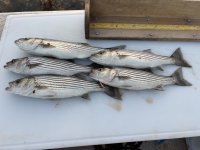
Striped bass caught vertical jigging with Captain Mack's Jig'N shad spoon.
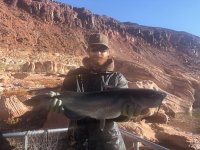
Channel catfish are also doing very well across the lake, particularly on the San Juan Arm. They were the third most abundant species in our San Juan catch, behind gizzard shad and striped bass. The largest catfish of the trip was 9.2 pounds.
We enjoyed beautiful weather during our time on the San Juan, although we did witness several boulders break loose and trigger a rockslide across Cha Bay from camp. I captured a short video of the slide (I will try to attach the video later)—a memorable reminder of how dynamic the canyons can be.
We also took advantage of the break in stormy weather to do some fishing, and the bite did not disappoint. Trolling a Strike King 5XD at 4–4.5 mph produced striped bass, while vertical jigging in 40–50 feet of water was another effective way to put stripers in the boat. Topwater fishing was good for smallmouth bass, along with a few largemouth bass, using Rebel Pop-R lures along the edges of newly flooded vegetation.
November is a great time to fish Lake Powell. Get out, enjoy the cooler weather, and take advantage of some excellent fall fishing!
We did find a massive wall of floating debris at the upstream end of Neskahi. At the time, it appeared to be piling up rather than moving farther down the San Juan Arm. With the lake still rising, however, we decided to move our sampling downstream to Cha Bay. We didn’t want to risk having that debris break loose, foul our nets, and create a safety hazard for our crew and boats.
The water in Cha Bay was surprisingly clear. Aside from the newly flooded vegetation, there was little visible evidence of the floodwater entering the lake upstream. We caught fewer fish than we typically catch at Neskahi Bay, but several factors likely contributed to the lower catch. Clear water may have allowed fish to detect and avoid our nets during daylight hours. The newly flooded vegetation also provided additional cover and may have dispersed fish or reduced their movements, making them less vulnerable to our nets.
The encouraging news was the condition of the striped bass: all those we examined appeared healthy and well fed. Stomach checks supported that observation, with most containing fish, primarily shad. In recent years when shad were less abundant, we found crayfish in as many as 11% of striped bass stomachs. This year’s results suggest the striped bass we sampled are finding plenty of shad to eat. At Wahweap bay we set 5 nets on the south shoreline and 5 nets on the north side, the nets on the north side caught many more striped bass than the south side, I don't know if that will stay consistent but might be worth checking out if your find yourself looking for stripers in Wahweap Bay.
Striped bass caught vertical jigging with Captain Mack's Jig'N shad spoon.
Channel catfish are also doing very well across the lake, particularly on the San Juan Arm. They were the third most abundant species in our San Juan catch, behind gizzard shad and striped bass. The largest catfish of the trip was 9.2 pounds.
We enjoyed beautiful weather during our time on the San Juan, although we did witness several boulders break loose and trigger a rockslide across Cha Bay from camp. I captured a short video of the slide (I will try to attach the video later)—a memorable reminder of how dynamic the canyons can be.
We also took advantage of the break in stormy weather to do some fishing, and the bite did not disappoint. Trolling a Strike King 5XD at 4–4.5 mph produced striped bass, while vertical jigging in 40–50 feet of water was another effective way to put stripers in the boat. Topwater fishing was good for smallmouth bass, along with a few largemouth bass, using Rebel Pop-R lures along the edges of newly flooded vegetation.
November is a great time to fish Lake Powell. Get out, enjoy the cooler weather, and take advantage of some excellent fall fishing!