

JFRCalifornia
Keeper of San Juan Secrets
I recently took an overnight kayak trip through lower Glen Canyon below the dam, following the last undammed 16 miles from the dam to Lees Ferry. It’s a worthwhile trip, and I’ll probably end up posting about that at another time. On that trip, I kept thinking about the fact that had things broken slightly differently, a smaller version of Glen Canyon Dam might have been located at two different places along that 16-mile float. The point of this post is to illustrate where the two possible alternative dam sites identified by E.C. LaRue in his 1925 USGS report would have been located, and how either one would have fundamentally changed the nature of the lower canyon. I point this out only to give a sense of what it must have felt like to those who knew Glen Canyon before the dam was built in the early 1960s. Here's a link to a previous post that goes into this in some detail:
As a reminder, there were two sites identified for a possible dam between Wahweap Creek and Lees Ferry, neither of which were the location where it actually ended up being built. These were:
1. Glen Canyon Dam Site No. 1. About 4 miles upstream of Lees Ferry, river elevation 3127.
2. Glen Canyon Dam Site No. 2. About 9.5 miles upstream of Lees Ferry, river elevation 3129.
The two dam sites closer to Lees Ferry stood out because they were relatively accessible as construction sites, since it was possible to reach Lees Ferry by automobile, even then. (Consideration of a dam near Lees Ferry was likely one impetus for completing the Navajo Bridge over Marble Canyon in 1929.) Both sites also had a unique topographical advantage since both were located near the head of a horseshoe bend, and a spillway could have been drilled straight through the canyon wall to bypass the dam, instead of inline with the dam itself.
Either site would have been a much lower structure than what was eventually built farther upstream, each closer to 400 feet high instead of the 710 feet where it is today. That means the reservoir capacity would have been much smaller: closer to 8 maf, instead of a reservoir three times the potential volume as it is now. Why? Two main reasons: 1) because at the time USGS assumed another dam would be built in lower Cataract Canyon, and a larger dam at Glen Canyon would have created a huge reservoir that would have made such a dam impossible; and 2) a larger reservoir would have backed up into Rainbow Bridge National Monument, which was (and still is) an important legal consideration.
When you take a kayak journey through these last 16 miles of Glen Canyon, you experience lots of things: the slow roll of the river, the sound of birds and cottonwoods, a few petroglyphs, some hidden, others in the open, riverside walks and longer hikes up side canyons. And when you do that, it gives you pause to wonder what would have been lost or altered had either of those dam sites been chosen. (For example, the Horseshoe Bend overlook would have provided a view of a reservoir if Site 1 was chosen, and would have been in full view of a dam if Site 2 were picked.) But in a larger sense, it makes you imagine all the things that were submerged by Lake Powell by Glen Canyon Dam, some of which are only now beginning to reveal themselves as the reservoir has dropped.
What follows are a few images showing where those two dam sites would have been located, or how they would have appeared from nearby viewing locations on or near the river. The photos are mine, while the two drawings are from the 1925 USGS report, showing plan views of the two unused dam sites.
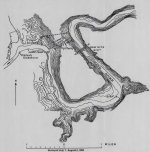
Here's the plan view of LaRue's preferred site (Site #1), about 4 mile up from Lees Ferry, or about 12 miles downstream of the current dam:
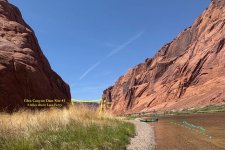
And here's a photo of what this would have looked like from the river, just downstream of the dam site:
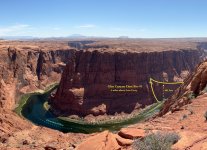
Here's another view of the same site, looking down from the top of the mesa, just upstream of the previous photo. In the distance to the northeast, you can see Navajo Mountain and various buttes near Padre Bay:
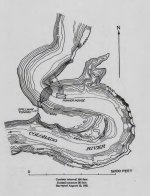
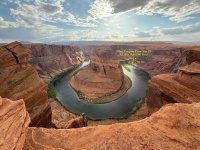
Dam Site #2 was 9.5 miles upstream of Lees Ferry, or about 6.5 miles south of Glen Canyon Dam. It would have been located in the upper reach of Horseshoe Bend. Here's the plan drawing from the 1925 USGS report, with the modern Horseshoe Bend overlook area at far right:
Here's what the dam would have looked like from the Horseshoe Bend overlook:
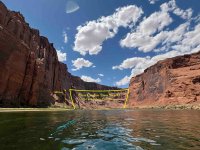
And here's how it would have appeared from the river, looking upstream at its face:
There you go. Just some food for thought…

The modern narrative is that Glen Canyon Dam arose as the result of an unholy deal. In the common telling of the tale, a proposed dam that would have flooded idyllic Echo Park in Dinosaur National Monument near the confluence of the Green and Yampa rivers was swapped for one in Glen Canyon because of a compromise between the Sierra Club and the Bureau of Reclamation in the early 1950s. As the story went, the Sierra Club—and its president David Brower—just didn’t know what they were giving away.
The story was not that simple. Stories like this never are.
The truth was that a dam at Glen...
The story was not that simple. Stories like this never are.
The truth was that a dam at Glen...
- JFRCalifornia
- Replies: 18
- Forum: Lake Powell Issues


As a reminder, there were two sites identified for a possible dam between Wahweap Creek and Lees Ferry, neither of which were the location where it actually ended up being built. These were:
1. Glen Canyon Dam Site No. 1. About 4 miles upstream of Lees Ferry, river elevation 3127.
2. Glen Canyon Dam Site No. 2. About 9.5 miles upstream of Lees Ferry, river elevation 3129.
The two dam sites closer to Lees Ferry stood out because they were relatively accessible as construction sites, since it was possible to reach Lees Ferry by automobile, even then. (Consideration of a dam near Lees Ferry was likely one impetus for completing the Navajo Bridge over Marble Canyon in 1929.) Both sites also had a unique topographical advantage since both were located near the head of a horseshoe bend, and a spillway could have been drilled straight through the canyon wall to bypass the dam, instead of inline with the dam itself.
Either site would have been a much lower structure than what was eventually built farther upstream, each closer to 400 feet high instead of the 710 feet where it is today. That means the reservoir capacity would have been much smaller: closer to 8 maf, instead of a reservoir three times the potential volume as it is now. Why? Two main reasons: 1) because at the time USGS assumed another dam would be built in lower Cataract Canyon, and a larger dam at Glen Canyon would have created a huge reservoir that would have made such a dam impossible; and 2) a larger reservoir would have backed up into Rainbow Bridge National Monument, which was (and still is) an important legal consideration.
When you take a kayak journey through these last 16 miles of Glen Canyon, you experience lots of things: the slow roll of the river, the sound of birds and cottonwoods, a few petroglyphs, some hidden, others in the open, riverside walks and longer hikes up side canyons. And when you do that, it gives you pause to wonder what would have been lost or altered had either of those dam sites been chosen. (For example, the Horseshoe Bend overlook would have provided a view of a reservoir if Site 1 was chosen, and would have been in full view of a dam if Site 2 were picked.) But in a larger sense, it makes you imagine all the things that were submerged by Lake Powell by Glen Canyon Dam, some of which are only now beginning to reveal themselves as the reservoir has dropped.
What follows are a few images showing where those two dam sites would have been located, or how they would have appeared from nearby viewing locations on or near the river. The photos are mine, while the two drawings are from the 1925 USGS report, showing plan views of the two unused dam sites.
Here's the plan view of LaRue's preferred site (Site #1), about 4 mile up from Lees Ferry, or about 12 miles downstream of the current dam:
And here's a photo of what this would have looked like from the river, just downstream of the dam site:
Here's another view of the same site, looking down from the top of the mesa, just upstream of the previous photo. In the distance to the northeast, you can see Navajo Mountain and various buttes near Padre Bay:
Dam Site #2 was 9.5 miles upstream of Lees Ferry, or about 6.5 miles south of Glen Canyon Dam. It would have been located in the upper reach of Horseshoe Bend. Here's the plan drawing from the 1925 USGS report, with the modern Horseshoe Bend overlook area at far right:
Here's what the dam would have looked like from the Horseshoe Bend overlook:
And here's how it would have appeared from the river, looking upstream at its face:
There you go. Just some food for thought…
