

Dan Keller
UT DWR Fish Biologist
Recent heavy rains have raised Lake Powell to an elevation of 3,527.5, up from a low of 3,516 on September 16th. Much of the water originated from the San Juan River, where the USGS gauge near Bluff UT registered 41,600 cubic feet / second on October 26th. We experienced some wild rainstorms while completing our annual fisheries gillnet survey Oct 19-22. I wanted to share some first impressions on what we observed in our gillnets and what anglers should expect while fishing this fall / winter. We started netting near Blue Notch (Good Hope Bay area) on the far north end of the Reservoir. Good Hope Bay typically holds a lot more fish, especially Walleye, compared to other locations we monitor, and so far that holds true this year. We found good numbers of Striped Bass in the nets, mostly 2-year-old fish that survived the die off last year when shad numbers were very low. Young Striped Bass feed on zooplankton and survive better than older fish when shad numbers crash. Most all the Striped Bass were in excellent condition and will survive well over the winter. Fishing for Striped Bass from the Bullfrog area up to Good Hope Bay will be good all fall and winter.
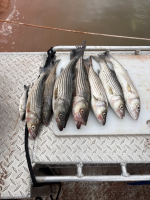
Walleye numbers were average at Good Hope Bay with many Walleye measuring between 19-21 inches.
As expected with all this rain, the water clarity in the Good Hope Bay area is very poor, meaning flood water carries a high load of silt and mud and since Good Hope Bay is close to the inflow, water clarity has been reduced to only a few inches. This will make fishing for Largemouth Bass, and Smallmouth Bass difficult at Good Hope Bay for several days, or longer depending on future rainstorms, and how fast the water clears up. Bass fishing becomes more difficult when a lake is turbid (muddy or cloudy) primarily because bass are visual predators that rely heavily on sight to locate, identify, and capture prey. When turbidity increases, bass can still feed, but their ability to detect prey decreases, their feeding behavior changes, and anglers often have a harder time getting their lures in front of actively feeding fish. Despite the poor visibility, each evening around 5:30 Striped Bass were boiling in the main channel, scattered from Blue Notch to Ticaboo Canyon. We were able to catch many casting or vertical jigging spoons or trolling crankbaits. We could see massive schools of Striped Bass on our sonar, sometimes the schools were so dense that the depth finder would read a false bottom.
In turbid or muddy water, the best bass lures are those that create vibration, displace water, make noise, or present a strong silhouette. In muddy water Bass have a harder time seeing prey, so you want a lure they can detect through their lateral line or see at close range.
For Lake Powell, particularly when targeting Smallmouth and Largemouth Bass in muddy water, I would focus on these four presentations:
1. Spinnerbait
Use a 3/8–1/2 oz spinnerbait with a Colorado blade for strong vibration. Slow-roll it around rocky banks, brush, and shallow points.
Colors: Chartreuse/white, black/chartreuse
2. Squarebill crankbait — Best around rocks
Use a wide-wobbling crankbait with rattles. Deflect it off rocks, wood, and other cover to trigger reaction strikes.
Colors: Chartreuse/black back, firetiger, red craw
3. ChatterBait — Best for vibration
Its vibrating blade helps bass locate the lure. Retrieve slowly enough to maintain vibration while keeping it near the bottom or cover.
Colors: Black/blue, white/chartreuse
4. Jig with craw trailer — Best for slow fishing
A 3/8–1/2 oz jig with a bulky craw trailer offers a strong silhouette and water displacement. Drag or hop it slowly around rocks.
Colors: Black/blue, black, green pumpkin
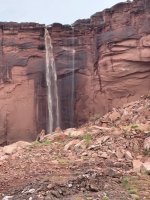
After netting at Good Hope Bay, we moved camp to the Rincon. On the ride down we saw dozens of waterfalls dropping off the cliff walls, seeing the impressive waterfalls made it worth dealing with the rain.
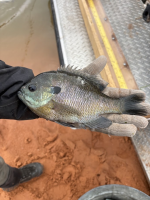
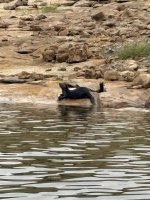
Numbers of Striped Bass and Walleye were much lower on the Rincon however we did catch many nice Catfish and Bluegill. Bluegill and Catfish are two species that have been steadily increasing in recent years. We even found a pair of otters that helped themselves to a few Gizzard Shad from one of our nets!
Water temperatures are now in the mid 60’s, this is the trigger that will start fall feeding and improve catch rates. Not only does fishing pick up this time of year, but an added bonus is otters and other wildlife are spotted more frequently this time of year as lake traffic tapers off.
We will be netting the San Juan and Wahweap November 2-6. I suspect the San Juan arm to be even more turbid than Good Hope Bay due to all the flooding. If you are considering a fishing trip in the next week or so I would recommend avoiding fishing very far up the San Juan Arm or too close to the Colorado Inflow until the water clears up. I will report back on what we find on the San Juan and Wahweap in November.
Walleye numbers were average at Good Hope Bay with many Walleye measuring between 19-21 inches.
As expected with all this rain, the water clarity in the Good Hope Bay area is very poor, meaning flood water carries a high load of silt and mud and since Good Hope Bay is close to the inflow, water clarity has been reduced to only a few inches. This will make fishing for Largemouth Bass, and Smallmouth Bass difficult at Good Hope Bay for several days, or longer depending on future rainstorms, and how fast the water clears up. Bass fishing becomes more difficult when a lake is turbid (muddy or cloudy) primarily because bass are visual predators that rely heavily on sight to locate, identify, and capture prey. When turbidity increases, bass can still feed, but their ability to detect prey decreases, their feeding behavior changes, and anglers often have a harder time getting their lures in front of actively feeding fish. Despite the poor visibility, each evening around 5:30 Striped Bass were boiling in the main channel, scattered from Blue Notch to Ticaboo Canyon. We were able to catch many casting or vertical jigging spoons or trolling crankbaits. We could see massive schools of Striped Bass on our sonar, sometimes the schools were so dense that the depth finder would read a false bottom.
In turbid or muddy water, the best bass lures are those that create vibration, displace water, make noise, or present a strong silhouette. In muddy water Bass have a harder time seeing prey, so you want a lure they can detect through their lateral line or see at close range.
For Lake Powell, particularly when targeting Smallmouth and Largemouth Bass in muddy water, I would focus on these four presentations:
1. Spinnerbait
Use a 3/8–1/2 oz spinnerbait with a Colorado blade for strong vibration. Slow-roll it around rocky banks, brush, and shallow points.
Colors: Chartreuse/white, black/chartreuse
2. Squarebill crankbait — Best around rocks
Use a wide-wobbling crankbait with rattles. Deflect it off rocks, wood, and other cover to trigger reaction strikes.
Colors: Chartreuse/black back, firetiger, red craw
3. ChatterBait — Best for vibration
Its vibrating blade helps bass locate the lure. Retrieve slowly enough to maintain vibration while keeping it near the bottom or cover.
Colors: Black/blue, white/chartreuse
4. Jig with craw trailer — Best for slow fishing
A 3/8–1/2 oz jig with a bulky craw trailer offers a strong silhouette and water displacement. Drag or hop it slowly around rocks.
Colors: Black/blue, black, green pumpkin
After netting at Good Hope Bay, we moved camp to the Rincon. On the ride down we saw dozens of waterfalls dropping off the cliff walls, seeing the impressive waterfalls made it worth dealing with the rain.
Numbers of Striped Bass and Walleye were much lower on the Rincon however we did catch many nice Catfish and Bluegill. Bluegill and Catfish are two species that have been steadily increasing in recent years. We even found a pair of otters that helped themselves to a few Gizzard Shad from one of our nets!
Water temperatures are now in the mid 60’s, this is the trigger that will start fall feeding and improve catch rates. Not only does fishing pick up this time of year, but an added bonus is otters and other wildlife are spotted more frequently this time of year as lake traffic tapers off.
We will be netting the San Juan and Wahweap November 2-6. I suspect the San Juan arm to be even more turbid than Good Hope Bay due to all the flooding. If you are considering a fishing trip in the next week or so I would recommend avoiding fishing very far up the San Juan Arm or too close to the Colorado Inflow until the water clears up. I will report back on what we find on the San Juan and Wahweap in November.