

Dan Keller
UT DWR Fish Biologist
Spring fishing has arrived at Lake Powell. Temperatures this week have ranged from 62-68 degrees, on the south end of the lake, and not too much cooler up north. Largemouth Bass have moved into shallow water to spawn and can be caught right now near shallow points and coves with nearby cover, such as overhanging rocks, tumble weed piles, or submerged trees. Smallmouth Bass fishing is picking up but will not peak for a few more weeks. This unusually warm spring has ramped up the numbers of bass moving up, however bass spawning is triggered by a combination of water temperature and photoperiod (day length) and while we jumped up into the 60-degree range quickly it takes a week or so of consistent temperatures to really kick off the spawn. The moon cycle also plays a role, with studies suggesting that the full moon occurring April 1st, and the new moon (17 April) increases the movement of bass into shallow water to spawn. So, take all that for what is worth, the bottom line is this, you don’t want to miss April fishing at Lake Powell ! I have been summarizing our angler survey data from last year and learned that based on our survey conducted from April-Oct 2025 catch rates (# fish caught per hour) were higher in 2025 that than any survey in recent years. The lake-wide catch rate for the 7-month survey was an impressive 2.56 fish/hr (weighted average).
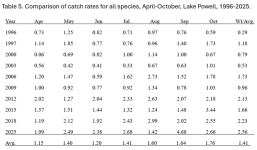
As stated, this was a record for the fishery and well above the statewide UDWR catch rate goal of 0.50 fish/hr from flat-water fisheries. The best fishing was in September (4.68 fish/hr) and July (2.68), with September being the highest catch rate of the entire dataset (1996-present). The bulk of that record catch was Striped Bass that were hungry and easy to catch with cut bait, particularly on the south end of the lake where many anglers caught 100’s of fish per day. Due to poor spring runoff, shad spawning and survival was diminished in 2025; the older age classes of Striped Bass have been dying off since last spring; they simply can't find enough shad to survive. Fortunately, young Striped Bass eat zooplankton their first year in the lake, so they have survived better and are in good condition this spring. Anglers are reporting catching healthy Striped Bass at Lake Canyon and Good Hope Bay on the North end and Rock Creek / Last Chance down South.
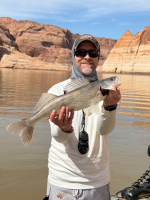
Smallmouth Bass, Black Crappie and Walleye are also showing up quite a bit in fishing reports. Bret Kenworthy, Ridge Henderson and Colt Henderson from Kanab reported catching Walleye and Black Crappie in Navajo Canyon. The Walleye was caught in stained water with a dark 3.5” tube jig worked along the bottom. April and May are the time of year you can catch multiple species of fish all day long with simple, tried and true techniques such as weightless Senko or wacky rigged stick worms, swimbaits, creature baits, jigs with craw trailers, ned rig, tube jigs, and much more.

One more item related to the angler survey. Lake Powell continues to be a phenomenal fishery, maintaining high harvest rates of Striped Bass is critical to improving the health of many of the fish species at Lake Powell. Striped Bass and Smallmouth Bass remain both the most targeted and the most frequently caught species in the reservoir. Anglers harvested Walleye at highest rates (67%) however in 2025 Striped Bass harvest fell to 27%. In contrast, anglers only harvested 11% of Smallmouth Bass, and 2% of Largemouth Bass.
The reduction of Striped Bass harvest is concerning, although the lower harvest rate could be explained by an increasing trend of anglers puncturing the air bladder and throwing back skinny Striped Bass that would not yield a great fillet. While these fish are technically harvested, they are not kept in a cooler or livewell and harvested in a traditional manner. It’s no surprise that anglers are more likely to provide an accurate count (or be counted by the creel technician) when the majority have been kept for later processing rather than estimated from the number that were caught, killed, and released. In a system like Lake Powell, where Striped Bass populations can boom due to strong forage cycles, underestimating total mortality can lead to a mismatch between what managers think is happening and what’s actually happening in the water. If a meaningful portion of fish are dying but not being counted as “kept,” it may look like harvest pressure is declining—even if total removals (kept + discarded mortality) aren’t dropping nearly as much. Regulations allow for Striped Bass to be killed and thrown back and there is no issue with this, in fact returning the carcass to the water may be beneficial as the nutrients contained in the fish will in one form or another return to the food web and add to the productivity of the lake. I bring this subject up not to dwell on minor details, but to emphasize the big picture, that being the important reminder that harvesting Striped Bass is very important to maintaining good fishing at Lake Powell. Even if Striped Bass isn’t your top species to target, please take some time during your trip to harvest Striped Bass and cook a hot meal on the lake and take what you can home to enjoy later. Thank You !

As stated, this was a record for the fishery and well above the statewide UDWR catch rate goal of 0.50 fish/hr from flat-water fisheries. The best fishing was in September (4.68 fish/hr) and July (2.68), with September being the highest catch rate of the entire dataset (1996-present). The bulk of that record catch was Striped Bass that were hungry and easy to catch with cut bait, particularly on the south end of the lake where many anglers caught 100’s of fish per day. Due to poor spring runoff, shad spawning and survival was diminished in 2025; the older age classes of Striped Bass have been dying off since last spring; they simply can't find enough shad to survive. Fortunately, young Striped Bass eat zooplankton their first year in the lake, so they have survived better and are in good condition this spring. Anglers are reporting catching healthy Striped Bass at Lake Canyon and Good Hope Bay on the North end and Rock Creek / Last Chance down South.
Smallmouth Bass, Black Crappie and Walleye are also showing up quite a bit in fishing reports. Bret Kenworthy, Ridge Henderson and Colt Henderson from Kanab reported catching Walleye and Black Crappie in Navajo Canyon. The Walleye was caught in stained water with a dark 3.5” tube jig worked along the bottom. April and May are the time of year you can catch multiple species of fish all day long with simple, tried and true techniques such as weightless Senko or wacky rigged stick worms, swimbaits, creature baits, jigs with craw trailers, ned rig, tube jigs, and much more.
One more item related to the angler survey. Lake Powell continues to be a phenomenal fishery, maintaining high harvest rates of Striped Bass is critical to improving the health of many of the fish species at Lake Powell. Striped Bass and Smallmouth Bass remain both the most targeted and the most frequently caught species in the reservoir. Anglers harvested Walleye at highest rates (67%) however in 2025 Striped Bass harvest fell to 27%. In contrast, anglers only harvested 11% of Smallmouth Bass, and 2% of Largemouth Bass.
The reduction of Striped Bass harvest is concerning, although the lower harvest rate could be explained by an increasing trend of anglers puncturing the air bladder and throwing back skinny Striped Bass that would not yield a great fillet. While these fish are technically harvested, they are not kept in a cooler or livewell and harvested in a traditional manner. It’s no surprise that anglers are more likely to provide an accurate count (or be counted by the creel technician) when the majority have been kept for later processing rather than estimated from the number that were caught, killed, and released. In a system like Lake Powell, where Striped Bass populations can boom due to strong forage cycles, underestimating total mortality can lead to a mismatch between what managers think is happening and what’s actually happening in the water. If a meaningful portion of fish are dying but not being counted as “kept,” it may look like harvest pressure is declining—even if total removals (kept + discarded mortality) aren’t dropping nearly as much. Regulations allow for Striped Bass to be killed and thrown back and there is no issue with this, in fact returning the carcass to the water may be beneficial as the nutrients contained in the fish will in one form or another return to the food web and add to the productivity of the lake. I bring this subject up not to dwell on minor details, but to emphasize the big picture, that being the important reminder that harvesting Striped Bass is very important to maintaining good fishing at Lake Powell. Even if Striped Bass isn’t your top species to target, please take some time during your trip to harvest Striped Bass and cook a hot meal on the lake and take what you can home to enjoy later. Thank You !