It’s a wonder that Powell was ever able to fill in the first place. I wonder if all these current control points (dams) were in place during the “fill” years or was the river more free flowing back then that simply resulted in more water reaching Powell? Are the number of dams in the system a contributing factor to Powells lack of ability to rise more today than it did in the past? I have to believe it’s a factor. If more storage today is good then we shouldn’t be surprised that in a normal snowpack year that Powell doesn’t rise as much as it did in the past. I’m thinking out loud here but these are the questions that swirl through my mind.

You are using an out of date browser. It may not display this or other websites correctly.
You should upgrade or use an alternative browser.
You should upgrade or use an alternative browser.
June Level/Forecasts (not good)...
- Thread starter DVexile
- Start date
- Status
- Not open for further replies.
Powder Hound
Active Member
Ive posted this link before. This is the Colorado River at Glenwood Springs, Co and its running high right now. Glenwood Springs sits pretty far east in the Rockies near Aspen. It was running much lower 7 days ago. Im not sure if the river is controlled above this location. I check this periodically over the runoff months to use as a gauge for flow.
Glenwood Kayak Park Wave Wide View Webcam Colorado River | Colorado Webcam
The Glenwood Kayak Park offers a live webcam for viewers to watch the action on the waves. The camera, owned by Absolute Computer Design and supported by the Glenwood Springs Chamber and the Town of Glenwood Springs, has a 50MM zoom lens and is focused on the wave. In addition to the kayak park...coloradowebcam.net
Continuous data
Colorado River Below Glenwood Springs, CO - 09085100Subscribe to WaterAlert
May 28, 2025 - June 4, 2025
Discharge, cubic feet per second
6400 ft3/s - Jun 02, 2025 11:00:00 PM MDT
10000 ft3/s - Jun 02, 2024 11:00:00 PM MDT

ImportantData may be provisional
Show legend
Hide graph details
Value
Status
Time
Latest value
7220 ft3/s
Provisional
Jun 04, 2025
11:15:00 AM MDT
Selected
6400 ft3/s
Provisional
Jun 02, 2025
11:00:00 PM MDT
Prior year
10000 ft3/s
Approved
Jun 02, 2024
11:00:00 PM MDT
Hide graph details
Hide today's statistics
Statistics for June 4, 2025 based on 58 years of data
Streamflow, ft³/s
low (2002)
3260 ft3/s
25th percentile
6910 ft3/s
median
9840 ft3/s
75th percentile
12500 ft3/s
mean
10200 ft3/s
high (1984)
23000 ft3/s
Hide today's statistics
Change
time span
Subscribe
to WaterAlert
View
related graphs
Download
data
View
data records
Available data
Select data types to graph from categories based on the way the data were collected.Learn about the data collection categories This flow is barely above the 25th percentile. The river is running about 4000 cfs below average and really not much snow left up high. Us here on the western slope is in for a very high fire danger year. Peter
UPDATE: Up two feet so far, and probably two more to come
The lake is now up two feet from the low. Not usually something to write home about...
Getting another foot is certain in the next week. The inflow forecast says we should just cross four feet above the low by the middle of the month.
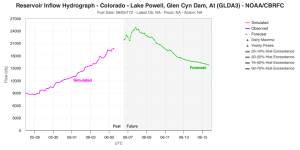
The forecast is for the inflow peak to be this weekend. But that doesn't represent the elevation peak, rather that represents the fastest rate of rise. The peak elevation will occur when the inflow crosses below about 11,500 cfs. As you can see above that isn't forecast to happen until sometime after the middle of the month.
For every 4,000 cfs above 11,500 cfs the lake will rise about 0.10 feet per day. Integrating the above forecast inflows predicts that we'll get an additional 2.1 feet of rise out to 6/15. So it looks like by June 15th we should probably have successfully gotten four feet above the low.
What happens after that is uncertain. The 6/15 forecast inflow is just enough for a 0.10 foot rise per day, so whatever happens is going to be pretty slow. It would seem a stretch to manage to eke out one more foot (we'd need ten more days of 15,500 cfs inflow), but may a half a foot is a reasonable expectation? So maybe a best guess of a peak of 3562.5 in the middle of the last half of June?
The CBRFC issued their "official" inflow forecast for June 1st recently as well. Their 50% is 2900 kaf which is about where the daily estimates were when the original post in this thread was made. At the moment the daily estimate has bounced a bit above that, and presumably it will bounce around some more in both directions.
So for now, it looks like no big surprises from how things looked at the start of the week. And the usual caveat that this is pointlessly counting tenths of a foot when in reality there is still quite a bit of uncertainty in all these forecasts!
The lake is now up two feet from the low. Not usually something to write home about...
Getting another foot is certain in the next week. The inflow forecast says we should just cross four feet above the low by the middle of the month.
The forecast is for the inflow peak to be this weekend. But that doesn't represent the elevation peak, rather that represents the fastest rate of rise. The peak elevation will occur when the inflow crosses below about 11,500 cfs. As you can see above that isn't forecast to happen until sometime after the middle of the month.
For every 4,000 cfs above 11,500 cfs the lake will rise about 0.10 feet per day. Integrating the above forecast inflows predicts that we'll get an additional 2.1 feet of rise out to 6/15. So it looks like by June 15th we should probably have successfully gotten four feet above the low.
What happens after that is uncertain. The 6/15 forecast inflow is just enough for a 0.10 foot rise per day, so whatever happens is going to be pretty slow. It would seem a stretch to manage to eke out one more foot (we'd need ten more days of 15,500 cfs inflow), but may a half a foot is a reasonable expectation? So maybe a best guess of a peak of 3562.5 in the middle of the last half of June?
The CBRFC issued their "official" inflow forecast for June 1st recently as well. Their 50% is 2900 kaf which is about where the daily estimates were when the original post in this thread was made. At the moment the daily estimate has bounced a bit above that, and presumably it will bounce around some more in both directions.
So for now, it looks like no big surprises from how things looked at the start of the week. And the usual caveat that this is pointlessly counting tenths of a foot when in reality there is still quite a bit of uncertainty in all these forecasts!
Mid-June Update: On track for 3562.5 and a bit under 5 feet total peak
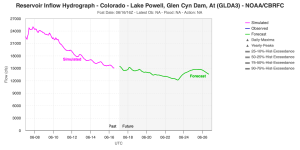
The lake level this morning was 3561.7 and the inflow forecast (graph below) integrated through 6/26 expects about 0.7 foot of additional rise. Looking upstream the flow rates drop a lot after the pulse from the Flaming Gorge release (current forecast below shows the start of that drop). Based on those upstream forecasts it looks like the lake will peak probably around 6/28 and will maybe eke out another 0.1 foot of rise beyond the 0.7 foot forecast in the plot below. Remember, the peak will occur when the inflow crosses below around 11,500 cfs.
That would put the peak at 3562.5 and so really no change from the guess in the last post from about 10 days ago. That will be only a 4.7 foot peak from the low, pretty miserable but certainly not the worst on record either. The peak is going to be pretty broad and almost at the end of the month rather than the middle of the end as things looked previously. The Flaming Gorge release pushed out the peak by a handful of days, so it will be nearly at the end of June.
As to total inflow through end of July, the CBRFC estimate as of today is 2919 kaf, which is essentially identical to their last "official" forecast of 2900 kaf on June 1. I believe the June 24 Month Forecast should be released very soon and it should be based on that June 1 number of 2900 kaf which still looks like the "right" forecast to be using (unlike the previous months' studies which were already overestimating by the time they were published). The current 10% to 90% range of the CBRFC forecast works out to only be about +/- 1 foot of lake elevation, so unless things somehow go really bonkers the study forecast when it comes out should be pretty decent for the summer at least!
The lake level this morning was 3561.7 and the inflow forecast (graph below) integrated through 6/26 expects about 0.7 foot of additional rise. Looking upstream the flow rates drop a lot after the pulse from the Flaming Gorge release (current forecast below shows the start of that drop). Based on those upstream forecasts it looks like the lake will peak probably around 6/28 and will maybe eke out another 0.1 foot of rise beyond the 0.7 foot forecast in the plot below. Remember, the peak will occur when the inflow crosses below around 11,500 cfs.
That would put the peak at 3562.5 and so really no change from the guess in the last post from about 10 days ago. That will be only a 4.7 foot peak from the low, pretty miserable but certainly not the worst on record either. The peak is going to be pretty broad and almost at the end of the month rather than the middle of the end as things looked previously. The Flaming Gorge release pushed out the peak by a handful of days, so it will be nearly at the end of June.
As to total inflow through end of July, the CBRFC estimate as of today is 2919 kaf, which is essentially identical to their last "official" forecast of 2900 kaf on June 1. I believe the June 24 Month Forecast should be released very soon and it should be based on that June 1 number of 2900 kaf which still looks like the "right" forecast to be using (unlike the previous months' studies which were already overestimating by the time they were published). The current 10% to 90% range of the CBRFC forecast works out to only be about +/- 1 foot of lake elevation, so unless things somehow go really bonkers the study forecast when it comes out should be pretty decent for the summer at least!

Rainbowbridge
Keeper of San Juan Secrets
So appreciate this tech stuff....put into easy to digest layman's terms.....
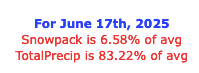
This was rather sobering today......6.58%......maybe we should all pee in the lake....as Philbo suggested.....
This was rather sobering today......6.58%......maybe we should all pee in the lake....as Philbo suggested.....

Colin
Well-Known Member
It’s a wonder that Powell was ever able to fill in the first place. I wonder if all these current control points (dams) were in place during the “fill” years or was the river more free flowing back then that simply resulted in more water reaching Powell? Are the number of dams in the system a contributing factor to Powells lack of ability to rise more today than it did in the past? I have to believe it’s a factor. If more storage today is good then we shouldn’t be surprised that in a normal snowpack year that Powell doesn’t rise as much as it did in the past. I’m thinking out loud here but these are the questions that swirl through my mind.
Interesting question that I had to look up (ChatGPT) the answer to.
River System | Dam | Year Completed |
|---|---|---|
Colorado River | Glen Canyon Dam | 1956–1966 |
Green River | Flaming Gorge Dam | 1958–1962 |
San Juan River | Navajo Dam | 1962 |
Gunnison River | Blue Mesa Dam | 1962–1966 |
Gunnison River | Morrow Point Dam | 1963–1968 |
Gunnison River | Crystal Dam | 1972–1976 |
Duchesne River | Strawberry Dam (orig.) | 1913 |
Duchesne River | Soldier Creek Dam | 1970–1972 |
Duchesne River | Starvation Dam | 1967–1970 |


JFRCalifornia
Keeper of San Juan Secrets
I looked a little more closely at the average annual inflows and outflows of the three major reservoirs above Lake Powell: Flaming Gorge, Navajo, and Blue Mesa. The water database only shows data back to 1969 for Blue Mesa and Flaming Gorge, and back to 1964 for Navajo. So I focused on data since 1969, which we have for all three reservoirs.It’s a wonder that Powell was ever able to fill in the first place. I wonder if all these current control points (dams) were in place during the “fill” years or was the river more free flowing back then that simply resulted in more water reaching Powell? Are the number of dams in the system a contributing factor to Powells lack of ability to rise more today than it did in the past? I have to believe it’s a factor. If more storage today is good then we shouldn’t be surprised that in a normal snowpack year that Powell doesn’t rise as much as it did in the past. I’m thinking out loud here but these are the questions that swirl through my mind.
This is the hypothesis, put in the form of a question: "Are the reservoirs above Lake Powell impeding Lake Powell's ability to refill?" To test that hypothesis, we simply need to compare annual inflows and outflows from each reservoir. If the inflows exceed the outflows, those reservoirs are holding something back that might otherwise reach Powell. If those numbers are the same, there is no effect on Lake Powell. I'd expect average annual inflows to be slightly greater than outflows, or else those reservoirs would quickly be drained.
Here's the data, for different periods since 1969:
Net Average Annual Inflow by Reservoir (acre-feet)
Flaming Gorge
1969-80 - 159,000 af
1981-99 - 106,000 af
2000-23 - 27,000 af
1969-2023 - 83,000 af
Blue Mesa
1969-80 - 23,000 af
1981-99 - 12,000 af
2000-23 - 11,000 af
1969-2023 - 14,000 af
Navajo
1969-80 - 101,000 af
1981-99 - 179,000 af
2000-23 - 222,000 af
1969-2023 - 181,000 af
All 3 Reservoirs Combined
1969-80 - 283,000 af
1981-99 - 297,000 af
2000-23 - 259,000 af
1969-2023 - 277,000 af
Well, the first thing you can say from this is that by looking at the "combined" data, the amount held back above Powell has been very consistent since 1969--an average of about 277,000 af. Sounds like a lot, but in the context of releasing about 8.2 maf from Powell through GCD each year, the input only amounts to about 3% what is released from GCD. Put another way, 277,000 af amounts to about 5 feet in Lake Powell, assuming the lake is roughly half full. That volume means less when the lake is closer to full, and means more when it is down. But about 5 feet. Of course, that's a meaningless statistic, since the USBR can easily modify that number simply by holding back 277,000 af from being released down through GCD in any given year. Bottom line is that the reservoirs above Powell do next to nothing to impede Powell being filled when viewed in the big picture.
That said, there are interesting trends that come out of the data. For example, the amount "held back" in the upper reservoirs during the period when Lake Powell was approaching full (1969-80) was almost 10% more than the amount held back during the sustained drought of 2000-23. This suggests that if anything, USBR has been trying to help Powell since 2000, not hurt it.
It's also worth noting the relative amount held back in each reservoir. Of the three, by far Navajo holds the most back each year, and that's been especially true since 2000. But at the same time, substantially more has been released (relative to inflow) from Flaming Gorge since 2000 than any period before that.
USBR has its management methods, but one thing you can't say is that their operation of the upper reservoirs in the past two decades has been hurting Lake Powell relative to how management was done in the past.
Last edited:

Marina Bum
Escalante-Class Member
To state the obvious: So next year by April we will be roughly 30 feet down from where we are now. It will be like the spring of 2022 again with rocks popping up in the marina and the Wahweap Ramp closed along with the concierge ramp at Antelope. IF we don't see better inflow in the spring if 2026 things will get more dire as BOR is forced to release more water than they have been in order to satisfy the 10 year release average. Over the last few years they had some excess to play with but that is almost all gone and they will be forced to up releases again to be in compliance with the law. OR, we could have a banner record breaking winter next year and a great inflow and this all goes away; I'm hoping for the latter.
Last edited:
Two quick updates:
1. The CBRFC forecast now shows inflows crossing the important 11,500 cfs inflow the morning of 6/27. So it looks like our peak elevation will probably occur sometime very close to the 27th.
2. The June 24 Month Study was released today. I posted it in a separate discussion thread since I think it is probably a lot more relevant as an official (and scary) long term forecast that more people will care about than just "water nerds" following the minutiae in this thread!
Link to June 24 Month Study discussion thread: June 24 Month Study - It's really ugly...
1. The CBRFC forecast now shows inflows crossing the important 11,500 cfs inflow the morning of 6/27. So it looks like our peak elevation will probably occur sometime very close to the 27th.
2. The June 24 Month Study was released today. I posted it in a separate discussion thread since I think it is probably a lot more relevant as an official (and scary) long term forecast that more people will care about than just "water nerds" following the minutiae in this thread!
Link to June 24 Month Study discussion thread: June 24 Month Study - It's really ugly...
Thanks for taking the time on this analysis, JFR. I guess I just have to come to the realization there is less water falling from the sky than before.I looked a little more closely at the average annual inflows and outflows of the three major reservoirs above Lake Powell: Flaming Gorge, Navajo, and Blue Mesa. The water database only shows data back to 1969 for Blue Mesa and Flaming Gorge, and back to 1964 for Navajo. So I focused on data since 1969, which we have for all three reservoirs.
This is the hypothesis, put in the form of a question: "Are the reservoirs above Lake Powell impeding Lake Powell's ability to refill?" To test that hypothesis, we simply need to compare annual inflows and outflows from each reservoir. If the inflows exceed the outflows, those reservoirs are holding something back that might otherwise reach Powell. If those numbers are the same, there is no effect on Lake Powell. I'd expect average annual inflows to be slightly greater than outflows, or else those reservoirs would quickly be drained.
Here's the data, for different periods since 1969:
Net Average Annual Inflow by Reservoir (acre-feet)
Flaming Gorge
1969-80 - 159,000 af
1981-99 - 106,000 af
2000-23 - 27,000 af
1969-2023 - 83,000 af
Blue Mesa
1969-80 - 23,000 af
1981-99 - 12,000 af
2000-23 - 11,000 af
1969-2023 - 14,000 af
Navajo
1969-80 - 101,000 af
1981-99 - 179,000 af
2000-23 - 222,000 af
1969-2023 - 181,000 af
All 3 Reservoirs Combined
1969-80 - 283,000 af
1981-99 - 297,000 af
2000-23 - 259,000 af
1969-2023 - 277,000 af
Well, the first thing you can say from this is that by looking at the "combined" data, the amount held back above Powell has been very consistent since 1969--an average of about 277,000 af. Sounds like a lot, but in the context of releasing about 8.2 maf from Powell through GCD each year, the input only amounts to about 3% what is released from GCD. Put another way, 277,000 af amounts to about 5 feet in Lake Powell, assuming the lake is roughly half full. That volume means less when the lake is closer to full, and means more when it is down. But about 5 feet. Of course, that's a meaningless statistic, since the USBR can easily modify that number simply by holding back 277,000 af from being released down through GCD in any given year. Bottom line is that the reservoirs above Powell do next to nothing to impede Powell being filled when viewed in the big picture.
That said, there are interesting trends that come out of the data. For example, the amount "held back" in the upper reservoirs during the period when Lake Powell was approaching full (1969-80) was almost 10% more than the amount held back during the sustained drought of 2000-23. This suggests that if anything, USBR has been trying to help Powell since 2000, not hurt it.
It's also worth noting the relative amount held back in each reservoir. Of the three, by far Navajo holds the most back each year, and that's been especially true since 2000. But at the same time, substantially more has been released (relative to inflow) from Flaming Gorge since 2000 than any period before that.
USBR has its management methods, but one thing you can't say is that their operation of the upper reservoirs in the past two decades has been hurting Lake Powell relative to how management was done in the past.
Im heading to Powell in mid July. Can't wait. Im working on my explore plan now. I won't make it up to the Escalante arm this trip but may try and spend some time in Reflection Canyon one day. My other thought is to spend some time at the back of Last Chance, never been up there, just past by it heading north.
The End is Nigh (or maybe even here already)...
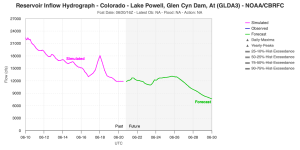
Well, that looks to be about it for the rise. Recall again the outflow is around 11,500 cfs which the forecast is barely above for the coming week. We should therefore mostly hold steady and bounce around a tiny bit next week before the decline slowly begins.
If we take the forecast above as "truth" it all adds up to only about 0.1 foot total rise from now until 6/27. Thing is that this forecast has been slightly overestimating inflow for most of the past week or so. There is a chance we don't even see that 0.1 foot. So it may be a struggle to get the last little bit to 3562 ft.
Of course the reality of measuring 0.1 foot (i.e. one inch) of elevation is pretty silly. So really what this means is we are essentially at the peak now and it will be a broad peak due to the Flaming Gorge release making its way down to the lake at the moment. That release that looked so big upstream is the modest little hump in the above graph from 6/24 to 6/26.
Meanwhile the total inflow forecast through July has been trending down even a bit more, now 2832 kaf which amounts to another foot lower than what the June 24 Month Study used. Not really a big difference, but just a little bit more insult of always being at the extreme bottom of the forecast ranges for this runoff season!
Well, that looks to be about it for the rise. Recall again the outflow is around 11,500 cfs which the forecast is barely above for the coming week. We should therefore mostly hold steady and bounce around a tiny bit next week before the decline slowly begins.
If we take the forecast above as "truth" it all adds up to only about 0.1 foot total rise from now until 6/27. Thing is that this forecast has been slightly overestimating inflow for most of the past week or so. There is a chance we don't even see that 0.1 foot. So it may be a struggle to get the last little bit to 3562 ft.
Of course the reality of measuring 0.1 foot (i.e. one inch) of elevation is pretty silly. So really what this means is we are essentially at the peak now and it will be a broad peak due to the Flaming Gorge release making its way down to the lake at the moment. That release that looked so big upstream is the modest little hump in the above graph from 6/24 to 6/26.
Meanwhile the total inflow forecast through July has been trending down even a bit more, now 2832 kaf which amounts to another foot lower than what the June 24 Month Study used. Not really a big difference, but just a little bit more insult of always being at the extreme bottom of the forecast ranges for this runoff season!
- Status
- Not open for further replies.