

JFRCalifornia
Keeper of San Juan Secrets
If all you do is open your web browser, social media feed, or just about any newspaper, we appear to be in some sort of unprecedented water apocalypse. In may ways, that's true. River inflow has never been consistently lower since the time Lake Powell came online, with the last quarter century of data acting as Exhibit A. And, as the story goes, it seems no matter how we respond, it's possible we'll never see Lake Powell (or Mead) filled again. So why do we need both reservoirs?
That may be right. But it's hardly a foregone conclusion. Those who insist that we "Fill Mead First" say it in part because they believe we'll never fill the collective storage of Mead and Powell again. (And they hate Lake Powell.) Let's address that.
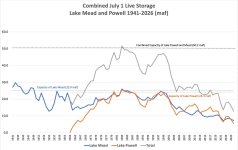
Take a look at the chart below. This shows the collective live storage of Mead and Powell on July 1, from 1941-2026. Of course, before 1963, that figure only included Lake Mead, since there was no Glen Canyon Dam. But in those 22 years of data from 1941-63, we have an idea of what it meant to "Fill Mead First."
A few things jump out at you here.
The two lakes were a combined 80% full or more for much of the 1980s and 90s, even exceeding total capacity in 1983, but that’s another story. Hold that thought. But look closely, and compare the trend of 1942-55 with 2011-26. They are nearly identical. Both showed a 15+/- year slide from a total storage of close to 30 maf down to about 13 maf. The 1940s and early 1950s were very much like what we've seen since about 2012. Were people panicking in 1955? No. They somehow did the opposite—they approved Glen Canyon Dam! Was that a dumb idea? Based on the conventional wisdom of today, it seems that would have been a stupid thing to do, given that Mead couldn’t even keep itself full in 1955. And yet they did it anyway. At first, that seemed like a bad bet. In the 1960s, the reservoirs weren’t climbing much, and collective storage only rose because of a concerted effort to hold back water. Many were concerned when Lake Powell hadn't filled by 1970.
And yet… it was the 1970s that made the Bureau look like geniuses. Snowpack returned, and collective storage rose to a level that wouldn't have been possible with just Lake Mead. By 1980, the reservoir system was nearly full, with both Powell and Mead at or near capacity. Imagine for a moment the magnitude of today’s crisis if Powell wasn’t there to double the capacity for future emergencies, like now. That extra 25 maf that was once in Powell's bank would not have been there. We are reaping the benefits of that now. It's certainly true that we face a crisis today, with collective storage almost exactly what it was in 1955.
We've been here before. We can't predict the snowpack over the next few years. It might continue downward. Or, as in the late 1950s, it might begin a rebound. Or it might just bump along. But it's not yet time to say "we'll never need Powell's capacity again." We don't yet have enough data to draw that conclusion.
The big difference, then to now, is that in 1955, collective water consumption in the two basins was only about 8 maf. Today it's at about 10.5 maf. We still need to work on that side of the equation...
But that's a separate post for another day...
That may be right. But it's hardly a foregone conclusion. Those who insist that we "Fill Mead First" say it in part because they believe we'll never fill the collective storage of Mead and Powell again. (And they hate Lake Powell.) Let's address that.
Take a look at the chart below. This shows the collective live storage of Mead and Powell on July 1, from 1941-2026. Of course, before 1963, that figure only included Lake Mead, since there was no Glen Canyon Dam. But in those 22 years of data from 1941-63, we have an idea of what it meant to "Fill Mead First."
A few things jump out at you here.
The two lakes were a combined 80% full or more for much of the 1980s and 90s, even exceeding total capacity in 1983, but that’s another story. Hold that thought. But look closely, and compare the trend of 1942-55 with 2011-26. They are nearly identical. Both showed a 15+/- year slide from a total storage of close to 30 maf down to about 13 maf. The 1940s and early 1950s were very much like what we've seen since about 2012. Were people panicking in 1955? No. They somehow did the opposite—they approved Glen Canyon Dam! Was that a dumb idea? Based on the conventional wisdom of today, it seems that would have been a stupid thing to do, given that Mead couldn’t even keep itself full in 1955. And yet they did it anyway. At first, that seemed like a bad bet. In the 1960s, the reservoirs weren’t climbing much, and collective storage only rose because of a concerted effort to hold back water. Many were concerned when Lake Powell hadn't filled by 1970.
And yet… it was the 1970s that made the Bureau look like geniuses. Snowpack returned, and collective storage rose to a level that wouldn't have been possible with just Lake Mead. By 1980, the reservoir system was nearly full, with both Powell and Mead at or near capacity. Imagine for a moment the magnitude of today’s crisis if Powell wasn’t there to double the capacity for future emergencies, like now. That extra 25 maf that was once in Powell's bank would not have been there. We are reaping the benefits of that now. It's certainly true that we face a crisis today, with collective storage almost exactly what it was in 1955.
We've been here before. We can't predict the snowpack over the next few years. It might continue downward. Or, as in the late 1950s, it might begin a rebound. Or it might just bump along. But it's not yet time to say "we'll never need Powell's capacity again." We don't yet have enough data to draw that conclusion.
The big difference, then to now, is that in 1955, collective water consumption in the two basins was only about 8 maf. Today it's at about 10.5 maf. We still need to work on that side of the equation...
But that's a separate post for another day...

