

JFRCalifornia
Keeper of San Juan Secrets
You know the narrative. It goes something like this:
"The reason the Colorado River is in trouble is because of the farmers in the Imperial Valley who use way too much water growing a lot of alfalfa that gets exported out of the country."
But is that really the problem? Or are they just a convenient scapegoat?
Well, let’s start with what we know. The 2024 Imperial County Agricultural Crop and Livestock Report reveals a fairly diverse variety of ag products:
The total value of all this was about $2.5 billion in 2024.
Imperial County includes the entire southeastern corner of California, which goes beyond the boundaries of the Imperial Irrigation District, which comprises about 1,500 square miles focused on Imperial Valley, generally adjacent to or south of the Salton Sea. The far eastern part of the county adjacent to the Colorado River is within the Palo Verde Irrigation District, which also extends a bit into Riverside County, just to the north. The PVID is much smaller than the IID, about 189 square miles. But for our purposes, it’s convenient to assume that Imperial County ag approximates the boundaries of the IID and PVID together.
For now, let’s focus on the products that a lot of people are concerned about: lettuce, alfalfa and cattle. Lettuce and especially alfalfa are often perceived as low value crops that waste a lot of water. Since 2000, the amount of land in production of those crops in Imperial hasn’t changed much. For alfalfa, it’s about 150,000-180,000 acres. For lettuce, it’s somewhere just under 25,000 acres. Both alfalfa and lettuce can yield multiple crops in a single season, which is true of most ag products in Imperial County. Similar story for cattle—the number of head has held steady in the 21st century, roughly 300,000 a year, plus or minus.
So the short story is that for the past 25 years, Imperial County has grown pretty much the same things in the same amounts, with about the same number of acres under cultivation.
And yet…
The amount of water they have used to raise those crops and feed those cattle has decreased by about 25% over that time. In 2000, the IID and PVID collectively used about 3.4 maf. In 2024, they used about 2.6 maf. That’s quite a savings, but still a lot of water.
Here’s a graph showing the water use by IID and PVID together since 1970.
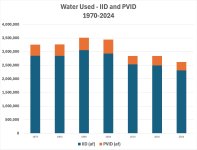
So they takeaway there is that the growers and ranchers of Imperial County have become about 25% more efficient in their water use in the past quarter century. And yet, it’s still 2.6 maf—more than currently used by any of the six other states party to the 1922 Compact.
Can they use even less and still make their operations work, still turn a profit?
It seems so. Let’s look at the Imperial County ag revenue since 2000. At the turn of the century, gross revenue was about $800 million. Now it’s closer to $2.5 billion… for essentially the same products, in the same quantity! And they’re using 25% less water to do it. Think about that for a second. Crop value has far outstripped inflation. The growers and ranchers are making a lot more money, and they are using a lot less water. It seems to me that if push came to shove, and they have to use even less water, they’d still be able to make a hefty profit on what they might grow with diminished water resources.
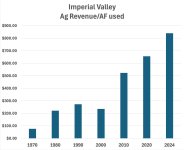
This next chart is an eye-opener. It shows how much ag revenue is realized per AF of water used, from 1970-2024. In 2000, it was about $235 in the pocket for every AF of water used for irrigation. In 2024, it’s up to about $840—more than 3.5 times the figure from a quarter century ago. This suggests that even if they cut their water use in half, they’d still be making more money than in the past on their diminished yields, even accounting for inflation.
Of course, no grower wants to reduce their profit if they can avoid it, but they might not have a choice if the water isn’t there. So if they were forced to cut back either through federal edict or a re-imagined Compact, where could they do it?
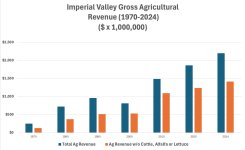
Well, just to keep this simple, here’s a chart comparing actual ag revenue since 1970 to what it would have been without cattle, alfalfa or lettuce. What you find is that those products have comprised a diminishing percentage of the County’s ag revenue over the past half century. In 1970, those products made up about half of the total ag revenue of the County. Today, it’s only about 35%.
Those same products use a lot of land and water. Although the cattle are mostly concentrated in feedlots, they use a lot of acreage indirectly, consuming alfalfa, hay and Bermuda grass grown elsewhere in the County. Roughly 60% of the total irrigated land in the county is used to grow those feed crops, with multiple harvests. Throw lettuce acreage in, and now were closer to 65% of all the irrigated cropland countywide. That consumes a disproportionately high volume of water.
Without getting into the math, if you eliminated the cattle, the feed crops and the lettuce, the county would make roughly 65% of the current revenue using about 35% of the irrigated land. That’s a whole lot less water used, and the total ag revenue would still be in the neighborhood of $1.4 billion, roughly what the industry generated in 2010. A more efficient operation. Not ideal in terms of total revenue for the local ag industry, but a whole lot better than nothing, and way more efficient when you consider land use and water consumption.
I’m no ag economist, just a guy with some data and a computer. But it seems to me there’s some wiggle room in there to change practices and further reduce water use without killing the ag industry in Imperial County. Now you can be sure the ag managers in the county know the intricacies of all this better than any of us, on how best to maximize profitable crop production, to improve efficiencies. And they’ll do that. But at the same time, you can be sure the IID and PVID will fight to protect their water rights, resist efforts to reduce, push against the upper basin states’ refusal to accept any cutbacks. It’s certainly true the IID has cut back more than any other entity in the past quarter century. It’s also true they still consume the most water not only within California’s share, but more than any other state is using right now.
There’s a perception, perhaps encouraged by Imperial County, that its ag products are critical to masses of people, consumed not only by Californians, but across the country and around the world. But from a revenue standpoint, their output is a drop in California's bucket. In 2024, the county’s ag revenue comprised only about 4% of the state’s massive $61 billion ag industry. Among the leading products California is famous for—grapes, almonds, milk, berries—Imperial County produces exactly none. Zero. They do produce a small amount of carrots and citrus, but it’s really cattle, lettuce and alfalfa that lead the way. And yet, revenue from cattle is only half that of Tulare County. Lettuce? Only a third of what’s produced in Monterey County. Imperial is an important ag county in the state. But it still only ranks #8, with a quarter of the revenue of the leading counties in the Central Valley, like Kern and Fresno counties.
Bottom line is that cutting back on ag production in Imperial County won’t make a huge difference for most products. They do produce 11% of the state’s cattle revenue. About 19% of the lettuce revenue. And 22% of the alfalfa. Beyond that, mostly negligible.
Even though they’ve already made big cuts to their water use, can the IID (and PVID for that matter) cut back even more, while still leaving the local farmers and ranchers in the green, without jeopardizing the availability of crucial products? It would seem so.
Is the IID the bad guy in this story? Not really. But it holds the keys to the car.
Somewhere in there is a path that leads to a fair solution for all the states, and it runs through the IID.
"The reason the Colorado River is in trouble is because of the farmers in the Imperial Valley who use way too much water growing a lot of alfalfa that gets exported out of the country."
But is that really the problem? Or are they just a convenient scapegoat?
Well, let’s start with what we know. The 2024 Imperial County Agricultural Crop and Livestock Report reveals a fairly diverse variety of ag products:
- Field Crops – 359,000 acres, about half of which is alfalfa (the rest includes Bermuda grass, sugar beets, wheat, and cotton)
- Vegetables and Melons – 106,000 acres (about 30% of which is lettuce, but also carrots, onions, cauliflower, spinach, corn, cantaloupes and other melons)
- Seed Crops – 51,000 acres, about half of which is alfalfa seed
- Fruit Crops – 9,600 acres (mostly dates, lemons and grapefruit)
- Cattle – 328,000 head
The total value of all this was about $2.5 billion in 2024.
Imperial County includes the entire southeastern corner of California, which goes beyond the boundaries of the Imperial Irrigation District, which comprises about 1,500 square miles focused on Imperial Valley, generally adjacent to or south of the Salton Sea. The far eastern part of the county adjacent to the Colorado River is within the Palo Verde Irrigation District, which also extends a bit into Riverside County, just to the north. The PVID is much smaller than the IID, about 189 square miles. But for our purposes, it’s convenient to assume that Imperial County ag approximates the boundaries of the IID and PVID together.
For now, let’s focus on the products that a lot of people are concerned about: lettuce, alfalfa and cattle. Lettuce and especially alfalfa are often perceived as low value crops that waste a lot of water. Since 2000, the amount of land in production of those crops in Imperial hasn’t changed much. For alfalfa, it’s about 150,000-180,000 acres. For lettuce, it’s somewhere just under 25,000 acres. Both alfalfa and lettuce can yield multiple crops in a single season, which is true of most ag products in Imperial County. Similar story for cattle—the number of head has held steady in the 21st century, roughly 300,000 a year, plus or minus.
So the short story is that for the past 25 years, Imperial County has grown pretty much the same things in the same amounts, with about the same number of acres under cultivation.
And yet…
The amount of water they have used to raise those crops and feed those cattle has decreased by about 25% over that time. In 2000, the IID and PVID collectively used about 3.4 maf. In 2024, they used about 2.6 maf. That’s quite a savings, but still a lot of water.
Here’s a graph showing the water use by IID and PVID together since 1970.
So they takeaway there is that the growers and ranchers of Imperial County have become about 25% more efficient in their water use in the past quarter century. And yet, it’s still 2.6 maf—more than currently used by any of the six other states party to the 1922 Compact.
Can they use even less and still make their operations work, still turn a profit?
It seems so. Let’s look at the Imperial County ag revenue since 2000. At the turn of the century, gross revenue was about $800 million. Now it’s closer to $2.5 billion… for essentially the same products, in the same quantity! And they’re using 25% less water to do it. Think about that for a second. Crop value has far outstripped inflation. The growers and ranchers are making a lot more money, and they are using a lot less water. It seems to me that if push came to shove, and they have to use even less water, they’d still be able to make a hefty profit on what they might grow with diminished water resources.
This next chart is an eye-opener. It shows how much ag revenue is realized per AF of water used, from 1970-2024. In 2000, it was about $235 in the pocket for every AF of water used for irrigation. In 2024, it’s up to about $840—more than 3.5 times the figure from a quarter century ago. This suggests that even if they cut their water use in half, they’d still be making more money than in the past on their diminished yields, even accounting for inflation.
Of course, no grower wants to reduce their profit if they can avoid it, but they might not have a choice if the water isn’t there. So if they were forced to cut back either through federal edict or a re-imagined Compact, where could they do it?
Well, just to keep this simple, here’s a chart comparing actual ag revenue since 1970 to what it would have been without cattle, alfalfa or lettuce. What you find is that those products have comprised a diminishing percentage of the County’s ag revenue over the past half century. In 1970, those products made up about half of the total ag revenue of the County. Today, it’s only about 35%.
Those same products use a lot of land and water. Although the cattle are mostly concentrated in feedlots, they use a lot of acreage indirectly, consuming alfalfa, hay and Bermuda grass grown elsewhere in the County. Roughly 60% of the total irrigated land in the county is used to grow those feed crops, with multiple harvests. Throw lettuce acreage in, and now were closer to 65% of all the irrigated cropland countywide. That consumes a disproportionately high volume of water.
Without getting into the math, if you eliminated the cattle, the feed crops and the lettuce, the county would make roughly 65% of the current revenue using about 35% of the irrigated land. That’s a whole lot less water used, and the total ag revenue would still be in the neighborhood of $1.4 billion, roughly what the industry generated in 2010. A more efficient operation. Not ideal in terms of total revenue for the local ag industry, but a whole lot better than nothing, and way more efficient when you consider land use and water consumption.
I’m no ag economist, just a guy with some data and a computer. But it seems to me there’s some wiggle room in there to change practices and further reduce water use without killing the ag industry in Imperial County. Now you can be sure the ag managers in the county know the intricacies of all this better than any of us, on how best to maximize profitable crop production, to improve efficiencies. And they’ll do that. But at the same time, you can be sure the IID and PVID will fight to protect their water rights, resist efforts to reduce, push against the upper basin states’ refusal to accept any cutbacks. It’s certainly true the IID has cut back more than any other entity in the past quarter century. It’s also true they still consume the most water not only within California’s share, but more than any other state is using right now.
There’s a perception, perhaps encouraged by Imperial County, that its ag products are critical to masses of people, consumed not only by Californians, but across the country and around the world. But from a revenue standpoint, their output is a drop in California's bucket. In 2024, the county’s ag revenue comprised only about 4% of the state’s massive $61 billion ag industry. Among the leading products California is famous for—grapes, almonds, milk, berries—Imperial County produces exactly none. Zero. They do produce a small amount of carrots and citrus, but it’s really cattle, lettuce and alfalfa that lead the way. And yet, revenue from cattle is only half that of Tulare County. Lettuce? Only a third of what’s produced in Monterey County. Imperial is an important ag county in the state. But it still only ranks #8, with a quarter of the revenue of the leading counties in the Central Valley, like Kern and Fresno counties.
Bottom line is that cutting back on ag production in Imperial County won’t make a huge difference for most products. They do produce 11% of the state’s cattle revenue. About 19% of the lettuce revenue. And 22% of the alfalfa. Beyond that, mostly negligible.
Even though they’ve already made big cuts to their water use, can the IID (and PVID for that matter) cut back even more, while still leaving the local farmers and ranchers in the green, without jeopardizing the availability of crucial products? It would seem so.
Is the IID the bad guy in this story? Not really. But it holds the keys to the car.
Somewhere in there is a path that leads to a fair solution for all the states, and it runs through the IID.
Last edited:
