Inflow thoughts & comments?

Rainbowbridge

Keeper of San Juan Secrets
Hi All,

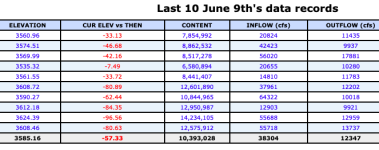
Was looking at 'inflows' this AM (Thanks, Dave.... (y) :love: ) and was amazed at the history...IE:

7,944 yesterday, 6/9
20, 824 same date 2025
40,554 all time this date....wow!
36,707 since 2000

Then looking at the last 10 years, and 2021 being almost twice today's....and then the 'average'.....as dear Ol' Dad would say....'Holy Smokes'!
1781096680788.png

So, couple O' questions for the sages....and apologize if this has been asked and answered before.....but remember i was born at a very young age......:rolleyes:

Is the 'pittance' of 7,944 yesterday from any snow left? Lingering Flaming gorge release? current rainfall? Monsoon activity?

Also, Is there any way to accurately gauge if this low inflow has occurred before, say since Powell's time? :unsure:

As always, mucho thanks for the WW education!

🙏(y)
 
GPT summary:
Water Year 2026 is widely considered the worst or among the worst snowpack years in the modern record for the Colorado River Basin, but it cannot be definitively called the lowest in all history because reliable basin-wide measurements do not extend far enough back.
So, the only “good news” is, it can’t be worse than this year? Sigh.
 
Actually, thinking about it a little more, our experts have explained that average snowpack no longer produces anything close to average inflow do to a variety of causes. So maybe it could be worse. A pretty good snowpack could still result in another paltry inflow. A near record snowpack may only produce an average inflow.
Sincerely,
Debbie Downer.
 
Hi All,

Was looking at 'inflows' this AM (Thanks, Dave.... (y) :love: ) and was amazed at the history...IE:

7,944 yesterday, 6/9
20, 824 same date 2025
40,554 all time this date....wow!
36,707 since 2000

Then looking at the last 10 years, and 2021 being almost twice today's....and then the 'average'.....as dear Ol' Dad would say....'Holy Smokes'!

View attachment 35947

So, couple O' questions for the sages....and apologize if this has been asked and answered before.....but remember i was born at a very young age......:rolleyes:

Is the 'pittance' of 7,944 yesterday from any snow left? Lingering Flaming gorge release? current rainfall? Monsoon activity?

Also, Is there any way to accurately gauge if this low inflow has occurred before, say since Powell's time? :unsure:

As always, mucho thanks for the WW education!

🙏(y)
Yes in 2022 that was at the time the lowest Lake Powell had been since filled. We had a snowfall in 2023 or 2024 and people though that look were ok. Not at all we have extreme weather conditions around the US with flash flooding in the Southeast. There problem of exterme weather and fire fires isn't limited to the US it's globally.
 
GPT summary:
Water Year 2026 is widely considered the worst or among the worst snowpack years in the modern record for the Colorado River Basin, but it cannot be definitively called the lowest in all history because reliable basin-wide measurements do not extend far enough back.
So, the only “good news” is, it can’t be worse than this year? Sigh.
Well yes it's even worse than 2022 which was at the time the lowest Lake Powell water level reached since filled so you don't have to look far back to see how dire the situation is.
 
Thanks for all your thoughts & comments, and we all figure that the Anasazi relocated to Switzerland ( :rolleyes: ) because of drought.....

was just wondering what level of drought thru history compared to today, and how many multiple years of a drought happened in the past....but yes, Flowerbug is right in looking at the tree ring studies......this will be a fun little search.......(y)
 
And just now I read that the WMO says 90% chance of Godzilla El Nino. Per report: it will exacerbate drought and heavy rainfall and increase the risk of heatwaves both on land and in the ocean, dogs and cats living together, mass hysteria.

And, . . . It is also expected that El Niño will delay Southern Arizona’s monsoonal season. The lack of rain will cause drier conditions, increasing the risk of wildfires. Then, when the season peaks, it could trigger more intense rainfall that could reach upwards of 150% of the normal average.
And the proof is that it is hot in Phoenix today.
 
Talk to the Anasazi
Anasazi This is the Native word that is often translated as ancient ones but literally means enemy ancestors. Because of this modern Native American tribe that are direst descendants find the term offensive. Ancestral Puebloans This is the preferred respectable term used by modern archeoligists, scholars and the US National Park Service to descripe this group.
 
Anasazi This is the Native word that is often translated as ancient ones but literally means enemy ancestors. Because of this modern Native American tribe that are direst descendants find the term offensive. Ancestral Puebloans This is the preferred respectable term used by modern archeoligists, scholars and the US National Park Service to descripe this group.
Toomato... tomato either way they left for a reason
 
Hi All,

Was looking at 'inflows' this AM (Thanks, Dave.... (y) :love: ) and was amazed at the history...IE:

7,944 yesterday, 6/9
20, 824 same date 2025
40,554 all time this date....wow!
36,707 since 2000

Then looking at the last 10 years, and 2021 being almost twice today's....and then the 'average'.....as dear Ol' Dad would say....'Holy Smokes'!

View attachment 35947

So, couple O' questions for the sages....and apologize if this has been asked and answered before.....but remember i was born at a very young age......:rolleyes:

Is the 'pittance' of 7,944 yesterday from any snow left? Lingering Flaming gorge release? current rainfall? Monsoon activity?

Also, Is there any way to accurately gauge if this low inflow has occurred before, say since Powell's time? :unsure:

As always, mucho thanks for the WW education!

🙏(y)
It's not from Flaming Gorge since they decreased their outflow to about 1K cfs for the last 2 weeks. It hasn't rained enough to cause that inflow so that leaves the last of the snowmelt as the likely culprit for the inflow that is keeping the lake at a steady state. I expect they will increase the Flaming Gorge contribution once the meager input from the last of the snowmelt is gone. It looks like they are only going to use FG to bump up the inflow to Powell when there is no other source like snowmelt or rainfall to keep it above about 3520 to 3525 ft.
 
It's not from Flaming Gorge since they decreased their outflow to about 1K cfs for the last 2 weeks. It hasn't rained enough to cause that inflow so that leaves the last of the snowmelt as the likely culprit for the inflow that is keeping the lake at a steady state. I expect they will increase the Flaming Gorge contribution once the meager input from the last of the snowmelt is gone. It looks like they are only going to use FG to bump up the inflow to Powell when there is no other source like snowmelt or rainfall to keep it above about 3520 to 3525 ft.
I just checked the old Lake Powell Water Database and they jacked up the outflow from Flaming Gorge to 4500 cfs on June 9 to make up for the loss of the snowmelt. It will be interesting to see if they cut it back to 1K cfs if and when the monsoons start.
 
Yes in 2022 that was at the time the lowest Lake Powell had been since filled. We had a snowfall in 2023 or 2024 and people though that look were ok. Not at all we have extreme weather conditions around the US with flash flooding in the Southeast. There problem of exterme weather and fire fires isn't limited to the US it's globally.
The low in 2022 was BEFORE the runoff. By July of 2022, it had come up a fair amount. The difference this year is we are flirting with the low and the runoff is basically done.
 
So, couple O' questions for the sages....and apologize if this has been asked and answered before.....but remember i was born at a very young age......:rolleyes:

Is the 'pittance' of 7,944 yesterday from any snow left? Lingering Flaming gorge release? current rainfall? Monsoon activity?

Also, Is there any way to accurately gauge if this low inflow has occurred before, say since Powell's time? :unsure:

As always, mucho thanks for the WW education!

🙏(y)
There's a couple of ways to answer these questions. If we are just looking at June 9 in isolation, the 7,944 cfs is just about the lowest flow on that date since Lake Powell came into existence. On June 9, 2012, the flow was 6,175 cfs, a hair lower. But it's more meaningful to look at the whole springtime flow if you want a better answer. And when you do that, you have to look at 2002, not 2012. That year had the lowest peak runoff since the advent of Lake Powell. On June 5, 2002, the flow peaked at 11,329 cfs. That is the lowest peak flow recorded since the reservoir began. This year comes pretty close, and might actually be worse. For a few days in mid-May this year, the inflow peaked at between 12-14,000 cfs--but that was when the gates were wide open at Flaming Gorge. Without that extra slug of water, it's doubtful that inflow to Lake Powell would have ever gotten much past 10,000 cfs.

So, yeah, I'm ready to say that 2026 is likely the worst inflow in the lake's history.

What about before Lake Powell? There's good flow records back to the beginning of the 20th century. But when you look at the worst of the years--like 1934, 1941, 1954, etc.--you end up seeing an aggregate flow to Lees Ferry of at least 15,000 cfs or so at some point. And 1934 is especially interesting, because at some point that summer, the San Juan ran completely dry. No flow for a while. Zero. And yet 1934 was not as bad overall as 2026.

So here's the verdict. It might not be quite over yet, but it's likely that 2026 will rank as the worst runoff year of either the 20th or 21st century. We're watching history unfold.

By the way, none of that is gonna stop me from being on Lake Powell for a week at the end of July. Leaving from Halls Crossing in a Bullfrog rental.
 
Back
Top