Fire at Wahweap

Status
Not open for further replies.
This did not start in the engine compartment, it started inside the boat.

So wait for the full report to know what happened.

For sure all speculation on my part from unconfirmed rumors and pics.

As a pilot I am fast to speculate and learn from all the possible failure points that could have caused the result. Sometimes that comes off as quick to judge or insensitive. Its not my intent to blame, but to learn.

I have already ordered an upgraded engine compartment fire suspension system and two larger fire extinguishers for our boat. Even if that was not the cause this accident it’s worth learning from.

Mike
 
Scary stuff! Our boat is slipped in B5. From the looks of things, that’s right where the action was happening. We had it up in Padre all week and came back into Wahweap this morning to the news. Luckily we weren’t doing a slip trip otherwise our boat might have gone up in flames. They had us park temporarily in another slip. Glad nobody lost their life. 70750343340__30EE2636-1110-4456-911C-87D6D623DEEA.jpeg
 
On a facebook page someone said it was an unattended stove or oven. We'll see if that's accurate.

I'm amazed at how good & accurate these fire professionals are at determining causes.

Hats off to 'em..... (y)
There are pictures that will help with the investigation.

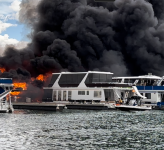
However, I agree that this will be hard with the heat that was coming off the fire, and the explosions of gas tanks. Even the water looked to be on fire with the gas that sprayed everywhere.
 
Scary stuff! Our boat is slipped in B5. From the looks of things, that’s right where the action was happening. We had it up in Padre all week and came back into Wahweap this morning to the news. Luckily we weren’t doing a slip trip otherwise our boat might have gone up in flames. They had us park temporarily in another slip. Glad nobody lost their life. View attachment 23245
I am glad you were out, it created a little bit of a fire block!
 
Pure speculation, but depending upon how/where the fire originated (point of origin) and how fast is spread, most folks do not know how to fight an incipient-stage fire (i.e., waste basket-size, oven, etc.), nor deploy their fire extinguisher(s). Once the fire has started that's not really the time to read the instructions on any available extinguisher(s). The simple acronym; "P.A.S.S." (Pull-Aim-Squeeze-Sweep) was how I was trained for incipient-size fires. Most important, was also trained to realize when the fire was simply too large for the extingusiher available. At that point, you use the extinguisher for one thing only... opening a path for your own route of egress. The last thing you want to do is blow your extingusiher on something that simply can't be extinguished with what's at hand and then find yourself trapped. It is excellent response to immediately recognize the scope of the problem and try to cut adjacent boats loose. So grateful there are some darn intelligent and quick-thinking folks out there that seem to have done (or at least attempted to have done) just that.

1) PULL EXTINGUISHER PIN;
2) AIM AT BASE OF FLAMES;
3) SQUEEZE TRIGGER;
4) SWEEP BACK-AND-FORTH (AS IF TRYING TO HOSE-OFF YOUR SIDEWALK WITH A HOSE).

Many times, myself included before aforementioned training (and annual re-training), folks panic and blow the extinguishing agent AT THE FLAMES, themselves, which actually accelerates and spreads the flames. Obviously, you have to try to recognize the fuel source as well. If, for example, the primary fuel is a pool of gasoline, you must ensure you don't just blow liquid gasoline all over the place, thus exacerbating the problem at nearly the speed of light (that was a joke, but I am certain the point is clear). Know your 'audience' and when to run.

Folks may consider contacting their local fire department and see if they are willing to train or point in the right direction. Typically fire fighting agencies are thrilled to have folks express such initiative. If nothing else, probably have some videos (and will certainly remind you to close the hood on your automobile/shut engine hatch if a fire starts under the hood/engine compartment, respectively, as well as close any doors/windows, hatches, etc. if possible). The next best thing to an extinguished fire is a retarded / slowed fire. Remove the oxygen, fuel, and/or heat (or impede any/all of those components)... you're dialed!

BIG PICTURE? For what it's worth, have some cognizance and/or plan as to how to operate a fire extinguisher BEFORE you need to draw on that knowledge. I actually saw a guy literally run in 5 or 6 approximately 3-foot diameter circles within 5 seconds when a small fire broke out where I worked years ago. EASILY in the top 3 most hilarious (and panicked) things I've ever seen in my entire life.
 
Last edited:
We race Offroad desert trucks and fuel the truck in remote pits with a 200 gallon pressurized fuel system. Lots can go wrong so we have proper fire gear, extinguishers and training.

We have had a couple fires on the truck and it’s surprising how little the small extinguishers will do. All of our fires have been put out but it took a couple extinguishers to do the job. On our race truck we have 1 small, 1 large, and large fire suppression system. We have had 3 fires and all took every bit of what we had to get out. And it took training and fast action by the crew to put out before it got too large.

The more we train and watch videos of when things go wrong the more you realize the average person has no idea how to fight a fire. And for sure does not have the tools.

We think more about fire safety with our race team than about fire safety on our houseboat. That’s changed after these two events.

Given the new info that the fire most likely started in the kitchen I have ordered 3 of the fire blankets for the kitchen, smoker, and bbq.

You have to have the right tool close and know how to use them.

Lots of room for improvement on our boat and I assume many others. As well as adding tools and training on the docks.


Mike
 
Pure speculation, but depending upon how/where the fire originated (point of origin) and how fast is spread, most folks do not know how to fight an incipient-stage fire (i.e., waste basket-size, oven, etc.), nor deploy their fire extinguisher(s). Once the fire has started that's not really the time to read the instructions on any available extinguisher(s). The simple acronym; "P.A.S.S." (Pull-Aim-Squeeze-Sweep) was how I was trained for incipient-size fires. Most important, was also trained to realize when the fire was simply too large for the extingusiher available. At that point, you use the extinguisher for one thing only... opening a path for your own route of egress. The last thing you want to do is blow your extingusiher on something that simply can't be extinguished with what's at hand and then find yourself trapped. It is excellent response to immediately recognize the scope of the problem and try to cut adjacent boats loose. So grateful there are some darn intelligent and quick-thinking folks out there that seem to have done (or at least attempted to have done) just that.

1) PULL EXTINGUISHER PIN;
2) AIM AT BASE OF FLAMES;
3) SQUEEZE TRIGGER;
4) SWEEP BACK-AND-FORTH (AS IF TRYING TO HOSE-OFF YOUR SIDEWALK WITH A HOSE).

Many times, myself included before aforementioned training (and annual re-training), folks panic and blow the extinguishing agent AT THE FLAMES, themselves, which actually accelerates and spreads the flames. Obviously, you have to try to recognize the fuel source as well. If, for example, the primary fuel is a pool of gasoline, you must ensure you don't just blow liquid gasoline all over the place, thus exacerbating the problem at nearly the speed of light (that was a joke, but I am certain the point is clear). Know your 'audience' and when to run.

Folks may consider contacting their local fire department and see if they are willing to train or point in the right direction. Typically fire fighting agencies are thrilled to have folks express such initiative. If nothing else, probably have some videos (and will certainly remind you to close the hood on your automobile/shut engine hatch if a fire starts under the hood/engine compartment, respectively, as well as close any doors/windows, hatches, etc. if possible). The next best thing to an extinguished fire is a retarded / slowed fire. Remove the oxygen, fuel, and/or heat (or impede any/all of those components)... you're dialed!

BIG PICTURE? For what it's worth, have some cognizance and/or plan as to how to operate a fire extinguisher BEFORE you need to draw on that knowledge. I actually saw a guy literally run in 5 or 6 approximately 3-foot diameter circles within 5 seconds when a small fire broke out where I worked years ago. EASILY in the top 3 most hilarious (and panicked) things I've ever seen in my entire life.
I had a truck burn to the ground about 12 years ago 20 miles from Bullfrog . Everything you are saying is dead on , I did everything wrong .
You have to Know when to Walk away , I learned that part.
 
 
Weird. thanks Sealegs. That’s close.

Here is another link

Emergency Fire Blanket for Home and Kitchen Fire Extinguishers for the House x2 Prepared Fire Blankets Emergency for Home Hero Fireproof Blanket Fire Retardant Blankets Grease Spray Emergency Blankets https://a.co/d/2Qq9fZr


Mike
 
I know there will be serious questions too. I usually am a pretty happy go lucky guy when it comes to Powell, if you don't expect to much from others you won't be disappointed. But when it comes to subjects of preparedness and safety I try to be a stickler; Caution and personal responsibility go a long way around here because boating/house boating on Powell can get you into some dangerous situations at times.

I don't want to say to much but I think we got lucky and dodged a bullet on this fire. Had the winds been going towards the store and G docks instead of away we could have lost much of the marina. IF it turns out to be true that the hydrant sized water supply was not working nor was there a fire fighting pumper boat on the water then that would really be true.
18E3804D-491E-4F9D-B088-4333B870DB6A.jpeg
 
Last edited:
I was not planning on going to work during our Powell trip but as a career firefighter its not in my DNA to stay away during an emergency. We were wake surfing close by when the fire started and luckily got there early on. Just as we pulled to the west side of B dock we found an employee trapped on end of a dock (not sure why she didn't jump in the lake, perhaps couldn't swim?) with everyone yelling and pointing at her. We quickly pulled our ski boat up and had her jump on (my daughter caught a pic that's attached). Next I flagged a willing guy on a jet ski to attempt to get some water on this inferno. I once put out a ski boat fire on Saguaro lake with a jet ski by standing on the front which made the nose dive down and allowing the water jet to shoot into the air. Our attempts were in vain as his jet ski was to buoyant. It was at this time one of the boats on fire floated into the taxi way between B and Pier One 11 and was pushed by the wind right into Pier One 11 slip 19 catching the back of it on fire. I had my new jet ski buddy drop me off on the end of Pier One 11 to see what could be done. The wind blew the fully involved boat from the taxi way out into the breakwater (this was good) but it left the back of the slip 19 boat on fire. I yelled at some bystanders to grab extinguishers and we went to work. With three or four of us ejecting extinguisher after extinguisher we got the fire out! We saved that sucker and it was awesome!! Had we not been able to put that back deck out, slip 19 and 20 (both massive ships) would have gone up in flames.

I then went to see what could be done next and found a top executive with two assistants walking the Pier One 11 and I asked where are the fire suppression equipment. He said they have a fire boat that is in the shop getting a new motor. What an unacceptable answer. If the fire boat is in the shop, where is the back up boat?! Where are the hoses and pumps, portable extinguishing systems (besides extinguishers), golf carts with pumps, ANYTHING!! We are on water for crying out loud, half the solution is right under our feet, we just need to pump it!!

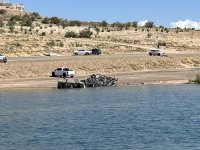
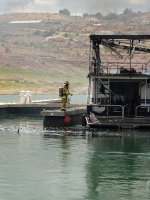
Many of you who have identified the elephant in the room, where were any suppression tools besides extinguishers. Please be aware, that it is possible that the marina meets all standards REQUIRED by them but that depends on what code they are mandated to follow (not sure what that is yet). NFPA 303 seems to be the governing standard which only requires extinguishers every 75 feet. I am a municipal firefighter in a large city and never had to deal with a marina. But what you HAVE to do versus what you SHOULD do are two different things. Lots of money and lives are floating in that marina and proper protection SHOULD be in place. Calling Page Fire Dept. (they did all they could) and shuttling one firefighter in gear at a time out in boats with a trash pump is not acceptable (Marina Bum's picture above says it all). The response time on this was beyond pathetic. I will say, the wind was a critical factor on this fire and even with fire hoses and pumps it would have been a tough one but certainly the situation could have been improved and property loss mitigated.

I absolutely hope those that manage Wahweap take some serious heat (pun intended) for what happened and learn from this very costly lesson (they are very lucky nobody died). You may have heard the slogan, "If you fail to plan, then you plan to fail" and Wahweap Marina failed in my humble opinion. Own it and make things right by putting proper fire protection in place to ensure a tragedy to this scale is minimized in the future. 1Screenshot 2023-06-05 075308.png
 
Status
Not open for further replies.
Back
Top