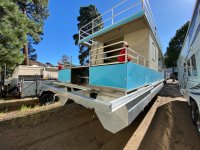
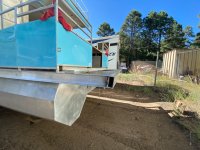
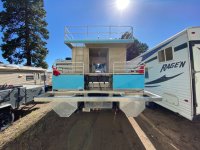
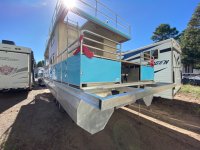
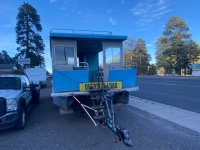
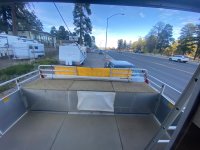
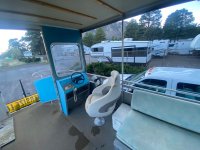
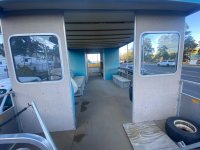
VERY EXCITING…
I agree with everything.
A lot to unpack…
1 - changing lake conditions (no predictable water level - short cut to warm creek is the driver to this build). Remember we could be at dead pool without that lucky storm 2 years ago.
2 - changing boat use conditions (family vrs solo)
3 - chaotic congestion to access upper lake (antelope and Maytag)
4 - time investment to get up lake to enjoy mental calmness with cut closed (extra 3 hours per trip)
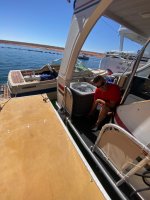
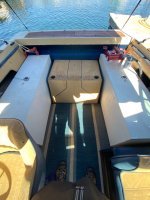
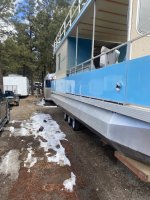
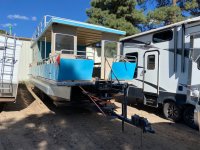
5 - feature set above water line in new build - hard walled day tripper with inside toilet - fast houseboat
6 - wing design - tons of variables but proven concept - explore flying electric boats in Europe
7 - horsepower - basically determined by fuel tank size and burn rate - better to refine wing than add extra power and bigger tanks. Have a happy balance of speed / power…
8 - speed factors - wetted area / water line / weight / entry angle / hull speed / theoretical wave resistance / lateral & direct wind drag / waves / prop size (larger better)
9 - build cost - who cares
10 - fun factor building it - huge
11 - fun factor using it - huge
12 - ownership cost - slip - insurance / hours used - who cares
13 - ease of use - smaller fast micro houseboat vrs larger existing big house boat - significant
I can tell this thread for me will be like a new girlfriend in college - full of surprises everyday with a unpredicted and unbalanced amount of pleasure and displeasure.
There are two projects in play - the above waterline structure and the feature set for comfort and the below water line dynamics focused on the forced shape of the hull and design and efficiency of the wing and then power choices.
The hull shape is displacement so getting on plane is a rabbit hole - it is on plane in the slip. The only way to improve the shape of the hull for wetting area coefficient would be to make the toons round, but the toons are not round so just play the cards you have.
Hull speed analysis will be easy and conventional horsepower / speed curves will be predictable for the most part with known wetted area and waterline and weight. The curve ball here is the unknown wing multiplier which will be much greater than 1. Remember - the wing has wetted area too.
The fascinating part for me will be the main wing shape and size and the dynamics of the secondary elevator design for controlling angle of attack at CL point across changing velocities. Is the main wing fixed or adjustable while in motion… Consider a pressure breakaway to pop the linkage at excessive negative load in event of catching a wave and entering nose low.
I think the largest limiting factor of the lifting wing design is the forced requirement of fitting it on a trailer - if you do not have to trailer this thing, you can get very creative with winglet length and cantilevered shape vrs a short center wing. With a short center wing you may discover the hull is always hunting or chasing for roll balance and thus may always be rocking back and forth on center line, with a larger wing that produces more lift with greater stability farther outside of centerline axis the hunt or rolling will be reduced with added ability to also deliver less wetted area and higher speed. A longer wing with shorter chord or a shorter wing with longer chord - A quick YouTube on fluid dynamics will hit the high points, or just get a multi variable app - reach out to Jimbo. If no joy on the app just get a pencil and a pizza box or a napkin, and 2 beers.
The factory boys have attempted to reduce wetted area by simply adding lifting strakes to the sides of the toons - the wing will absolutely have higher efficiency and much greater adjustability to gain max performance at any set variable - tune angle for max speed or for best fuel burn, etc. With enough wing and proper thrust you can change the designation of displacement hull to flying hull. And that would just kick a$$.
At the end of the day the smaller flying pontoon offers 2 key benefits. It provides a platform that is easier to manage while also getting you through the chaos and into the adventure faster - once you pass 25 or better yet, have west at 6 o clock, you can throttle back and enjoy the powell at any speed. Once you get away from the people and the wakeboat d1cks you can slow down…
I would focus on wing performance and lower weight instead of horsepower to reduce need for more gas which forces more weight. Definitely install larger tanks for greater range not for top speed. But if you do need to burst, a set of 250’s can easily drink 45 gallon per hour… at $7 / gallon that $300 per hour.
What is your time worth…
If you go with solar and a gas generator and electric azipods for propulsion you can also enjoy dynamic postioning, but I would still bring an anchor and a desiginated digger or better yet a drill and a few steel pins.
Cheers…
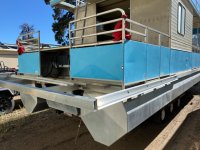
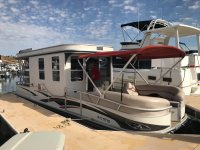
Thanks for your supportive feedback. I'm looking at the Day Tripper as a money saving option and as a time saving utilitarian setup both.
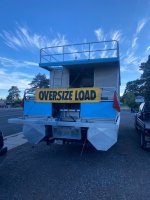
I agree with you 100 percent that without the heavy snowpack of the winter of 22/23 and the resulting inflow we could have seen a far different situation today. With a trailerable boat you can self launch on your time and potentially launch yourself even if all of the improved ramps are closed. You don't have to have a slip or a buoy either as long as your truck can handle the load.
Plus with a smaller boat you can slip hop, get a slip just for the summer, narrow 40 and 50 slips abound. If you get into the office in the spring they are nearly always available. My 20x75 premium slip under my big boat is in a must pay situation; If I ever let it go even one month someone would snatch it up, they are in short supply. Someday I'll sell that big boat and I'm looking to still get out on the lake, that's part of this build too.
As far as the performance goes I'm trying to find a sweet spot

where I can reduce running area at speed with the help of my Hydrofins and reduce power while keeping much of the lift. I have fins on my 25 foot pontoon boat with a 115 hp outboard and it works well there. Once up and trimmed up
at full throttle I can reduce power by 1/3 and only loose a couple of miles per hour. The nose stays high and the whole ride is much softer and quieter. If you reduce power too much or trim to high you'll loose the lift, you'll feel the nose drop. So you've got to find the sweet spot.
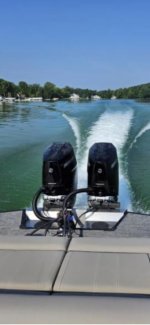
I'm hoping that if I can run at 30 MPH WOT on the Day Tripper (a big if) with Hydrofins I'm sure I'd be consuming near the rated 17 GPH in each engine. The sweet spot could be to reduce throttle by 1/3, drop to 24 to 26 mph and reduce consumption to something like 12 GPH each. If that would hold true then that would be 1 mile per gallon with a camper boat/party boat/personal tour boat and that would be very efficient; Twenty four miles up lake in one hour on 24 gallons of fuel. One reason I'm starting with pontoons rather than tritoons is that Hydrofin only work on Pontoons Boats. In some other technical fields I play in they have a saying that"sometimes 2 plus 2 can equal 5 or 6" That's kinda what I'm looking for on efficiency here
Those are my hopes anyway, we will see.
I haul my own fuel in a tanker I built out of an old cruiser that I bought on the cheap so I'm almost 100 percent more efficient than buying it on the lake to begin with, I only burn non-ethanol fuel. I launch and put around and fill all my watercraft in the marina
Thanks again Bubba