

JFRCalifornia
Keeper of San Juan Secrets
It’s easy to see with your own eyes that flows from the Colorado River are not keeping up with the demand on those resources. But is this really something new? Or had we just not noticed before? Or is it possible that there really is no “structural deficit,” as the phenomenon of chronic shortage has come to be known?
If you go back in time, it’s obvious why the original 1922 Compact assumed there’d be enough water for the way they intended to divide the river. The “natural flow” of the river (i.e., before any diversions) averaged 18.1 maf from 1906-22. If that had kept up, it was believed there would have been plenty to supply both the upper and lower basins (up to 15 maf), Mexico, and even account for evaporation. But of course after the 1920s, it never maintained that average again in any 10-year period, except for once, from 1978-87. So yes, there was a structural deficit built into the system, assuming all users would take what the Compact had assumed.
But the fact is that the upper and lower basin have collectively never taken more than 12.5 maf in any given year, so is it possible that actual supply and demand have been balanced?
Let’s start on the supply side of things. The USBR has good data about the natural flow of the river system all the way back to 1906, but to be able to compare this with reliable (and available) water use numbers, and focus on the realities of the more recent past, let’s just go back to 1971. Natural flow really just refers to what the river would produce if nobody took any water from it, including the evaporation that occurs from the major reservoirs along the length of the system. If you look at the last 55 years in aggregate (1971-2026), you come up with an average natural flow of 13.7 maf. It’s also true that in recent years, it’s been considerably less. Here’s a breakdown of natural flow in different recent timeframes:
1971-2026 – 13.7 maf
2000-2026 – 11.9 maf
2018-2026 – 10.6 maf
I won’t get into the reasons why, but suffice to say, the natural flow has been generally shrinking, and that even accounts for big years like 2011, 2019, and 2023, all of which had natural flows in the 17-20 maf range.
On the flipside, the natural flows from 1971-99 were relatively robust, an average of 15.4 maf, even with a few down years sprinkled in. Many years exceeded 20 maf, including every year from 1983-86. Put a pin in that, because I’m going to come back to that point later, when I do a final accounting of “what happened to all that excess water?”
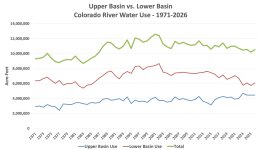
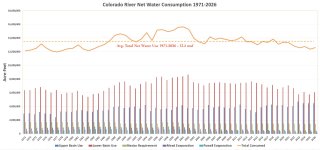
Now on the water demand side, I’ll simplify it for now, and just focus on the major draws from the system. It basically comes down to Upper Basin use, Lower Basin use, the water that is required to be delivered to Mexico, and the evaporation from Lake Mead and Powell. There are other straws in the drink—seepage, sublimation, and evaporation from other water bodies, including the river itself, but for now, let’s set those aside. And when you add all that up, you come up with a remarkably consistent annual use since 1971, in the ballpark of 13.5 maf. Collective water use reached its peak in 2001, at about 15.6 maf. It’s been up and down a bit over the years, but it’s actually lower today than any time since the mid-1980s. In 2025, collective water use from those sources was just 12.4 maf. It hasn’t been that low since 1987. (At the same time, Upper Basin use has generally been rising, hitting an all-time high of 4.7 maf in 2023.)
Here's a comparison of Upper Basin vs. Lower Basin use from 1971-2026, where you can see the use trending upward in the upper basin, declining in the lower basin...
The following chart summarizes the total average annual water use from these sources, including the two basins, Mexico, and major reservoir evaporation.
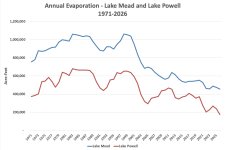
The major reason for the recent decline in overall water use is recent substantial cutbacks in Lower Basin use, and significantly lower evaporation from Mead and Powell, mostly because their surface areas have declined dramatically as their volume has shrunk. (Along with temperature, surface area is the primary driver of evaporation.) Take a look at this chart—evaporation in those two reservoirs has shrunk greatly, a silver lining in their recent decline. In the mid-1980s, collective evaporation from Mead and Powell was about 1.7 maf. Today, it is closer to 0.7 maf. But what has remained fairly constant is that evaporation from Lake Mead is about 67% higher than whatever is evaporating from Lake Powell in any given year. That’s an eye opener, and an important consideration for determining where best to store water in the system to minimize loss. This knotty fact runs counter to whatever virtues the GCI’s Fill Mead First campaign might otherwise have.
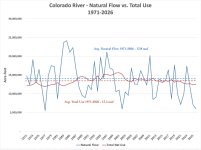
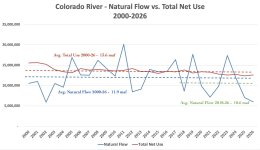
Now let’s put it all together. What happens when you overlay the natural flow of the river with total water use? Since 1971, it’s surprisingly almost balanced—actually, average annual natural flow exceeds total use by about 0.3 maf. How could this be? Aren’t we almost out of water? Are we missing something? Put a pin in that one too; we’ll get back to that in a minute. What is certainly true is that since 2000, the river system is running a net annual deficit of about 1.7 maf, and if you focus on the most recent period since 2018, the annual deficit is closer to 3 maf—even with shrinking demand numbers. That’s a clear indication of severely drying conditions, and a near systemic hemorrhage of water supply considering the depleted state of what remains in storage in the larger reservoirs.
Here’s a chart summarizing the natural flows since 1971, overlaid on top of total water demand in that timeframe.
Here's the same chart, but focused on just what has happened in the 21st century. Here you can see that total water demand has exceeded the shrinking natural flow.
So now let’s go back to something I mentioned earlier, about the spectacular gains in the system during the 1980s. If we had all that excess water then, why aren’t we reaping the benefits of that right now? Can’t we draw on that? No, and here’s why. It comes down to the limits in the overall storage capacity of the system. When Powell and Mead are full, they can hold a collective capacity of about 50 maf (as of 6-8-26, they collectively have a little over 13 maf in live storage). Any excess has to be let go. During the mid-1980s, those two reservoirs were more or less full. That meant that no matter how big the runoff was during those years, a substantial amount of the potential gain had to be discharged out of the system, to Mexico and beyond, to the Sea of Cortez.
That picture becomes clear when you examine the following chart, comparing the amount of water required to be delivered to Mexico each year, to what was actually sent across the border.
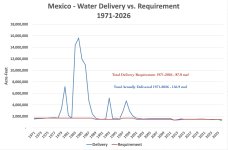
The 1944 treaty obligation to Mexico requires sending 1.5 maf annually (there are slight variations in that amount from year to year). Going through USBR records, that’s a collective 88 maf since 1971. But here’s the number that jumps out at you—the amount actually discharged across the border since then has been nearly double that—about 157 maf! And the chart clearly tells you why. In most years, USBR sent exactly what was required to Mexico. But in a few specific years in the late 70s, the mid-80s and in the 90s, vastly more was discharged. That’s because there was nowhere to store all that water in any upstream reservoir. As an example, each year from 1983-86, when the reservoirs were full, anywhere from 10-16 maf was discharged to the Sea of Cortez, right out of the Colorado River system, unavailable for future use.
In short, about 69 maf were discharged outside the system since 1971, used by no human. That’s an average of about 1.25 maf per year. On the one hand, some might say “what a waste,” that the region could have used that water today. On the other hand, many would argue that’s exactly how rivers are supposed to work. They flow, and eventually discharge to the sea. That flow water creates critical habitat, a thriving delta, contributes to necessary silt deposition to stabilize the river banks. But none of these armchair quarterback arguments matter now, since there were few if any voices complaining about a lack of water in 1986. Extra water flowing to the sea was almost nobody’s concern at the time. And today, it's all water under the bridge, so to speak.
This all begs the hypothetical question—should there have been more storage capacity in the system beyond Mead, Powell, and the other smaller reservoirs we have today? Would that have solved our current water crisis? There were certainly proposals for many more dams as far back as the 1920s, and more recently two major reservoirs in the Grand Canyon that were shelved in the late 1960s.
It’s a contentious point. There would have been massive trade-offs had any of those projects gone forward, and certainly some major unforeseen consequences. For many people, it is unimaginable to envision a Grand Canyon with two giant reservoirs, one in Marble Canyon, the other farther downstream, which would have formed a 90-mile-long reservoir in the lower Grand Canyon. And more importantly, would any of those reservoirs have made a difference in the long run? It’s entirely possible, for example, if there was more storage capacity, there’d be substantially more water use and less conservation in the system, much in the same way that when you add an extra lane on a freeway in a big city, more cars tend to use that freeway, and congestion happens anyway. You can’t really build your way out of a long-term problem. And when a river runs dry, it doesn’t matter how many reservoirs you have, they are still empty.
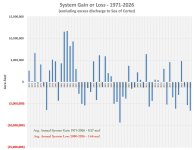
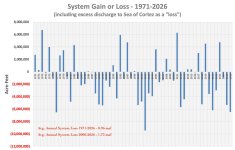
I’ll end this with a couple of charts that show the year-to-year system losses and gains when you summarize everything into a bar chart. I’ll show it two ways—what the system gains and losses were if you don’t consider what was discharged to the Sea of Cortez during the years of overabundance, and the other showing what really happened. You will see, for example, that in spite of the huge runoff years during the mid-1980s, the net effect on the river system in terms of increased storage was pretty much zero. And that’s because those reservoirs were already full, plain and simple. The giant runoff in those years was mostly just passed through to the sea.
You can’t really blame USBR "losing" that excess water. It’s one thing to try to manage long-term resources in a wet environment with predictable rain and snowfall. But in the desert southwest, that’s not how it works. There are years of extremes, in both directions. Trying to manage for a middle road ignores the realities the region has always faced. In the big picture, it is entirely possible that the system is “balanced” on paper, in the sense that natural flow and actual water use both have tended to hover in the 13-14 maf range over the last half century. But you can’t plan for that. The huge year-to-year variations in a delicately balanced system can wreak havoc in the short term, and just a few down years in a row can cause panic or even collapse, even if that’s exactly how the river has always operated. As humans, we’re just not comfortable with that. We don’t like uncertainty. But with the Colorado River, that’s all we have. It’s all we’ve ever had.
How to move forward with the realities we face? It starts by recognizing that for long periods of time, the river may only provide 9-10 maf (and sometimes less), not 13 maf or more. And that the flow can change quickly year-to-year. Predictions and models have proven to be poor indicators of the future, even of the very next year. That means any future interstate agreement needs to be responsive to those short-term changes, especially when we have very little in storage for the long-term. That appears to be the current thinking, maybe by default, as the states can’t seem to agree on a long-term plan. They might have to meet every year for the foreseeable future. So be it.
In that context, there are many reasonable things that can be done. Many states can do a much better job conserving water. It is possible for coastal cities to find alternate water supplies, and it’s reasonable for their current river rights to be made financially whole to do that. It is reasonable for inland desert cities to seek new water supplies (as Phoenix is doing), but to recognize there are limits to growth, what a desert can actually sustain. And to be realistic about what it costs to sustain that population. As for agriculture, it's better to focus on limiting total water use rather than limiting the types of crops grown.
This much seems certain: we’re not going to be building new dams of any size anywhere to save the day. We don’t have the money or stomach for giant reservoirs in Canada and pipelines and tunnels to take that water to the Southwest. We have to work with the tools we have, and the states have a mutual interest to cooperate with one another. One state’s failure is every state’s failure...
One final thought. We can argue about whether the Compact was intended to split things evenly between the Upper and Lower basins (it wasn’t), or whether it really was intended to favor the Lower basin all along (it was). But at this point, regardless of original intent, we have a track record of water use from all the states, what we have all been living with for decades, sort of an informal balance. To me, that means from here on, each state needs to proportionally ratchet back what they are already consuming in response to any shortages. Is that fair? We'll never agree on what "fair" means, but we can coalesce around what is possible. And along those lines, to the extent possible, it also means limiting upstream transfers of water outside the system, as has happened for a century along the front range in Colorado, or for that matter, to Salt Lake City. (In 2024, over 800,000 af was transferred out of the basin, either across the continental divide to eastern Colorado, or to the Salt Lake metro area.) That water is gone before it ever has a chance to benefit anybody else downstream in the Colorado River watershed, with all return flow headed in some other direction…
If you go back in time, it’s obvious why the original 1922 Compact assumed there’d be enough water for the way they intended to divide the river. The “natural flow” of the river (i.e., before any diversions) averaged 18.1 maf from 1906-22. If that had kept up, it was believed there would have been plenty to supply both the upper and lower basins (up to 15 maf), Mexico, and even account for evaporation. But of course after the 1920s, it never maintained that average again in any 10-year period, except for once, from 1978-87. So yes, there was a structural deficit built into the system, assuming all users would take what the Compact had assumed.
But the fact is that the upper and lower basin have collectively never taken more than 12.5 maf in any given year, so is it possible that actual supply and demand have been balanced?
Let’s start on the supply side of things. The USBR has good data about the natural flow of the river system all the way back to 1906, but to be able to compare this with reliable (and available) water use numbers, and focus on the realities of the more recent past, let’s just go back to 1971. Natural flow really just refers to what the river would produce if nobody took any water from it, including the evaporation that occurs from the major reservoirs along the length of the system. If you look at the last 55 years in aggregate (1971-2026), you come up with an average natural flow of 13.7 maf. It’s also true that in recent years, it’s been considerably less. Here’s a breakdown of natural flow in different recent timeframes:
1971-2026 – 13.7 maf
2000-2026 – 11.9 maf
2018-2026 – 10.6 maf
I won’t get into the reasons why, but suffice to say, the natural flow has been generally shrinking, and that even accounts for big years like 2011, 2019, and 2023, all of which had natural flows in the 17-20 maf range.
On the flipside, the natural flows from 1971-99 were relatively robust, an average of 15.4 maf, even with a few down years sprinkled in. Many years exceeded 20 maf, including every year from 1983-86. Put a pin in that, because I’m going to come back to that point later, when I do a final accounting of “what happened to all that excess water?”
Now on the water demand side, I’ll simplify it for now, and just focus on the major draws from the system. It basically comes down to Upper Basin use, Lower Basin use, the water that is required to be delivered to Mexico, and the evaporation from Lake Mead and Powell. There are other straws in the drink—seepage, sublimation, and evaporation from other water bodies, including the river itself, but for now, let’s set those aside. And when you add all that up, you come up with a remarkably consistent annual use since 1971, in the ballpark of 13.5 maf. Collective water use reached its peak in 2001, at about 15.6 maf. It’s been up and down a bit over the years, but it’s actually lower today than any time since the mid-1980s. In 2025, collective water use from those sources was just 12.4 maf. It hasn’t been that low since 1987. (At the same time, Upper Basin use has generally been rising, hitting an all-time high of 4.7 maf in 2023.)
Here's a comparison of Upper Basin vs. Lower Basin use from 1971-2026, where you can see the use trending upward in the upper basin, declining in the lower basin...
The following chart summarizes the total average annual water use from these sources, including the two basins, Mexico, and major reservoir evaporation.
The major reason for the recent decline in overall water use is recent substantial cutbacks in Lower Basin use, and significantly lower evaporation from Mead and Powell, mostly because their surface areas have declined dramatically as their volume has shrunk. (Along with temperature, surface area is the primary driver of evaporation.) Take a look at this chart—evaporation in those two reservoirs has shrunk greatly, a silver lining in their recent decline. In the mid-1980s, collective evaporation from Mead and Powell was about 1.7 maf. Today, it is closer to 0.7 maf. But what has remained fairly constant is that evaporation from Lake Mead is about 67% higher than whatever is evaporating from Lake Powell in any given year. That’s an eye opener, and an important consideration for determining where best to store water in the system to minimize loss. This knotty fact runs counter to whatever virtues the GCI’s Fill Mead First campaign might otherwise have.
Now let’s put it all together. What happens when you overlay the natural flow of the river with total water use? Since 1971, it’s surprisingly almost balanced—actually, average annual natural flow exceeds total use by about 0.3 maf. How could this be? Aren’t we almost out of water? Are we missing something? Put a pin in that one too; we’ll get back to that in a minute. What is certainly true is that since 2000, the river system is running a net annual deficit of about 1.7 maf, and if you focus on the most recent period since 2018, the annual deficit is closer to 3 maf—even with shrinking demand numbers. That’s a clear indication of severely drying conditions, and a near systemic hemorrhage of water supply considering the depleted state of what remains in storage in the larger reservoirs.
Here’s a chart summarizing the natural flows since 1971, overlaid on top of total water demand in that timeframe.
Here's the same chart, but focused on just what has happened in the 21st century. Here you can see that total water demand has exceeded the shrinking natural flow.
So now let’s go back to something I mentioned earlier, about the spectacular gains in the system during the 1980s. If we had all that excess water then, why aren’t we reaping the benefits of that right now? Can’t we draw on that? No, and here’s why. It comes down to the limits in the overall storage capacity of the system. When Powell and Mead are full, they can hold a collective capacity of about 50 maf (as of 6-8-26, they collectively have a little over 13 maf in live storage). Any excess has to be let go. During the mid-1980s, those two reservoirs were more or less full. That meant that no matter how big the runoff was during those years, a substantial amount of the potential gain had to be discharged out of the system, to Mexico and beyond, to the Sea of Cortez.
That picture becomes clear when you examine the following chart, comparing the amount of water required to be delivered to Mexico each year, to what was actually sent across the border.
The 1944 treaty obligation to Mexico requires sending 1.5 maf annually (there are slight variations in that amount from year to year). Going through USBR records, that’s a collective 88 maf since 1971. But here’s the number that jumps out at you—the amount actually discharged across the border since then has been nearly double that—about 157 maf! And the chart clearly tells you why. In most years, USBR sent exactly what was required to Mexico. But in a few specific years in the late 70s, the mid-80s and in the 90s, vastly more was discharged. That’s because there was nowhere to store all that water in any upstream reservoir. As an example, each year from 1983-86, when the reservoirs were full, anywhere from 10-16 maf was discharged to the Sea of Cortez, right out of the Colorado River system, unavailable for future use.
In short, about 69 maf were discharged outside the system since 1971, used by no human. That’s an average of about 1.25 maf per year. On the one hand, some might say “what a waste,” that the region could have used that water today. On the other hand, many would argue that’s exactly how rivers are supposed to work. They flow, and eventually discharge to the sea. That flow water creates critical habitat, a thriving delta, contributes to necessary silt deposition to stabilize the river banks. But none of these armchair quarterback arguments matter now, since there were few if any voices complaining about a lack of water in 1986. Extra water flowing to the sea was almost nobody’s concern at the time. And today, it's all water under the bridge, so to speak.
This all begs the hypothetical question—should there have been more storage capacity in the system beyond Mead, Powell, and the other smaller reservoirs we have today? Would that have solved our current water crisis? There were certainly proposals for many more dams as far back as the 1920s, and more recently two major reservoirs in the Grand Canyon that were shelved in the late 1960s.
It’s a contentious point. There would have been massive trade-offs had any of those projects gone forward, and certainly some major unforeseen consequences. For many people, it is unimaginable to envision a Grand Canyon with two giant reservoirs, one in Marble Canyon, the other farther downstream, which would have formed a 90-mile-long reservoir in the lower Grand Canyon. And more importantly, would any of those reservoirs have made a difference in the long run? It’s entirely possible, for example, if there was more storage capacity, there’d be substantially more water use and less conservation in the system, much in the same way that when you add an extra lane on a freeway in a big city, more cars tend to use that freeway, and congestion happens anyway. You can’t really build your way out of a long-term problem. And when a river runs dry, it doesn’t matter how many reservoirs you have, they are still empty.
I’ll end this with a couple of charts that show the year-to-year system losses and gains when you summarize everything into a bar chart. I’ll show it two ways—what the system gains and losses were if you don’t consider what was discharged to the Sea of Cortez during the years of overabundance, and the other showing what really happened. You will see, for example, that in spite of the huge runoff years during the mid-1980s, the net effect on the river system in terms of increased storage was pretty much zero. And that’s because those reservoirs were already full, plain and simple. The giant runoff in those years was mostly just passed through to the sea.
You can’t really blame USBR "losing" that excess water. It’s one thing to try to manage long-term resources in a wet environment with predictable rain and snowfall. But in the desert southwest, that’s not how it works. There are years of extremes, in both directions. Trying to manage for a middle road ignores the realities the region has always faced. In the big picture, it is entirely possible that the system is “balanced” on paper, in the sense that natural flow and actual water use both have tended to hover in the 13-14 maf range over the last half century. But you can’t plan for that. The huge year-to-year variations in a delicately balanced system can wreak havoc in the short term, and just a few down years in a row can cause panic or even collapse, even if that’s exactly how the river has always operated. As humans, we’re just not comfortable with that. We don’t like uncertainty. But with the Colorado River, that’s all we have. It’s all we’ve ever had.
How to move forward with the realities we face? It starts by recognizing that for long periods of time, the river may only provide 9-10 maf (and sometimes less), not 13 maf or more. And that the flow can change quickly year-to-year. Predictions and models have proven to be poor indicators of the future, even of the very next year. That means any future interstate agreement needs to be responsive to those short-term changes, especially when we have very little in storage for the long-term. That appears to be the current thinking, maybe by default, as the states can’t seem to agree on a long-term plan. They might have to meet every year for the foreseeable future. So be it.
In that context, there are many reasonable things that can be done. Many states can do a much better job conserving water. It is possible for coastal cities to find alternate water supplies, and it’s reasonable for their current river rights to be made financially whole to do that. It is reasonable for inland desert cities to seek new water supplies (as Phoenix is doing), but to recognize there are limits to growth, what a desert can actually sustain. And to be realistic about what it costs to sustain that population. As for agriculture, it's better to focus on limiting total water use rather than limiting the types of crops grown.
This much seems certain: we’re not going to be building new dams of any size anywhere to save the day. We don’t have the money or stomach for giant reservoirs in Canada and pipelines and tunnels to take that water to the Southwest. We have to work with the tools we have, and the states have a mutual interest to cooperate with one another. One state’s failure is every state’s failure...
One final thought. We can argue about whether the Compact was intended to split things evenly between the Upper and Lower basins (it wasn’t), or whether it really was intended to favor the Lower basin all along (it was). But at this point, regardless of original intent, we have a track record of water use from all the states, what we have all been living with for decades, sort of an informal balance. To me, that means from here on, each state needs to proportionally ratchet back what they are already consuming in response to any shortages. Is that fair? We'll never agree on what "fair" means, but we can coalesce around what is possible. And along those lines, to the extent possible, it also means limiting upstream transfers of water outside the system, as has happened for a century along the front range in Colorado, or for that matter, to Salt Lake City. (In 2024, over 800,000 af was transferred out of the basin, either across the continental divide to eastern Colorado, or to the Salt Lake metro area.) That water is gone before it ever has a chance to benefit anybody else downstream in the Colorado River watershed, with all return flow headed in some other direction…
Last edited: