
You are using an out of date browser. It may not display this or other websites correctly.
You should upgrade or use an alternative browser.
You should upgrade or use an alternative browser.
April 24 - 27, 2023 Lake Level Relatively Dramatic Drop (est. 2' - 4.5')
- Thread starter The Oracle
- Start date
- Status
- Not open for further replies.


viking842000
Well-Known Member
I will have to look for you... I have a Reata 212ls black and silver...love it !We decided to go ahead and do the trip, as this will likely be our only chance this spring. Heading down Saturday or Sunday through the Wednesday or Thursday. We will be in a gray and off white Ranger Reatta with a 150 Mercury with 3 dogs on board!
Love this site! Thank you for the intel, cheers!You locate them by calling, and use a hen call to bring them in to you. They are looking for love and (hopefully) come strutting into shotgun range. They have great eyesight and the odds of stalking one are slim...
That’s the fun of this site, as long as it stays civil it’s always great to see peoples input and stories on just about anything. Hijacking is what makes this site amazing.I was going to hijack the thread yet again with a couple western Colorado fall Turkey pics but I’ll refrain.


jlandon
Active Member
It would be 3 days and 8 hours. Not ideal. Hopefully the inflow can increase next week to soften the blow.What am I missing, if the HFE starts at 2:00 A.M. on 4/24 and ends at 10.M. on 4/27. My squirrel brain thinks that is 4 days of the HFE, not 3 days, or don't they count the day that it is ramping up and down. Sq
Keith Stockman
Well-Known Member
If the weather forecast for the front range is any indication of things, the runoff is going to be slower the next few days. That, combined with the HFE, probably means that the BF north ramp is somewhat in jeopardy for the end of the month. That makes the timing of the HFE all the more puzzling; never mind the forecast cool spell. Somehow I doubt the humpback chub cares about the timing of the HFE to a significant degree, but the taxpayers using the BF north ramp sure do! I understand that it's the same amount of water. It's just the timing of the event that I don't understand. I'm sure someone will be willing and able to clarify this for me.

Tiff Mapel
Escalante-Class Member
I'm no fish biologist, but I once observed several smallmouth bass preparing for the spawn near Iceberg Canyon in mid-June. The males made circular nests in the sand/rock in about 1 foot of water and aggressively defended their "turf." Perhaps the flush is intended to disrupt the smallmouth bass population below the dam? In that case, do they have a long spawning period? April through June????
Or, I don't know when trout spawn below the dam. Will the flush disrupt them? What about all the aquatic bugs the trout eat? So many questions.... *IS* there a perfect time to do a flush like the one coming up?
Tiff
Or, I don't know when trout spawn below the dam. Will the flush disrupt them? What about all the aquatic bugs the trout eat? So many questions.... *IS* there a perfect time to do a flush like the one coming up?
Tiff

JFRCalifornia
Keeper of San Juan Secrets
I think by the time the HFE peaks on the 24th we’re at about 3525. When the HFE is done, probably it’s back at 3523. And then the last three days of April will raise the lake a foot or a bit more…
I think Bullfrog will be okay. No, I’m sure it will be. It’s not gonna drop to 3520.
I think Bullfrog will be okay. No, I’m sure it will be. It’s not gonna drop to 3520.
Last edited:
Keith Stockman
Well-Known Member
I think it will be okay too. The suspense just seems a bit unnecessary. I'm sure this is a lot more complicated than I thought it would be. But it's certainly puzzling to me.

Dorado
Keeper of San Juan Secrets
The flush is not about the smallmouth specifically. The intent is to move sediment that has little chance to move around with the relatively consistent regulated flows that are the standard operation at the dam. If there was no reservoir, the flows would fluctuate wildly and move sediment, which alters the river morphology to create sandbars and backwater areas that are beneficial to the native species. Not just fish but plants, birds, etc.I'm no fish biologist, but I once observed several smallmouth bass preparing for the spawn near Iceberg Canyon in mid-June. The males made circular nests in the sand/rock in about 1 foot of water and aggressively defended their "turf." Perhaps the flush is intended to disrupt the smallmouth bass population below the dam? In that case, do they have a long spawning period? April through June????
Or, I don't know when trout spawn below the dam. Will the flush disrupt them? What about all the aquatic bugs the trout eat? So many questions.... *IS* there a perfect time to do a flush like the one coming up?
Tiff
Ideally the timing would mimic the natural flow regime, which is why they are trying it in the spring. The past releases resulted in improvements, but they are ephemeral. Which is why it needs to be done periodically, like floods would naturally occur.

Trix
Keeper of San Juan Secrets
ephemeral
1 of 2adjective
ephem·er·al i-ˈfem-rəl-ˈfēm-;
-ˈfe-mə-,
-ˈfē-
Synonyms of ephemeral
1
: lasting a very short time
ephemeral pleasures
2
: lasting one day only
an ephemeral fever

Dorado has the correct and concise answer. Long answer: The 260 mile stretch of the Colorado River between Glen Canyon dam and Lake Meade has become, in many, many ways, an artificially manipulated environment. Bugs are rare ( nice for camping, not nice for fish and birds and lizards and bats and…) due to daily water fluctuations caused by electricity demands drowning eggs and larvae in wet sand. And, certainly, there’s far less sand of any kind, as it deposits in north Lake Powell before reaching Grand Canyon. So, occasionally the powers that be experiment with “beach building flows” to stir up dwindling sand from the river bottom (called High Flow Experiments), some of which is deposited on shoreThe flush is not about the smallmouth specifically. The intent is to move sediment that has little chance to move around with the relatively consistent regulated flows that are the standard operation at the dam. If there was no reservoir, the flows would fluctuate wildly and move sediment, which alters the river morphology to create sandbars and backwater areas that are beneficial to the native species. Not just fish but plants, birds, etc.
Ideally the timing would mimic the natural flow regime, which is why they are trying it in the spring. The past releases resulted in improvements, but they are ephemeral. Which is why it needs to be done periodically, like floods would naturally occur.
 and some deposited downstream into Lake Meade
 They also try “bug flows” on occasion, which mitigate the water level variability for a period of time, to see if the bugs do better.
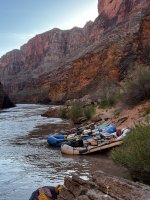
Here’s an example of daily water level variation in the Grand Canyon. The rafts were floating horizontally when we went to bed. Sometimes we awoke to find the boats fully beached on a mud flat. Just some perspective from the other side of the dam.

RandyAustinFishing
Well-Known Member
I really wanna do that trip. Bucket list item for me for sure.Dorado has the correct and concise answer. Long answer: The 260 mile stretch of the Colorado River between Glen Canyon dam and Lake Meade has become, in many, many ways, an artificially manipulated environment. Bugs are rare ( nice for camping, not nice for fish and birds and lizards and bats and…) due to daily water fluctuations caused by electricity demands drowning eggs and larvae in wet sand. And, certainly, there’s far less sand of any kind, as it deposits in north Lake Powell before reaching Grand Canyon. So, occasionally the powers that be experiment with “beach building flows” to stir up dwindling sand from the river bottom (called High Flow Experiments), some of which is deposited on shore
Here’s an example of daily water level variation in the Grand Canyon. The rafts were floating horizontally when we went to bed. Sometimes we awoke to find the boats fully beached on a mud flat. Just some perspective from the other side of the dam.View attachment 22088


Rainbowbridge
Keeper of San Juan Secrets
Thanks for that, Trix.....ephemeral
1 of 2
adjective
ephem·er·al i-ˈfem-rəl
-ˈfēm-;
-ˈfe-mə-,
-ˈfē-
Synonyms of ephemeral
1
: lasting a very short time
ephemeral pleasures
2
: lasting one day only
an ephemeral fever
after seeing the dino tracks on the other thread......
Methinks we all be rather ephemeral
Best to go fishing now!

It's going to stay cold and a little snow all the next 10 days in the Wyoming, Utah and Colorado high country . It will definitely slow down the run off dramatically. The lake dropping right in the middle of the spawning period really screws up the fish! Been there and seen it before. It's a real problem for the fish , and the fishermen.


- Status
- Not open for further replies.