Sedimentation and the Changing Extent of Lake Powell - 1968 vs. 2025

JFRCalifornia

Keeper of San Juan Secrets
Everyone on this forum is well aware of how much sedimentation over the years has affected the extent of Lake Powell. It's especially evident as the lake levels fall and reveal things not seen in decades. One of those "things" is vast amounts of sediment, which is pretty dramatically illustrated for anyone who has been to the overlook at Hite, or taken a boat to the end of either the Escalante or San Juan, or even spent time hiking in many of the side canyons of the lake. All that dirt deposited by the rivers feeding Lake Powell has dramatically cut into the extent of the lake. And that will continue.

In the mid-1960s, as the reservoir began to fill, it spread quickly upstream because the gradients in Glen Canyon before the lake were very shallow. By the end of 1963 (when the lake was at about 3400), the lake had already reached White Canyon, and about 20 miles up the San Juan.

As of December 2025, the lake sits at about 3542, the same level as it was in June 1968. However, the extent of the lake is dramatically smaller today than it was then, and it's all because of massive sedimentation that's happened over the decades. The sediment in the vicinity of Hite is well over 100 feet deep.

As part of a side project I'm working on, I put together a few maps to illustrate the change in the lake's extent between June 1968 and December 2025, even though the surface elevation was the same on both dates. It's one thing to read about the changes, but it's more dramatic to see them on a map. In the case of the main stem of the Colorado, the lake extended 30 miles farther (!) in June 1968 than in December 2025; on the San Juan, it was 18 miles. Up the Escalante, the difference is less because of the flow of the Escalante is much less than the big rivers. Still, a 4-mile change is dramatic.

Here are the maps showing the end of the lake along the Colorado, San Juan and the Escalante, comparing June 1968 to December 2025, at the same lake level of 3542...
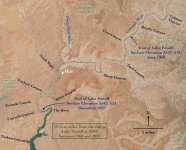
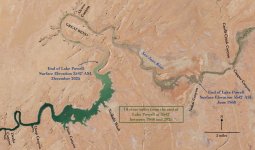
Siltation - 2025 vs 1968 - Colorado - basemap - anno - lake extent - extra anno.jpegSiltation - 2025 vs 1968 - San Juan - basemap - extra anno.jpgSiltation - 2025 vs 1968 - Escalante - extra anno.jpeg..
 
I’m assuming this translates to less storage capacity today vs 1968 for the same lake elevation? What would that look like in terms of MAF?
Well, the best estimates out there are that as of 2022 the total storage capacity of the reservoir had shrunk from 27 maf in 1963 to about 25 maf. That's not live volume (i.e., volume over dead pool), that's total volume. In all likelihood, that total capacity is probably slightly lower today. This suggests that sediment has displaced about 2 maf of the original capacity...
 
That's a big change. Could you show us on the same maps where full pool would be today and where the lake was at it's fullest?
It is a big change.

When the lake was at full pool (3700) from about 1980-87, the full extent could not be shown on the maps I posted. Up the main stem of the Colorado, the lake extended to about Imperial Canyon, which is about 45-50 miles upstream of Hite, and about 55-60 miles beyond where it is today. In the San Juan, the lake extended to about Clay Hills Crossing, which is the takeout point for San Juan rafting trips. That's about 53 miles from the confluence of the San Juan and the Colorado, or about 25 miles beyond the beginning of the Great Bend. In the Escalante, the lake extended to just beyond the mouth of Coyote Gulch, which is about 18 miles from its confluence with the Colorado, or about 11 miles past where it is right now.

Would it still reach these places at full pool today? it probably would, but because there's been so much sedimentation toward the heads of these stems of the lake, the reservoir would be pretty shallow toward the upper reaches of the lake, and toward the very end, you'd probably worry about running aground on hidden bars.

It's a different place today.
 
I was up at the Horn last weekend. I had My lake level adjusted to -156 on my fish finder to get the correct water level of 3544. My fish finder said that the water level in the main channel out from the horn should have been between 84 and 94 feet. On the inside corner just off of the Horn there was 11 feet of water. It got steadily deeper as you traveled toward the far shore where the depth was 22' right against the wall. This would represent a silt level of right at 70'.
Three or four years ago we were able to get up to Striper City where we used to do really well on the walleye in the fall. There was only a channel on the far/south side where the river had cut a channel through the silt laid down years before. All the humps and coves in the Striper Cty area where the walleye used to hang out had silted in and were flat. There were a dozen cows or so grazing right in the middle of our own honey holes. This area will never be the same again or hold the fish that it used to no matter what water level. That structure is gone.
Back a dozen years ago we were down in the fall, and a floating core drill rig came up the main channel. It was quite a site. A big platform for the drill rig surrounded by half a dozen house boats being pushed by some sort of tugboat all tied together. I had to stop over and asked what they were up to. The guy said that they were drilling core samples of the silt and riverbed below to see how much silt there was. I ask him how much they thought was there. He said that the instruments they had indicated a silt depth of 68 feet. Said to stop by in a couple days and they would know for sure. Days later I did just that and he said it was right at 70 feet.
I have watched for the last twenty years the silt, left from previous years when the water level was higher, get picked up by the spring runoff and get pushed further down the lake. I looked at the water in the Colorado at Grand Junction on the way down and think that doesn't look that dirty. Take the boat up to GHB and find water at some point much dirtier than it was in GJ.
Those of us that fish the north end have learned to adapt to these changing conditions. Some good water years, and it would not be an issue.
 
Eventually it will need some dredging. Not for many years but eventually.

To slow the process down would involve sediment treatment basins for the worst of the rivers that bring it (pretty much just different types of dams and water treatment areas - perhaps even large wetlands designed for that primary purpose but also would be great wildlife areas).

If you think about it the world is largely heading towards these sorts of mega-projects anyways because the topsoil erosion and nutrient loads are worth capturing for people who are otherwise going to die from starvation. Without population controls and changes in agricultural habits it is already written to me as a certainty.

Oh, and for sure the entire lake could be let to mostly fill up but only need some level of dredging to handle the one in 500 year flood events but I think the cooler water storage becomes rather critical too.

The next 1000yrs will be an interesting time - wish I could stick around and see what happens next. :)
 
Over time, as the San Juan arm silts in, it will eventually form a sediment delta at its mouth, which will effectively divide the lake in half. Not in my lifetime, in all probability, but almost a certainty within the next 100 years, since the San Juan arm is not that long (only about 23 miles from the confluence with the main canyon to the current head of the lake) and the San Juan contains a very large volume of sediment for a river of its size.
 
As Always, JFR...FANTASTIC post.... (y)

Flowerbug brings up an interesting point: dredging....perhaps could be useful/required at marinas but how could the cost be justified when they can't even spend money on a mid lake fueling station.....:unsure:

Also, your astute comment: 'It's a different place today.' sure fits.....do you think the tremendous amount of sediment was accurately forecast when our lake was planned? :unsure:
 
Eventually it will need some dredging. Not for many years but eventually.

To slow the process down would involve sediment treatment basins for the worst of the rivers that bring it (pretty much just different types of dams and water treatment areas - perhaps even large wetlands designed for that primary purpose but also would be great wildlife areas).
The logistics of dredging Lake Powell are staggering. There's not only the existing volume of dirt to consider (about a third of which is under the lake, while the rest is now exposed), but you'd need to figure out access to get to it, and then there's the question of where to put it all. Then there's the cost of doing all that. Oh, and a fifth problem--the rivers are relentlessly depositing another 200,000 cubic yards of sediment per day, and that's never going to stop. Assuming you could solve all five problems, here's what we're facing just in terms of existing sediment load:

Back of the napkin: there's been roughly about 2.7 maf of volume displaced by sediment since 1963 in Lake Powell. That's roughly equivalent to 4.3 BILLION cubic yards of dirt. Assuming the average dump truck holds 10 cubic yards, that's 430 million fully loaded dump trucks of dirt. The busiest freeway in LA carries about 350,000 vehicles per day. It would take about 3-4 years of heavy traffic every day on that freeway to generate 430 million trips. And on top of that, just to keep up with the existing rate of deposition, you'd first need to remove 20,000 truck loads of dirt per day just to make any headway into reducing what's already there.

Large scale dredging of Lake Powell is never going to happen, except by natural means, if and when the dam is no longer there...
 
.....do you think the tremendous amount of sediment was accurately forecast when our lake was planned? :unsure:
Yes, the USBR originally estimated life of the reservoir before it became a giant mudflat was about 710 years... the current rate of sedimentation is more or less consistent with that...

Of course, this begs the obvious question of whether on balance the long-term destruction of the resource is worth the benefits the reservoir provides in the short-term...
 
Just a side note, I go the Northeast end of Lake Mead every year, and the area above the South Cove launch ramp has been silted up for years. We used to camp on the north side of Sandy Point, which hasn't been accessable by water for many years. Even if the water level level came up, I cannot imagine the cost and amount of time it would take to return that area to normal. The dredging would be incredible.
 
Another problem nowadays with dredging that we have to deal with now, is the Envrios. That soil has toxins as well, and nobody wants it. Most inland water ways are not clean soil anymore, Lake Powell is probably the cleanest, but a lawsuit would stop it for sure.
 
The logistics of dredging Lake Powell are staggering. There's not only the existing volume of dirt to consider (about a third of which is under the lake, while the rest is now exposed), but you'd need to figure out access to get to it, and then there's the question of where to put it all. Then there's the cost of doing all that. Oh, and a fifth problem--the rivers are relentlessly depositing another 200,000 cubic yards of sediment per day, and that's never going to stop. Assuming you could solve all five problems, here's what we're facing just in terms of existing sediment load:

Back of the napkin: there's been roughly about 2.7 maf of volume displaced by sediment since 1963 in Lake Powell. That's roughly equivalent to 4.3 BILLION cubic yards of dirt. Assuming the average dump truck holds 10 cubic yards, that's 430 million fully loaded dump trucks of dirt. The busiest freeway in LA carries about 350,000 vehicles per day. It would take about 3-4 years of heavy traffic every day on that freeway to generate 430 million trips. And on top of that, just to keep up with the existing rate of deposition, you'd first need to remove 20,000 truck loads of dirt per day just to make any headway into reducing what's already there.

Large scale dredging of Lake Powell is never going to happen, except by natural means, if and when the dam is no longer there...

i don't see trucking it as a good way to solve that problem. instead large beltways to transfer materials would be able to move it up and out. once up and out then it would have to be stablelized wherever it ends up to keep it from being easily moved back in. nutrients and soil itself is a valueable resource in an arid climate as long as you can also have some water along with it to garden and grow food, so that is what i consider a likely outcome. yes, there can be pollution issues with dredging spoils but i don't think Lake Powell has that much of a problem compared to many other places - it really depends a lot upon what kind of population and industrial development happens along the upstream rivers and areas and how the overall watershed is treated (keep your farmers under control so they're not adding so many metals and toxins and also keep your industrial users from discharging too many of similar along with nutrients in general). wetlands can certainly help filter the waters and hold some of those cubic yards of dirt from easily moving downstream.
 
Another problem nowadays with dredging that we have to deal with now, is the Envrios. That soil has toxins as well, and nobody wants it. Most inland water ways are not clean soil anymore, Lake Powell is probably the cleanest, but a lawsuit would stop it for sure.

probably not as like you say it isn't as heavily polluted as many other places that are currently regularly dredged.

if you work it right you might get the environmental people onboard by trading off some water and wetland restorations and beaver habitat (which also becomes fish habitat :) )... :)
 
I have not personally studied the quality of the sediment in question but would have to think that the mixture of topsoil, sand, clays and organic material would make a great potting soil or topsoil mix for gardens and flower beds. Here's something to think about. If you could get the 2/3rds of the sediment that is above water, figure out a way to mine or dredge it out, haul it out and put it in 25-pound bags, truck it to every Walmart in the country and make it affordable so it would buy it, everyone in the country, all 335,000,000 of us would have to buy 341 bags each the first year or 8.5 tons, and 9 bags or 225 pounds every year just to break even with the rate coming in.
 
Back
Top